Most American Catholic families meet the Ten Commandments for real in second grade, when the First Reconciliation folder comes home from CCD or the parish school and a seven-year-old asks what “covet” means. The harder questions come later: why the poster at a friend’s Baptist church has “graven images” as number two, and what the sixth commandment has to do with a nine-year-old.
Below: the Catholic list, the reason for the numbering, each commandment in a child’s words with one question to talk about, the Precepts of the Church, and what second-grade prep does with all of it.
What are the Ten Commandments? The Catholic list
The Catechism of the Catholic Church prints the Decalogue three ways side by side: Exodus 20:2–17, Deuteronomy 5:6–21, and what it calls “a traditional catechetical formula”, the short form children learn by heart (USCCB Catechism, p. 498). The formula reads (vatican.va): history
- I am the LORD your God: you shall not have strange gods before me.
- You shall not take the name of the LORD your God in vain.
- Remember to keep holy the LORD’s Day.
- Honor your father and your mother.
- You shall not kill.
- You shall not commit adultery.
- You shall not steal.
- You shall not bear false witness against your neighbor.
- You shall not covet your neighbor’s wife.
- You shall not covet your neighbor’s goods.
Your child’s workbook may say “You shall not have other gods besides me” or “Keep holy the Sabbath day”. Same commandment, different publisher. If the catechist is testing memorization, stick with the wording in the book your child brought home.
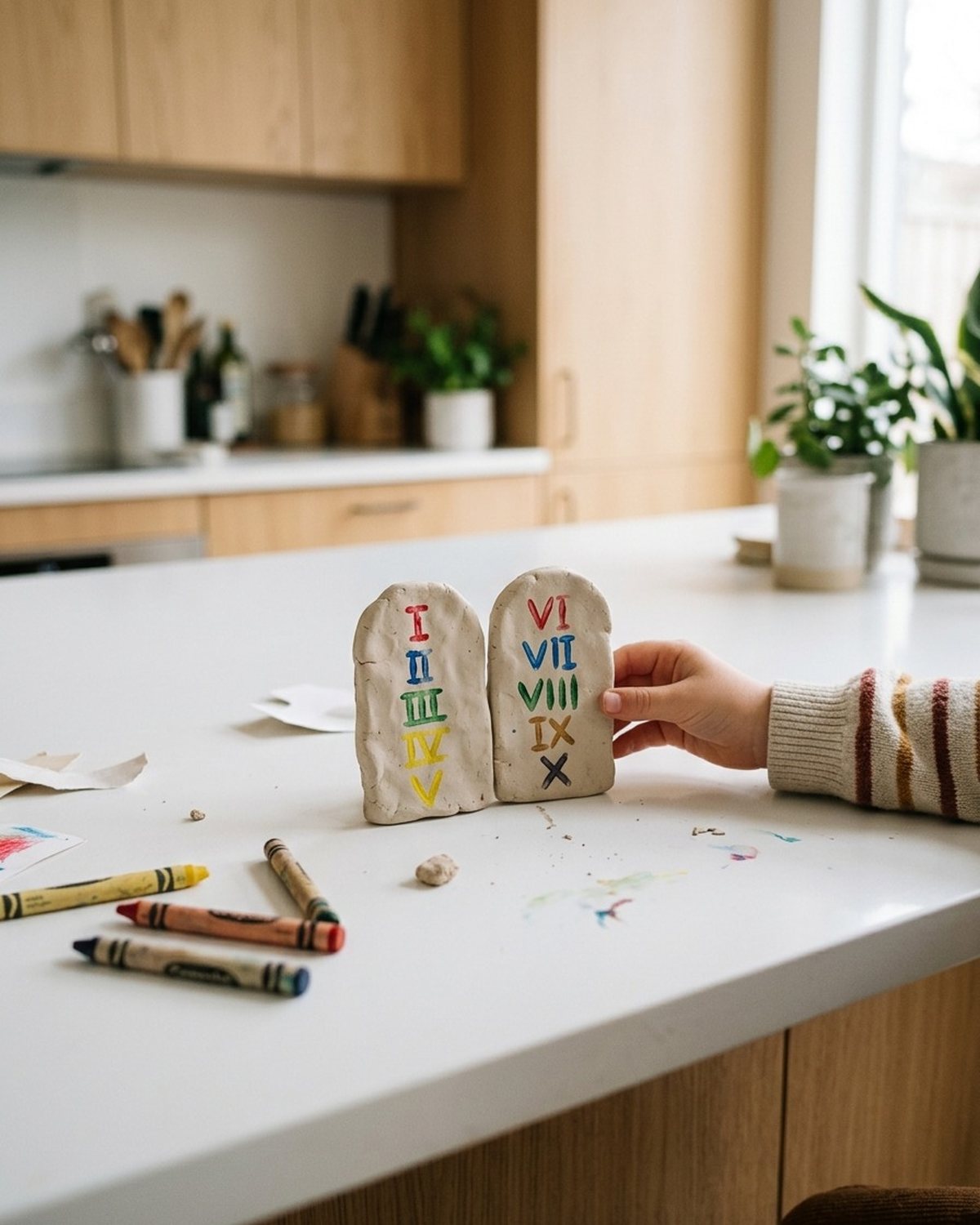
The Catechism also notes the shape of the list: “The first three concern love of God, and the other seven love of neighbor”, and so “the Ten Commandments were themselves given on two tablets. Three were written on one tablet and seven on the other” (CCC 2067, citing St. Augustine, USCCB Catechism, p. 504). history That is the picture for a small child: two tablets, and the two things Jesus said the whole law hangs on.
The two commandments Jesus gave
When a scholar of the law asked which commandment is the greatest, Jesus answered: “You shall love the Lord, your God, with all your heart, with all your soul, and with all your mind. This is the greatest and the first commandment. The second is like it: You shall love your neighbor as yourself. The whole law and the prophets depend on these two commandments” (Matthew 22:37–40, NABRE). Scripture
For a three-year-old, this is the whole lesson: I love God, I love people. A six-year-old can already see that the ten are the two, written out.
Why does my neighbor’s list look different?
The Bible does not number the commandments. Exodus 20 runs from “I am the LORD your God” through “You shall not covet your neighbor’s house” as continuous text (Exodus 20, NABRE), and different traditions cut it in different places.
The Catechism says it plainly: “The division and numbering of the Commandments have varied in the course of history”, and the Church “follows the division of the Commandments established by St. Augustine”, which “is also that of the Lutheran confessions”; the Greek Fathers “worked out a slightly different division, which is found in the Orthodox Churches and Reformed communities” (CCC 2066, vatican.va). history
| Catholic and Lutheran | Orthodox, Reformed and most Protestant | Jewish | |
|---|---|---|---|
| “I am the LORD your God” | opening of the first | prologue | the first commandment |
| no other gods | first | first | second (with images) |
| no graven images | part of the first | second | part of the second |
| wife / goods | ninth and tenth, split | one tenth commandment | one tenth commandment |
The practical effect: from “name in vain” to “false witness”, the Protestant number is one higher than the Catholic one. The Catholic ninth, “your neighbor’s wife”, follows Deuteronomy, where the wife is named before the house (Deuteronomy 5:21); in Exodus 20:17 the house comes first. U.S. Catholic sums it up: all three divisions were already proposed in ancient Judaism, and “none is technically wrong” (U.S. Catholic, 2011).
So when your child comes home from a friend’s VBS with a different poster: “Same words from God, cut into ten in a different place. We count the way St. Augustine did.”
Why do they start with freedom, not a rule?
Before the first “you shall not”, God says who he is: “I am the LORD your God, who brought you out of the land of Egypt, out of the house of slavery” (Exodus 20:2, NABRE). Scripture The Catechism builds on exactly this: the Decalogue “must first be understood in the context of the Exodus”, it describes “the conditions of a life freed from the slavery of sin”, and “the Decalogue is a path of life” (CCC 2057). The commandments “come in the second place”; moral life “is a response to the Lord’s loving initiative” (CCC 2062, vatican.va). history
This is the first thing to say to a child and the thing to keep saying: God rescued his people first, then told them how to stay free. Not a rulebook with fines. A map.
The Ten Commandments: the table to talk through
Print it or screenshot it. You do not need to get through it in one sitting; one commandment at dinner every few days is plenty. The questions are not a quiz: the parent answers too, and “I don’t know” is a fine answer.
| Commandment | In a child’s words | One question to talk about |
|---|---|---|
| 1. I am the LORD your God: you shall not have strange gods before me. | God is the most important, and we can talk to him any time, not only when we need something. | What do you want to thank God for today? |
| 2. You shall not take the name of the LORD your God in vain. | We say God’s name with respect, like the name of someone we love. | How do you feel when someone says your name nicely, and when they make fun of it? |
| 3. Remember to keep holy the LORD’s Day. | Sunday is for God and for the family: Mass, rest, time together. | What can we do this Sunday that makes it different from a school day? |
| 4. Honor your father and your mother. | We respect our parents and grandparents, and in a family we look after each other. | What did Grandma or Grandpa like doing when they were your age? Let’s call and ask. |
| 5. You shall not kill. | We take care of life and health, ours and other people’s. We don’t hit, and we don’t hurt with words. | What can you do when you are really angry, instead of hitting? |
| 6. You shall not commit adultery. | People who love each other keep their promises. We respect our own body and other people’s bodies. | Who is allowed to hug you, and who are you allowed to say “no” to? |
| 7. You shall not steal. | We don’t take what isn’t ours, and we give back what we borrow. | How would you feel if someone took your favorite thing? |
| 8. You shall not bear false witness against your neighbor. | We tell the truth even when it’s hard, and we don’t talk about people behind their backs. | When did someone last tell you the truth, even though it was hard for them? |
| 9. You shall not covet your neighbor’s wife. | We respect other people’s families and keep our heart clean. | What makes you feel good in our family? |
| 10. You shall not covet your neighbor’s goods. | We enjoy what we have, and we can be happy when other people are happy. | What are you glad about today, even if it isn’t new? |
One thing helps more than any table. When a child admits something hard, a lie for instance, thank them for the truth first, and only then talk about what happened. The eighth commandment is easier to keep in a house where the truth is not punished.
“Honor your father and mother” at six and at twelve
At six, the fourth commandment is mostly about obeying. The Catechism says so without embarrassment: “Filial respect is shown by true docility and obedience” (CCC 2216), and while a child lives at home, obedience is owed when what parents ask serves the child’s good or the family’s (CCC 2217, vatican.va). history For a six-year-old: “Mom and Dad look after you, so when they ask you to do something, you do it, even when you’d rather not. That’s how you show you trust them.”
At twelve, the same commandment has to grow, because the child has. The American Academy of Pediatrics describes the school-age years as a time when a child is “more independent than before”, spends more time with peers and feels “a strong need for both conformity (to be just like the others) and recognition” (HealthyChildren.org). A twelve-year-old who hears only “obey” hears a wall. The Catechism gives you more: respect continues after obedience ends, the commandment “reminds grown children of their responsibilities toward their parents” (CCC 2218), and there is a conscience clause: “If a child is convinced in conscience that it would be morally wrong to obey a particular order, he must not do so” (CCC 2217). For a twelve-year-old: “Honoring us isn’t the same as agreeing with us. It’s speaking to us with respect even when you’re angry, telling us where you are, and one day looking after us the way we look after you now.”
The commandment runs both ways. The same chapter tells parents to see their children as children of God and respect them as persons, and to teach mainly by example (CCC 2222–2223). A child who is spoken to with respect learns the word faster than one who is lectured about it.
The sixth and the ninth for kids, without the sex talk
Parents skip these two or mumble. No need: the Catechism’s own words are about promises and about privacy, not anatomy.
The sixth: keeping your word. On marriage the Catechism says “Fidelity expresses constancy in keeping one’s given word” (CCC 2365, USCCB Catechism, p. 570). history That is the sentence for a child: “When Mom and Dad got married, they made a promise to belong to each other for always. The sixth commandment says: keep that promise.” For a seven-year-old, nothing more is needed. For a ten-year-old who has seen a friend’s parents divorce, add: “Sometimes grown-ups can’t keep it, and that is sad, not a reason to stop believing in promises.”
The ninth: a clean heart and things that are private. The Catechism puts the ninth commandment under purity of heart and modesty: “Modesty protects the intimate center of the person. It means refusing to unveil what should remain hidden”, and “There is a modesty of the feelings as well as of the body” (CCC 2521, 2523, vatican.va). history In a child’s words: “Some things about your body are private, just yours. Nobody gets to look at or touch your private parts, and you can always tell us if someone tries.” That is also the body-safety talk, in the same sentence as the commandment. For an older child, the “modesty of the feelings” is the one to raise: not every thought needs a voice, and not every picture on a phone needs a look.
Neither commandment needs the word “sex” before the child asks. When they do ask, you answer that question, not this one.
What does First Reconciliation prep do with them?
In most US dioceses, children prepare for First Reconciliation in second grade, once they have reached the age of discretion, and confess before First Communion. Erie’s guidelines say second grade, and “The Sacrament of Penance will be celebrated prior to the child’s reception of first Eucharist” ([Diocese of Erie](https://www.eriercd.org/images/sections/religiouseducation/First Reconciliation.pdf)); Toledo calls 2nd grade “the ordinary time” (Diocese of Toledo). In England and Wales parishes set their own year; Westminster Cathedral’s First Communion course, for example, takes children aged 7 to 10, in Year 3 (Westminster Cathedral). The rule behind the schedules is in the Catechism: “Children must go to the sacrament of Penance before receiving Holy Communion for the first time” (CCC 1457, vatican.va). history
This is where the Ten Commandments turn into an examination of conscience, which the Catechism says should be “made in the light of the Word of God” (CCC 1454). The children’s sheets most parishes hand out walk through the commandments one by one. The Archdiocese of Milwaukee’s asks, under the fourth, “Do I obey my parents?”; under the eighth, “Have I been honest or have I lied?”; under the sixth, “Do I show respect for my body?” (Archdiocese of Milwaukee). The table above does the same translation a year or two earlier, so the sheet is not the first time your child hears it.
Two things you can do at home that the parish cannot:
- Go first. At dinner, say what was hard for you today: “I found it hard to tell the truth about something at work.” The child sees that the commandments belong to the whole family, not only to second graders.
- Keep God out of the guard tower. “God sees everything and gets angry” turns the examination of conscience into surveillance. “God loves you and wants you to be happy, and he’s glad when you say sorry” teaches the same commandments with the tone the Catechism itself uses. The teaching does not change; the tone does.
The Precepts of the Church
The precepts are not the Ten Commandments; they are the Church’s own minimum, “the very necessary minimum in the spirit of prayer and moral effort” (CCC 2041). The current edition of the Catechism lists five (USCCB Catechism, pp. 495–496): history
| Precept | In a child’s words |
|---|---|
| 1. You shall attend Mass on Sundays and on holy days of obligation and rest from servile labor. | On Sunday we go to Mass together and we rest. |
| 2. You shall confess your sins at least once a year. | At least once a year, and better more often, we go to confession. |
| 3. You shall receive the sacrament of the Eucharist at least during the Easter season. | At Easter time we receive Communion. |
| 4. You shall observe the days of fasting and abstinence established by the Church. | On Ash Wednesday and the Fridays of Lent we don’t eat meat; it’s a way of remembering Jesus. |
| 5. You shall help to provide for the needs of the Church. | We help our parish, because it’s our bigger family. |
In the United States, abstinence from meat binds Catholics from age 14 on Ash Wednesday, Good Friday and the Fridays of Lent; fasting binds ages 18 to 59 (USCCB). A seven-year-old is not bound by either, which is worth saying out loud: the fish sticks on Friday are something the family chooses to do together, not a rule the child is breaking if they are hungry.
Five or six? If your child’s book or your own childhood says six, nobody made a mistake. The Baltimore Catechism of 1891 lists six “chief commandments of the Church”: Mass on Sundays and holy days, fasting and abstinence, yearly confession, Easter Communion, “To contribute to the support of our pastors”, and a sixth on the Church’s laws about marriage (Baltimore Catechism, Q. 389). history An older English text of the Catechism on vatican.va words the list differently again, with the holy days of obligation as a separate precept (vatican.va archive); the text the USCCB prints today has the five above. Teach your child those five. If they meet six somewhere, the sixth is about marriage, still true, just filed elsewhere now.
For Sunday Mass with a child who cannot sit still, see Mass with toddlers. The commandments make a good bedtime examen for an eight-year-old; the two-minute version is in bedtime prayers for kids. And if your child wants Moses before the tablets, the escape from Egypt is in Bible stories for kids.
As of October 2026. Scripture quotations from the New American Bible, Revised Edition.

Eryk Panter
I make HOSANNA! with my family, at our own table. I write the rules, dig through the sources and work on the pictures; the children play first and tell me straight what does not work. Here I write what I was looking for as a dad: how to talk with children about the saints, concretely, with sources and without sugar-coating.
Frequently asked questions
What are the Ten Commandments in the Catholic list?
In the traditional catechetical formula printed in the Catechism of the Catholic Church: 1. I am the LORD your God: you shall not have strange gods before me. 2. You shall not take the name of the LORD your God in vain. 3. Remember to keep holy the LORD's Day. 4. Honor your father and your mother. 5. You shall not kill. 6. You shall not commit adultery. 7. You shall not steal. 8. You shall not bear false witness against your neighbor. 9. You shall not covet your neighbor's wife. 10. You shall not covet your neighbor's goods.
Why do Catholics and Protestants number the Ten Commandments differently?
The Bible does not number them. The Catechism (CCC 2066) says the Church follows the division established by St. Augustine, which Lutherans also use: the prohibition of other gods and of images is one commandment, and coveting is split into two. The Greek Fathers divided them slightly differently, and that division is used by the Orthodox Churches and by Reformed and most other Protestant communities: images are a separate second commandment and coveting is one tenth commandment. The text, Exodus 20:2–17 and Deuteronomy 5:6–21, is the same.
How do I explain the Ten Commandments to a child?
Start with the sentence before them: 'I am the LORD your God, who brought you out of the land of Egypt, out of the house of slavery' (Exodus 20:2). God freed his people first and then told them how to live free. The Catechism calls the Decalogue 'a path of life', not a list of punishments. Then take one commandment at a time, one sentence in the child's words and one question, over dinner, not as a test.
Are the Ten Commandments part of First Reconciliation preparation?
Usually, yes. In many US dioceses children prepare for First Reconciliation in second grade, before First Communion, once they have reached the age of discretion. The Catechism says the sacrament 'ought to be prepared for by an examination of conscience', and the children's examinations many dioceses hand out are organized by the Ten Commandments, with questions like 'Do I obey my parents?' and 'Have I been honest or have I lied?'
How many Precepts of the Church are there, five or six?
The Catechism of the Catholic Church lists five: Mass on Sundays and holy days of obligation, confession at least once a year, Communion at least in the Easter season, the days of fasting and abstinence, and helping to provide for the needs of the Church. Older American catechisms, including the Baltimore Catechism of 1891, listed six 'chief commandments of the Church', the sixth being the Church's laws on marriage. If your child's parish book says six, it is following the older list, not making a mistake.
What are the two greatest commandments?
When a scholar of the law asked Jesus which commandment is the greatest, he answered: 'You shall love the Lord, your God, with all your heart, with all your soul, and with all your mind', and 'You shall love your neighbor as yourself', adding that the whole law and the prophets depend on these two (Matthew 22:36–40). The first three commandments spell out the first, the other seven spell out the second.
Sources
Marks: [H] — Scripture, document, recorded fact · [T] — tradition, legend, custom · [N] — Church teaching · [D] — study, data.
- NCatechism of the Catholic Church, Part Three, Section Two: The Ten Commandments — nos. 2052–2074 (vatican.va)
- NCatechism of the Catholic Church, USCCB flipbook p. 498: Exodus 20, Deuteronomy 5 and the Traditional Catechetical Formula (commandments 1–3)
- NCatechism of the Catholic Church: the Ten Commandments in three columns, Exodus 20, Deuteronomy 5 and A Traditional Catechetical Formula, all ten (vatican.va)
- NCatechism of the Catholic Church, USCCB flipbook p. 504: the division of the Commandments (2066), two tablets, three and seven (2067), one coherent whole (2069)
- HExodus 20, New American Bible, Revised Edition (Bible Hub NABRE)
- HDeuteronomy 5:21 in parallel translations (ESV, NIV): the neighbor's wife named first (Bible Hub)
- HMatthew 22:36–40, New American Bible, Revised Edition (bible.com, NABRE)
- HU.S. Catholic, Alice Camille: Are there different lists of the Ten Commandments? (April 2011)
- NCatechism of the Catholic Church 2214–2228: the fourth commandment, duties of children and parents (vatican.va)
- NCatechism of the Catholic Church 2364–2365: conjugal fidelity, 'keeping one's given word' (USCCB flipbook p. 570)
- NCatechism of the Catholic Church 2520–2524: purity of heart and modesty (vatican.va)
- NCatechism of the Catholic Church 1454–1458: examination of conscience, confession before First Communion (vatican.va)
- NDiocese of Erie: First Penance Guidelines (PDF) — second grade, age of discretion, before First Eucharist
- NDiocese of Toledo: First Communion — 2nd grade as the ordinary time, Reconciliation first
- NWestminster Cathedral: First Holy Communion course — children aged 7 to 10 (Year 3)
- NArchdiocese of Milwaukee, K. D. Beuscher (2010): An Examination of Conscience for Children Using the 10 Commandments (PDF)
- NCatechism of the Catholic Church 2041–2043: the Precepts of the Church, the current text (USCCB flipbook pp. 495–496)
- NCatechism of the Catholic Church 2041–2043: the Precepts of the Church, an older English text (vatican.va archive)
- HBaltimore Catechism (1891), Lesson 35, Q. 389: the six chief commandments of the Church (IntraText)
- NUSCCB: Fast and Abstinence — Ash Wednesday, Good Friday, Fridays of Lent; ages 14 and 18–59
- DAmerican Academy of Pediatrics, HealthyChildren.org: Parenting School-Age Children