An Advent wreath is the simplest calendar you can give a child: four candles, four Sundays, one more light every week. In 2026 the first candle is lit on Sunday, November 29, and the last on December 20. You do not have to make the wreath yourself, you do not need a theology degree, and you do not even need purple candles. You need to sit down together for three minutes, light a candle and say one sentence. Those sentences are below, one set for each Sunday.
The whole season is in Advent with kids; here we stay with the wreath. Pills in the text: Scripture, history, tradition.
Where did the Advent wreath come from?
The first wreath was not Catholic and not really a wreath. In 1839 Johann Hinrich Wichern, a Lutheran pastor who ran the Rauhes Haus, a home for poor children in Hamburg, hung a wooden ring made from an old cartwheel in the prayer room, with one candle for every day from the First Sunday of Advent to Christmas Eve, one more lit each day so the children could count how long they still had to wait. The number of candles changed from year to year with the length of Advent; the familiar picture of four big white candles for the Sundays and small red ones for the weekdays is how the story is usually told, but the Rauhes Haus says its own archive holds only a drawing with all the candles the same size (evangelisch.de). The custom spread through German Protestant churches and shrank to the four candles we know. Catholics in Germany took it up in the 1920s (a UK Catholic leaflet dates the first wreath hung in a church in Cologne to 1925), it reached the United States in the 1930s, and British children met it in the 1960s as the Blue Peter “Advent crown” of wire coat hangers and tinsel (Wikipedia, ctsbooks.org, Blackpool Gazette). history
For a child, one thing matters: the wreath was invented by a man who looked after children and wanted them to stop asking “how many more days?”.
What does the Advent wreath mean?
The wreath began as a counter and gained its meanings later, which is why different sources phrase them differently. What repeats everywhere:
| Element | Meaning | Source |
|---|---|---|
| four candles | the four Sundays of Advent, lit one after another | Wikipedia |
| growing light | Christ, the light of God coming into the world | Wikipedia |
| evergreen branches | life and hope that last through winter | FOCUS |
| circle | God’s eternal love, with no beginning and no end | FOCUS |
All of it is tradition: lovely, in keeping with the faith, and not written in any document of the Church. The USCCB’s blessing calls the wreath only “a traditional practice which has found its place in the Church as well as in the home” (USCCB).
What does each candle “mean”? Here the sources part ways. The most common American set is hope, peace, joy and love, one per Sunday (FOCUS); an older set calls them the prophecy, Bethlehem, shepherds’ and angels’ candles (Wikipedia). Both are interpretations, not liturgy. If your parish uses one, use the same at home so your child hears one story. If not, skip the names. The prayers below take a third road: the Gospel you will actually hear at Mass that Sunday.
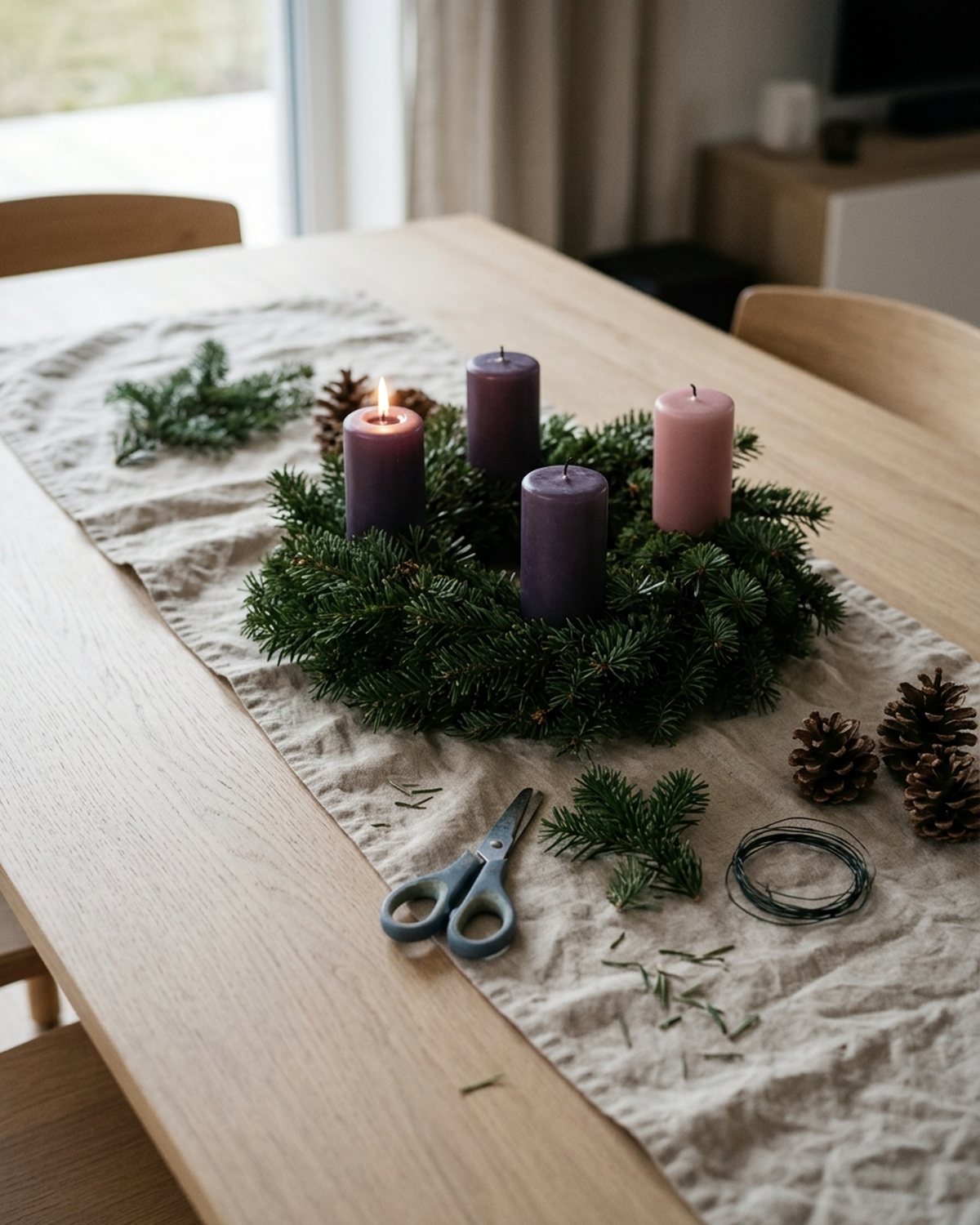
Advent wreath candle colors. Violet is the liturgical color of Advent, and rose “may be used, where it is the practice, on Gaudete Sunday (Third Sunday of Advent)”, says the General Instruction of the Roman Missal, no. 346 (EWTN); the 2026 US calendar marks that Sunday “violet or rose” (USCCB calendar). That is where three purple candles and one pink come from. Gaudete is the first word of that Sunday’s entrance antiphon, “Rejoice in the Lord always”, from Philippians 4 (Wikipedia). Some families add a fifth, white “Christ candle” in the middle for Christmas (FOCUS). In Germany four red candles are the norm, and in much of the UK too (hamburg-tourism.de, Wikipedia), so white or red candles from the grocery store are not a mistake.
Order of lighting. One candle on the First Sunday, two on the Second, three on the Third (including the pink one), all four on the Fourth; each earlier candle burns again with the new one. A tip from our table: let your child light the same candle every week, “their” candle, with your hand over theirs. After three weeks they notice on their own that theirs is the shortest.
Does the Church bless Advent wreaths?
Yes. The US bishops publish a Blessing of an Advent Wreath that “takes place on the First Sunday of Advent or on the evening before the First Sunday of Advent”, and for the home “it is appropriate that it be blessed by a parent or another member of the family” (USCCB). The USCCB sheet itself names no book; diocesan pages that reprint the same text credit it to Catholic Household Blessings & Prayers (Arkansas Catholic, Archdiocese of Los Angeles). Many parishes also bless wreaths after Mass on the First Sunday; check the bulletin for November 22.
How to bless the wreath at home, on Saturday evening, November 28, or on the Sunday itself:
- Everyone gathers at the wreath and makes the Sign of the Cross. The leader says “Our help is in the name of the Lord”, all answer “Who made heaven and earth”.
- A parent or an older child reads one of the three Isaiah passages the rite offers: Isaiah 9:1-2, 5-6, Isaiah 63:16-17, 19 or Isaiah 64:2-7; the last two are, give or take a half-verse, the first reading of the First Sunday this year Scripture.
- The leader prays the blessing. It praises God for Jesus, “Emmanuel, the hope of the peoples”, and asks: “let your blessing come upon us as we light the candles of this wreath. May the wreath and its light be a sign of Christ’s promise to bring us salvation. May he come quickly and not delay.” All: “Amen”.
- Light the first candle. The USCCB sheet has no rubric for this; its prayer says “as we light the candles”, so light it as the prayer ends.
- The rite may end with a verse of O Come, O Come, Emmanuel. One verse sung badly by everyone beats a recording.
Five minutes. The USCCB household text has no sprinkling with holy water, so you need none at home.
Advent wreath prayers for the four Sundays
One rule: light the candle, one verse from that Sunday’s readings, a short prayer, one sentence for your child. The readings are Year B, which begins this Advent (USCCB calendar 2026); they are the passages you will hear at Mass. The prayers are ours. An adult lights the candle; the child keeps a hand on the adult’s hand.
First Sunday, November 29: Be watchful
Readings: Isaiah 63:16b-17, 19b; 64:2-7 · 1 Corinthians 1:3-9 · Mark 13:33-37.
One verse: “Be watchful! Be alert! You do not know when the time will come” ([Mark 13:33](https://www.biblegateway.com/verse/en/Mark 13:33)) Scripture. Isaiah in the first reading: “we are the clay and you our potter: we are all the work of your hand” (Isaiah 64:7).
Prayer: “Lord Jesus, we light the first candle. We are starting to wait for you. Teach us to be watchful: to notice when someone at home needs a hand, and not to miss you when you come. You are the potter and we are the clay; shape us this Advent. Amen.”
Ages 3–6: “One candle. Jesus says: stay awake. That means: keep your eyes open, because he is coming.”
Ages 7–12: “In the Gospel the master of the house goes away and tells the gatekeeper to watch. Nobody knows when he’ll be back: evening, midnight, when the rooster crows, or morning ([Mark 13:35](https://www.biblegateway.com/verse/en/Mark 13:35)). What would you do if you were waiting for someone important and had no idea what time they’d arrive?”
Second Sunday, December 6: Prepare the way
Readings: Isaiah 40:1-5, 9-11 · 2 Peter 3:8-14 · Mark 1:1-8.
One verse: “A voice of one crying out in the desert: ‘Prepare the way of the Lord, make straight his paths’” (Mark 1:3) Scripture. John “was clothed in camel’s hair, with a leather belt around his waist. He fed on locusts and wild honey” (Mark 1:6).
Prayer: “Lord Jesus, we light the second candle. John the Baptist called people to prepare your way. Help us straighten one crooked path this week: to say sorry, to make up, to clear out something that has been lying around too long. Come, Lord Jesus. Amen.”
Ages 3–6: “Two candles. John told people: make a road for Jesus. We are making room for him at home and in our hearts.”
Ages 7–12: “John lived in the desert, ate locusts and honey and wore camel’s hair. People walked out to him anyway. Why do you think they did?” This Sunday is also St. Nicholas Day, so the shoes go out on Saturday night (St. Nicholas Day), and Tuesday, December 8, is the Immaculate Conception, a holy day of obligation in the US (USCCB calendar); the words for it are in Immaculate Conception for kids.
Third Sunday, December 13, Gaudete: Rejoice
Readings: Isaiah 61:1-2a, 10-11 · 1 Thessalonians 5:16-24 · John 1:6-8, 19-28. You light the pink candle.
One verse: “I will rejoice heartily in the LORD, my being exults in my God” (Isaiah 61:10) Scripture. The Gospel: “A man named John was sent from God” (John 1:6); “He was not the light, but came to testify to the light” (John 1:8). Asked who he is, John says only: “I am ‘the voice of one crying out in the desert’” (John 1:23).
Prayer: “Lord Jesus, we light the third candle, the pink one, because you are close now. Thank you for what made us happy this week: (everyone names one thing). John was not the light; he only pointed to it. Help us talk about you in a way that makes other people glad. Amen.”
Ages 3–6: “Three candles, and one is pink. Today the Church says: be glad! Jesus is very near.”
Ages 7–12: “People asked John whether he was the Messiah. He said no, he was only a voice. He could say: this isn’t about me. When is that hard for you to say?”
Fourth Sunday, December 20: Let it be done
Readings: 2 Samuel 7:1-5, 8b-12, 14a, 16 · Romans 16:25-27 · Luke 1:26-38. All four candles burn.
One verse: “Do not be afraid, Mary, for you have found favor with God” (Luke 1:30) Scripture, and Mary’s answer: “Behold, I am the handmaid of the Lord. May it be done to me according to your word” (Luke 1:38).
Prayer: “Lord Jesus, we light the fourth candle. The whole wreath is bright, and your birthday is a few days away. Mary said yes to God even though she was afraid. Give us the courage to say yes to you in small things: in helping, in making peace, in being patient at the Christmas table. Come, Lord Jesus. Amen.”
Ages 3–6: “Four candles! The angel Gabriel came to Mary and said: you will have a baby, Jesus. And Mary said: yes.”
Ages 7–12: “The angel tells Mary not to be afraid. So she was afraid. She was afraid and said yes anyway. What is the difference between being brave and not being scared?”
Christmas Eve, December 24. Light all four again at the table, and the white Christ candle, if you have one, for the first time. Read the Christmas Gospel beside them before anyone opens anything; how to do that with a small child is in Nativity scene and Midnight Mass.
How to make an Advent wreath with kids
Two versions, depending on age and patience. The rule is the same in both: scissors and pruners belong to the adult, arranging and decorating to the child. A wreath from the parish gift shop, the craft store or the florist is just as good. Your child will remember the lighting, not the wiring.
The 10-minute version, no tools (from age 3). A large tray, four candles standing in mason jars (the candle stands firm and the glass catches the wax), evergreen sprigs loosely scattered between the jars, a few pine cones, some slices of dried orange. The child does everything except putting in the candles.
The classic version, 30–40 minutes (from age 5 with help). A straw or foam ring from the craft store (ctsbooks.org). The adult cuts fir or spruce into pieces of 4–6 inches. The child lays them on the ring so they overlap like roof shingles; the adult wraps florist wire around every few sprigs and tucks the sharp end into the straw. Four candle holders go into the ring at equal distances. Then the child adds pine cones, dried oranges, cinnamon sticks, ribbon. Stand the whole thing on a non-flammable tray, never straight on the tablecloth.
Safety. Fresh evergreens dry out within a week in a heated house, and the NFPA says “December is the peak time of year for home candle fires”; “two of every five candle fires start when things that can burn are too close to the candle” (NFPA candle safety tip sheet). So:
- candle holders “that are sturdy, and won’t tip over easily”, and the wreath on a tray, not on the cloth
- the wreath “at least 1 foot” from “anything that can burn”: curtains, the tree, the Advent calendar
- “Blow out all candles when you leave the room or go to bed”; the candle burns during the prayer and the meal, not all evening
- matches and lighters “up high and out of children’s reach”; the adult lights and blows out, the child’s hand rests on the adult’s hand, not on the match
- after a week the needles start to dry: swap in fresh greens, or switch to flameless candles, which the same NFPA sheet suggests
A wreath with LED candles is not “less”. The blessing is for the wreath, not the flame.
Questions about the Advent wreath
What if we forget to light it on Sunday? Light it on Monday. The wreath is not a sacrament and your child is not keeping score. If anything is meant to stay, it is the memory of three calm minutes, not an attendance sheet.
How do I explain the wreath to a 3-year-old? “It’s our clock for waiting. Every Sunday one more candle, and when they’re all lit, it’s Jesus’ birthday.” Nothing more is needed.
Can we have a wreath if we don’t get to Mass every week? Yes. The wreath was made in a children’s home, for children, before it ever hung in a church. Three minutes by a candle on a Sunday evening is a good beginning, not a test.
As of October 2026. Scripture quotations from the New American Bible, Revised Edition; readings and liturgical colors from the USCCB Liturgical Calendar 2026.

Eryk Panter
I make HOSANNA! with my family, at our own table. I write the rules, dig through the sources and work on the pictures; the children play first and tell me straight what does not work. Here I write what I was looking for as a dad: how to talk with children about the saints, concretely, with sources and without sugar-coating.
Frequently asked questions
What does the Advent wreath mean?
The four candles are the four Sundays of Advent. The circle, with no beginning or end, stands for the eternity of God; the evergreen branches for life and hope that last through winter; and the light that grows week by week for Christ, the light of the world. All of this is devotional tradition, beautiful and in keeping with the faith, but not written in any Church document.
What do the four Advent candles mean?
First of all the four Sundays. The names hope, peace, joy and love, and the older set of prophecy, Bethlehem, shepherds and angels, are interpretations found in different parishes and books, not a liturgical rule. Use one set at home if it helps, or none. The prayers in this post follow a third road: the Gospel you will actually hear at Mass that Sunday.
What is the order of lighting the Advent wreath candles?
One candle on the First Sunday, two on the Second, three on the Third (the pink one is lit that week) and all four on the Fourth. The candles already lit are lit again together with the new one, so the light grows every week. In 2026 the Sundays of Advent are November 29 and December 6, 13 and 20.
Why is one Advent candle pink?
Because violet is the liturgical color of Advent and rose may be used on the Third Sunday, Gaudete Sunday, named after the first word of its entrance antiphon: 'Rejoice in the Lord always.' The rose candle marks that pause in a quieter season. It is a custom, not a rule: in Germany, where the wreath comes from, and in much of the UK the candles are often red or white.
Does the Advent wreath need to be blessed?
It does not have to be, but it can be. The USCCB publishes a Blessing of an Advent Wreath for the home, to be used on the First Sunday of Advent or the evening before. A parent or another member of the family reads a short passage from Isaiah, prays the blessing and lights the first candle. Many parishes also bless wreaths after Mass on the First Sunday.
Can we use LED candles in an Advent wreath?
Yes. Fresh evergreens dry out within a week in a heated house, and the NFPA names December as the peak month for home candle fires. Its tip sheet suggests flameless candles, sturdy holders, a foot of distance from anything that can burn, and never leaving a child alone with a flame. The blessing is for the wreath, not the flame.
Sources
Marks: [H] — Scripture, document, recorded fact · [T] — tradition, legend, custom · [N] — Church teaching · [D] — study, data.
- NUSCCB: Blessing of an Advent Wreath (prayer text, PDF)
- NArkansas Catholic (29 Nov 2024): Blessing of Advent wreath, attributed to Catholic Household Blessings & Prayers
- NArchdiocese of Los Angeles (24 Nov 2020): Advent calendar, Nov 28: the same blessing, credited 'from the USCCB' and 'From Catholic Household Blessings & Prayers'
- NUSCCB: Liturgical Calendar for the Dioceses of the United States of America 2026 (PDF): Sundays of Advent, readings, colors, holy days
- NEWTN / Zenit, Fr. Edward McNamara (2004): Rose-Colored Vestments on Gaudete Sunday, quoting GIRM 346
- TWikipedia: Gaudete Sunday: the introit 'Gaudete in Domino semper' and Philippians 4
- HWikipedia: Advent wreath: Wichern 1839, cartwheel, spread to Catholic Germany in the 1920s and to the US in the 1930s, candle colors, names of candles
- Hevangelisch.de / epd (27 Nov 2020): Neue Erkenntnisse zum Adventskranz: Rauhes Haus on Wichern's wreath, candle count varying by year, no evidence for the white/red sizes
- TBlackpool Gazette: 6 of the best ever Blue Peter makes: the Advent crown, first made in the 60s by Peter Trace from wire coat hangers and tinsel
- Thamburg-tourism.de: Der Adventskranz: four red candles in Germany today; red weekday and white Sunday candles in the usual telling
- TMaking an Advent Wreath (ctsbooks.org, UK, PDF): Wichern 1839, Cologne 1925, step-by-step with a straw ring
- TFOCUS, Gabriella Miller (1 Dec 2025): What Are Advent Candles For? Hope, peace, joy, love; the Christ candle
- DNFPA Candle Safety tip sheet (2018, hosted by the State of Michigan)
- HMark 13:33, New American Bible Revised Edition (Bible Gateway)
- HMark 13:35, New American Bible Revised Edition (Bible Gateway)
- HIsaiah 64, New American Bible Revised Edition (bible.usccb.org)
- HMark 1:3, New American Bible Revised Edition (Bible Gateway)
- HMark 1:6, New American Bible Revised Edition (Bible Hub, NABRE text under its 'New American Bible' label)
- HIsaiah 61, New American Bible Revised Edition (bible.usccb.org)
- HJohn 1:6, New American Bible Revised Edition (Bible Hub, NABRE text under its 'New American Bible' label)
- HJohn 1:8, New American Bible Revised Edition (Bible Hub, NABRE text under its 'New American Bible' label)
- HJohn 1:23, New American Bible Revised Edition (Bible Hub, NABRE text under its 'New American Bible' label)
- HJohn 1:29, New American Bible Revised Edition (Bible Hub, NABRE text under its 'New American Bible' label)
- HLuke 1, New American Bible Revised Edition (Bible Hub)
- NCatholic Gallery: Mass readings December 2026: Second, Third and Fourth Sunday of Advent
- NCatholic Gallery: November 2026: First Sunday of Advent, November 29, readings