Thanksgiving is on Thursday, November 26 this year. Three days later, on Sunday morning, Advent begins. That gap is the whole problem: the leftovers are still in the fridge, the Black Friday boxes are on the porch, and the parish bulletin is already talking about wreath blessings. Nobody is ready. That is fine, because Advent asks for very little, done steadily, not for a lot, done once.
What follows is the calendar for 2026, what the wreath and the calendar actually are, the one holy day that lands on a school night, and a four-week plan you can print. One activity a week, one sentence to say to a small child, one for a bigger one.
Labels: Scripture when something is in the Bible; history when documents confirm it; tradition when it is a custom.
When does Advent start in 2026?
Advent is the four Sundays, and the weekdays between them, leading up to Christmas (USCCB). The first Sunday moves from year to year; in 2026 it is November 29, and the Sunday readings switch to Year B (USCCB 2026 calendar). history
| Date | What |
|---|---|
| Thu, Nov 26 | Thanksgiving (federal calendar) |
| Sun, Nov 29 | First Sunday of Advent, first candle, wreath blessing |
| Sun, Dec 6 | Second Sunday; also St. Nicholas Day (see St. Nicholas Day) |
| Tue, Dec 8 | Immaculate Conception, holy day of obligation in the US |
| Sun, Dec 13 | Third Sunday, Gaudete, the rose candle |
| Thu, Dec 17 | O Antiphons begin, and the readings turn straight toward Bethlehem |
| Sun, Dec 20 | Fourth Sunday, all four candles |
| Thu, Dec 24 | Christmas Eve; Advent ends at evening |
| Fri, Dec 25 | Christmas |
Dates from the USCCB 2026 liturgical calendar. The weekdays from December 17 to 24 “are ordered in a more direct way” toward the Nativity, as the USCCB puts it; before that, Advent also looks ahead to Christ’s second coming (USCCB). So the season has two halves: waiting for Jesus to come again, then waiting for his birthday. Children mostly live in the second half, and the last week is built for them; that is why it feels different.
What is Advent? One sentence for your child
The Catechism says that when the Church celebrates Advent each year, “she makes present this ancient expectancy of the Messiah” (CCC 524). For a child, shorter:
Ages 3–6: “Advent is the time we wait for Jesus’ birthday. Every Sunday we light one more candle, so it gets brighter and brighter until Christmas.”
Ages 7–12: “Advent is four weeks of getting ready. The first part reminds us Jesus will come back one day; from December 17 we get ready for Christmas itself. The purple is for getting ready, like Lent, but quieter.”
The Gospel of the first Sunday this year is short and a child can hold the whole of it: “Be watchful! Be alert! You do not know when the time will come” (Mark 13:33, NABRE). Scripture You can say it at the wreath as the first candle goes on.
The Advent wreath: what the candles mean
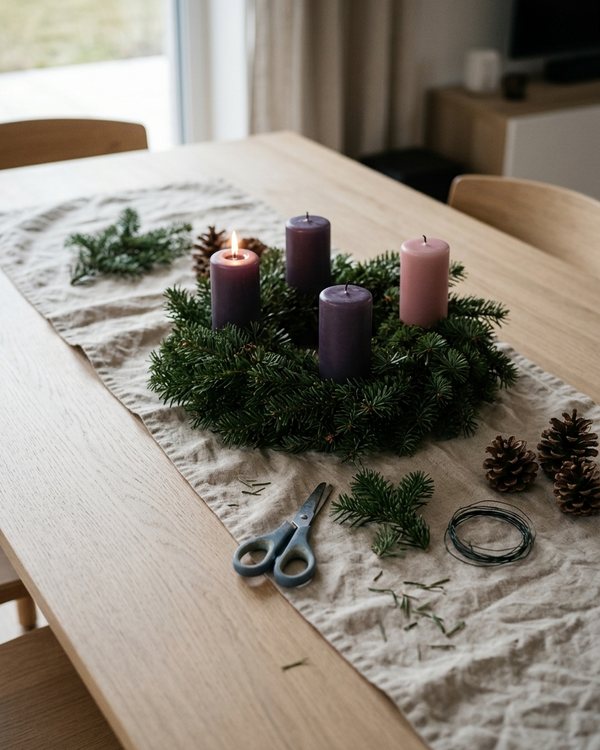
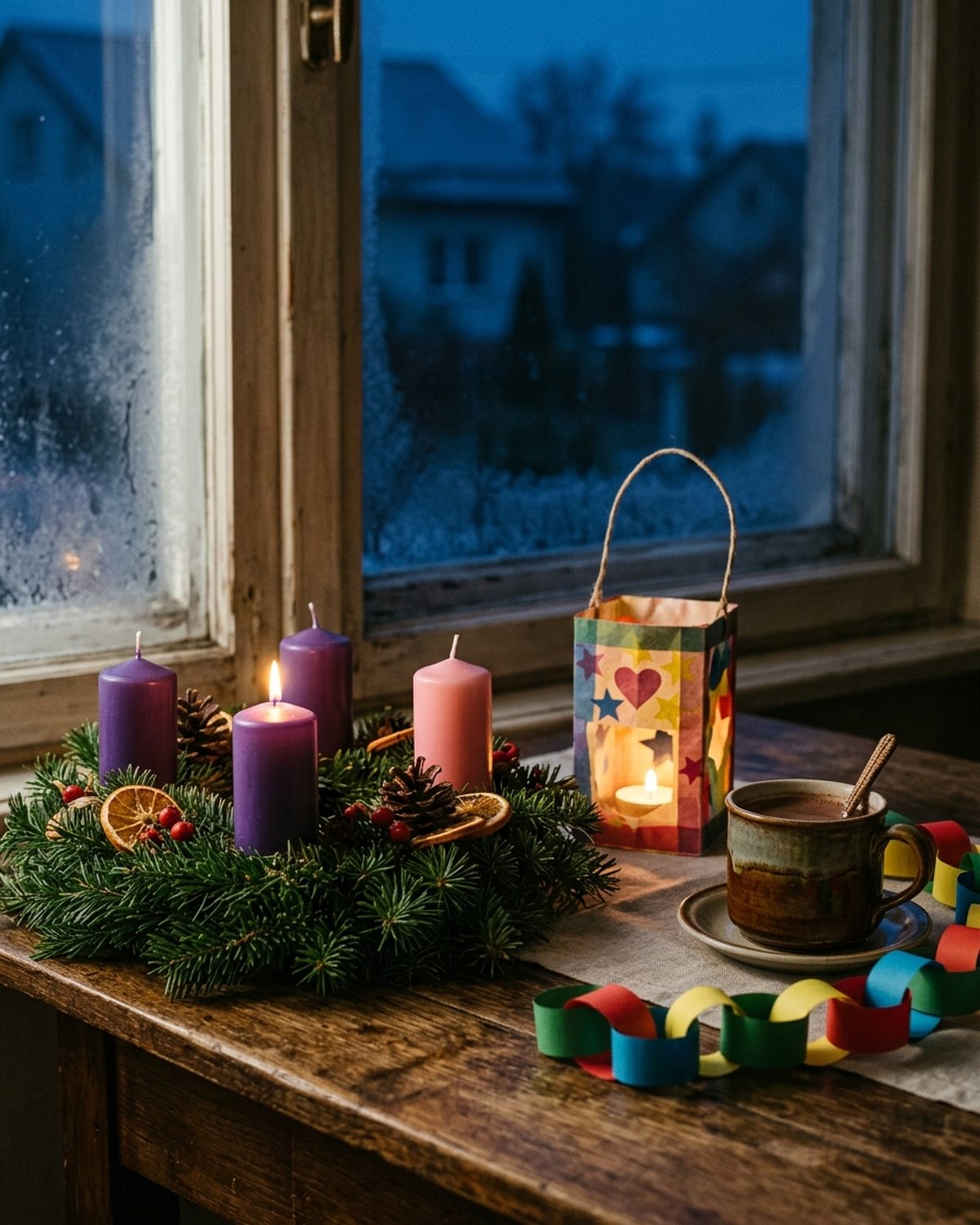
A circle of evergreen with four candles, three purple and one rose (USCCB). Purple is the color of Advent; rose may replace it on the third Sunday, Gaudete, “the Sunday of rejoicing,” when the priest may wear rose too. The progressive lighting, one more candle each week, “symbolizes the expectation and hope” of the season. tradition
Where it came from is well documented. In 1839 Johann Hinrich Wichern, a Lutheran pastor and theologian who had founded a home in Hamburg for poor and neglected children, the Rauhes Haus, was asked by them every day whether Christmas had come yet. He fixed candles to a large wooden ring from an old cartwheel: one for every day from the first Sunday of Advent to Christmas Eve, so the number changed from year to year; the usual telling has small red candles for weekdays and large white ones for Sundays, though the Rauhes Haus itself says that picture is not documented (details in the wreath post). German Catholics took up the custom in the 1920s, and it reached North America in the 1930s (Wikipedia, evangelisch.de). history So the wreath was invented for exactly your situation: a child who cannot see how long “soon” is.
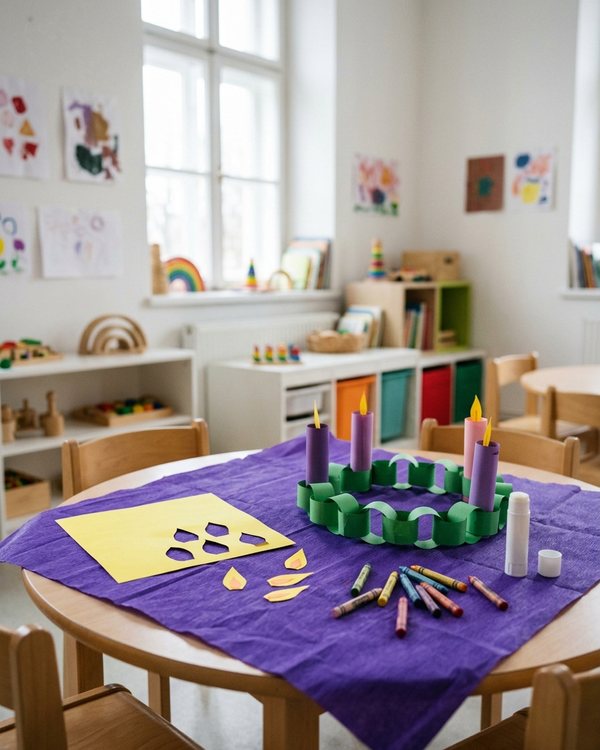
You do not need a priest to bless it. The USCCB’s household blessing says a wreath at home should “be blessed by a parent or another member of the family,” on the first Sunday or the evening before (USCCB). The prayer is a few lines; the one to keep is “Lord God, let your blessing come upon us as we light the candles of this wreath.” The parish gift shop or any craft store will have the candle set; a plate, a ring of greenery from the yard and four tea-light holders do the same job. How to make one with children, and what the colors mean when a child asks, is in Advent wreath for kids.
Chocolate calendar or Jesse Tree?
Both, if you like. They do different jobs.
The chocolate calendar counts days. It starts on December 1 for a historical reason, not a religious one: the first printed Advent calendar was made in Germany in 1908 by Gerhard Lang, whose mother had attached 24 candies to a piece of cardboard for him as a boy; early calendars were reused each year, so they needed fixed dates, and the December 1 start stuck (Aleteia). history There is nothing wrong with it. The honest thing to say to a child who notices the gap is: “The chocolate counts the days of December. The candles count the Sundays of Advent. They start two days apart this year, that’s all.”
The Jesse Tree tells the story. The name is from Isaiah 11:1, “a shoot shall sprout from the stump of Jesse” (NABRE), the father of King David (Loyola Press). Scripture A bare branch in a jar, and each day one paper ornament for a person on the road to Bethlehem: an ark for Noah, a ladder for Jacob, a coat for Joseph in Egypt, a crown for Solomon (Loyola Press activity). tradition The child draws the symbol, you read three verses, the ornament goes on the branch. Twenty minutes if you let it be messy. If you have ever wondered why saints are shown with keys, lions or lambs, this is the same language, one picture per person.
A good-deeds manger is the third option, and the one that works best under seven. An empty shoebox or a small wooden crib, a bag of raffia or shredded paper from the craft store, and a rule: every kind thing done in secret earns one piece of straw. By Christmas Eve the manger is soft enough for the baby. It costs a few dollars and no child has ever asked what it means.
Advent in four weeks: the plan
One activity a week is enough. The week’s Gospel is from Year B, the one read at Mass this year: Mark 13:33–37, Mark 1:1–8, John 1:6–8, 19–28 and Luke 1:26–38 (USCCB 2026 calendar); the sentences are what you can say at the wreath.
| Week | Candle | One family activity | Say to a 3–6-year-old | Say to a 7–12-year-old |
|---|---|---|---|---|
| 1 · Nov 29 | first purple | Bless the wreath after dinner on Sunday (a parent reads the prayer). Set up the Jesse branch or the manger. | “We’re waiting for Jesus’ birthday. Tonight we light one candle.” | “Jesus said: ‘Be watchful! Be alert!’ (Mark 13:33). Waiting is a job too. What are we waiting for this week?” |
| 2 · Dec 6 | second purple | Shoes by the door on Saturday night for St. Nicholas. Go to Mass on Tuesday, Dec 8, as a family; pick the time now. | “John the Baptist told everyone: Jesus is coming, get ready! He lived in the desert and ate honey.” | “‘Prepare the way of the Lord, make straight his paths’ (Mark 1:3). One thing in our house we could straighten out before Christmas: what is it?” |
| 3 · Dec 13 | rose | Gaudete: something pink on the table, a treat, and one bag of outgrown toys to the parish drive or a tag off the Giving Tree. | “The pink candle means: be happy, it’s almost here!” | “Gaudete means ‘rejoice.’ Halfway through Advent the Church says: it’s all right to be glad already. Who could we make glad this week?” |
| 4 · Dec 20 | fourth purple, all four lit | Read the Annunciation (Luke 1:26–38) at the wreath. From Dec 17, sing one verse of “O Come, O Come, Emmanuel” each night. | “An angel told Mary: you will have a baby, and his name is Jesus. Mary said yes.” | “Gabriel said ‘Do not be afraid, Mary’ (Luke 1:30), and she answered ‘May it be done to me according to your word’ (Luke 1:38). Saying yes to God is the whole of Advent.” |
Scripture in the table is NABRE, from the USCCB’s Advent lectio divina (week 1, week 2, week 4). Scripture
December 8: a holy day in the middle of a school week
In the United States, the Immaculate Conception is one of six holy days of obligation, alongside Christmas, January 1, the Ascension (which most provinces move to Sunday), August 15 and All Saints (USCCB, canon 1246). The rule that lifts the obligation when a feast falls on a Saturday or Monday names three other days and not this one; in 2026 it is a Tuesday anyway (USCCB 2026 calendar). So it is a Mass day, on a school night, with homework. history
In England and Wales the Liturgy Office lists Christmas, Epiphany, the Ascension, Sts. Peter and Paul, the Assumption and All Saints; December 8 is not among them (Liturgy Office).
Practically: many parishes add an evening Mass that day; the bulletin for November 29 will list the times. Decide on Sunday which one, write it on the fridge, and let dinner be sandwiches. For the children it is the day of Mary, not a day about a rule. What the feast actually means, and how to say it to a child without a theology degree, is in Immaculate Conception for kids.
Gaudete, the O Antiphons and Las Posadas
Gaudete Sunday, December 13. The rose candle, possibly rose vestments, and permission to be cheerful (USCCB). In a house with small children this is the Sunday to put the tree up if you have been holding out, or to bake. The point a 9-year-old can get: the Church builds a rest stop into the waiting.
The O Antiphons, December 17 to 23. Seven short prayers, each calling Jesus by an Old Testament name, sung before the Magnificat at Evening Prayer; the Church has used them since at least the eighth century (USCCB). O Wisdom, O Sacred Lord, O Flower of Jesse’s Stem, O Key of David, O Radiant Dawn, O King of all the Nations, O Emmanuel (USCCB reflection). history You already know them: “O Come, O Come, Emmanuel” is a verse paraphrase of the antiphons, a Latin hymn first printed in 1710 and put into English by John Mason Neale in 1851 (Wikipedia), which is why it belongs to Advent and not to Christmas (USCCB reflection). One verse a night at the wreath, from the 17th, and the children will have learned something the Church has sung for some twelve centuries.
Las Posadas, December 16 to 24. If your parish has a Hispanic community, you may be invited. For nine nights, a procession with children dressed as angels and shepherds goes from house to house; the couple playing Mary and Joseph sing for lodging, are turned away, and are finally let in at the last house, where the feast begins (Aleteia, Britannica). tradition It is a Mexican tradition, now widely celebrated in the US; it is not ours to claim, but it is good to be a guest at, and a four-year-old who has knocked on a door and been told “no room” understands Christmas Eve better than any of us.
When the plan falls apart
It will, around December 9. Someone gets sick, the candles burn down unevenly, the Jesse Tree stops at Moses. None of that is failure. The wreath was invented for impatient children, the calendar for a boy who wanted candy, and the Church gives the season a rest stop in the middle because it expects you to be tired.
Keep one thing: the candles on Sunday. Four times, with the lights off and a sentence from the table, is an Advent a child will remember. Everything else is extra.
After Christmas, the next door to chalk is on January 6: Epiphany, chalk the door.
As of October 2026. Dates checked against the USCCB 2026 liturgical calendar. Scripture quotations from the New American Bible, Revised Edition.

Eryk Panter
I make HOSANNA! with my family, at our own table. I write the rules, dig through the sources and work on the pictures; the children play first and tell me straight what does not work. Here I write what I was looking for as a dad: how to talk with children about the saints, concretely, with sources and without sugar-coating.
Frequently asked questions
When does Advent start in 2026?
On Sunday, November 29, 2026, three days after Thanksgiving. It lasts until Christmas Eve, Thursday, December 24. The Sundays are November 29, December 6, December 13 (Gaudete) and December 20. The Sunday readings in this liturgical year are from Year B.
What do the four Advent candles mean?
One candle for each Sunday of Advent. Usually three are purple and one is rose; the rose candle is lit on the third Sunday, Gaudete Sunday, when the priest may wear rose vestments. Lighting one more candle each week shows the waiting getting shorter and the light getting stronger. The meanings given to individual candles (hope, peace, joy, love) are a popular tradition, not a rule.
Is December 8 a holy day of obligation in 2026?
In the United States, yes. The Immaculate Conception falls on a Tuesday in 2026 and is a holy day of obligation, so Catholics go to Mass that day. In England and Wales it is not on the list of holydays of obligation.
Should an Advent calendar start on December 1 or on the first Sunday of Advent?
Store-bought calendars start on December 1 because the first printed calendars, made in Germany around 1908, were reused every year and needed fixed dates. Advent itself starts on a Sunday that moves between November 27 and December 3. Either works at home; if your calendar has 24 doors, open the first one on December 1 and light the first candle two days earlier.
What is a Jesse Tree?
A small tree or branch on which a family hangs one symbol a day from the Old Testament story leading to Jesus: an ark for Noah, a ladder for Jacob, a coat for Joseph, a crown for Solomon. The name comes from Isaiah 11:1, a shoot from the stump of Jesse, the father of King David.
What are the O Antiphons?
Seven short prayers sung before the Magnificat at Evening Prayer from December 17 to 23, each calling Jesus by an Old Testament name: Wisdom, Lord, Flower of Jesse's Stem, Key of David, Radiant Dawn, King of Nations, Emmanuel. The hymn 'O Come, O Come, Emmanuel' is a verse paraphrase of them: the Latin text was first printed in 1710 and John Mason Neale's English translation dates from 1851.
Sources
Marks: [H] — Scripture, document, recorded fact · [T] — tradition, legend, custom · [N] — Church teaching · [D] — study, data.
- NUSCCB: 2026 Liturgical Calendar for the Dioceses of the United States (PDF)
- NUSCCB: What is Advent? (Prayer and Worship, Liturgical Year)
- NUSCCB: Complementary norm to canon 1246, holy days of obligation in the United States
- NLiturgy Office of England and Wales: Holydays of Obligation
- NUSCCB: About Advent Wreaths, blessing of an Advent wreath at home (PDF)
- NUSCCB: Reflection on the O Antiphons of Advent
- NCatechism of the Catholic Church 524: the liturgy of Advent (USCCB edition, p. 134)
- HIsaiah 11:1, New American Bible, Revised Edition (bible.usccb.org)
- HMark 13:33–37, New American Bible, Revised Edition, in USCCB Lectio Divina for the First Week of Advent (PDF)
- HMark 1:1–8, NABRE, in USCCB Lectio Divina for the Second Week of Advent (PDF, Diocese of Portland copy)
- HLuke 1:26–38, NABRE, in USCCB Lectio Divina for the Fourth Week of Advent (PDF, Diocese of Portland copy)
- HWikipedia: O Come, O Come, Emmanuel (paraphrase of the O Antiphons; Latin 1710, Neale 1851)
- HWikipedia: Advent wreath (Wichern, Rauhes Haus, 1839)
- Hevangelisch.de: Wichern-Adventskranz für den Bundestag (the Rauhes Haus as a home for neglected children; the 1839 wheel)
- HAleteia: Where did Advent calendars originate? (Gerhard Lang, 1908)
- TLoyola Press: The Jesse Tree
- TLoyola Press: Our Jesse Tree, activity with symbols and Bible references
- TAleteia: A brief guide to the Mexican tradition of Las Posadas
- HEncyclopaedia Britannica: Las Posadas
- DUS Courts (W.D. Wisconsin): 2026 federal holiday schedule, Thanksgiving Thursday, November 26