Bedtime prayer with a child is mostly two quiet minutes together, and only then a text to say. When you need the words themselves, everything is in one place below: the traditional Catholic prayers in full with a source for each, a two-minute routine by age (2–4, 5–7, 8–12), and what to do on the nights when nobody wants to settle.
What does the Church actually ask of bedtime prayer?
Less than you might fear. The Catechism says the Christian family is “the first place of education in prayer” and that for young children “daily family prayer is the first witness of the Church’s living memory” (CCC 2685). Memorizing the basic prayers “offers an essential support to the life of prayer, but it is important to help learners savor their meaning” (CCC 2688).
The Church’s own night prayer is a good model because it is short and has a clear shape. In the Bishops of England and Wales’ booklet for Thy Kingdom Come it opens with a moment to “reflect on your day”, moves through a psalm and the words of old Simeon, and ends with “The Lord grant us a quiet night and a perfect end” (CBCEW Night Prayer). Look back on the day, hand it over, ask for a peaceful night. A four-year-old can do that in three sentences.
The psalm behind all of it: “In peace I will lie down and fall asleep, for you alone, LORD, make me secure” (Ps 4:9, NABRE). Scripture
A 2-minute bedtime prayer routine
The American Academy of Pediatrics sums up a good bedtime routine as “Brush, Book, Bed”, recommends “regular bedtimes (and, if appropriate, nap times)”, and says to start before your child is overtired rather than waiting for yawning (HealthyChildren.org). Prayer slots in between the book and the light switch; it replaces the last two minutes of fidgeting, it does not add fifteen.
A script for most children from about three up:
| Time | What happens | Who speaks |
|---|---|---|
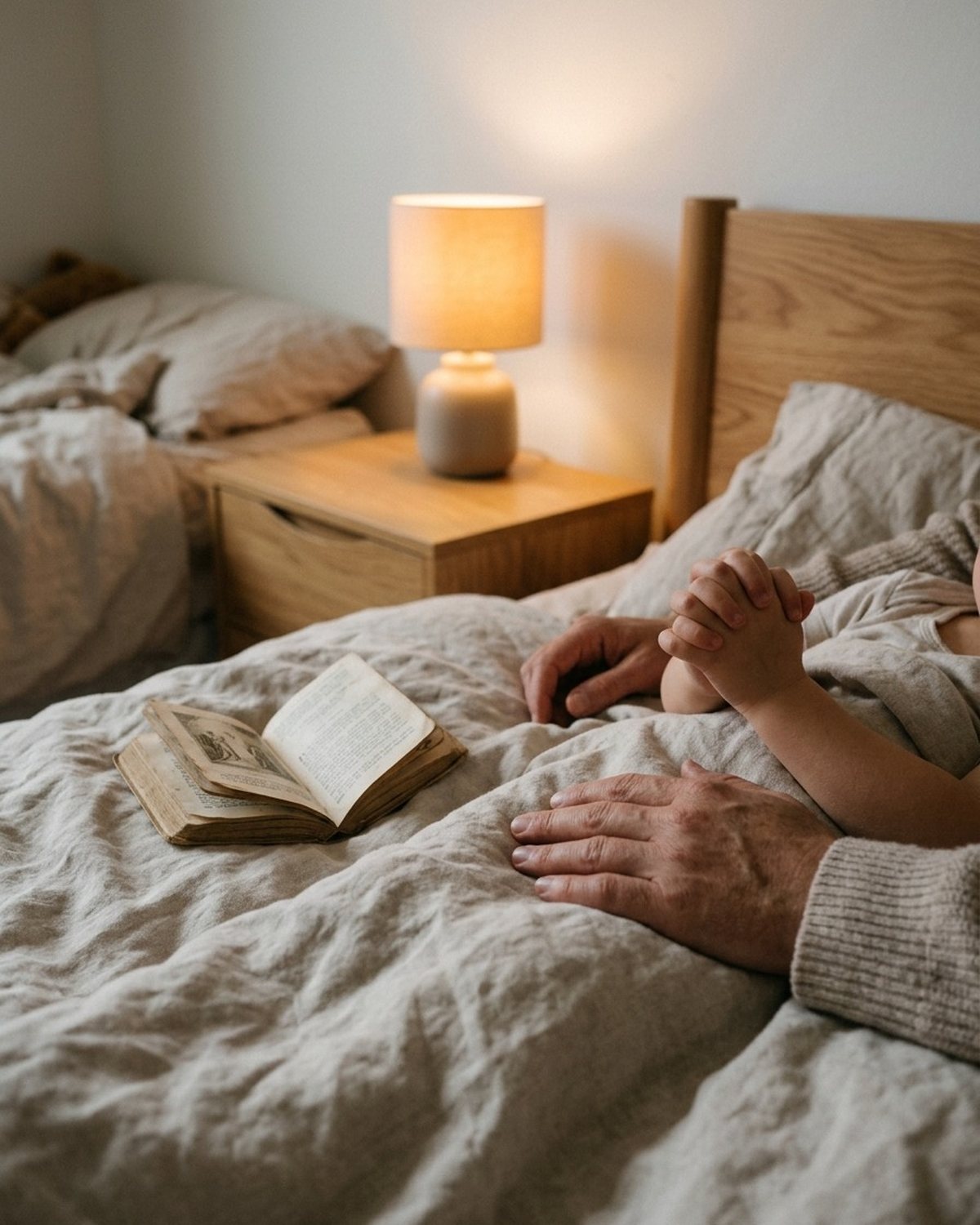
| 0:00 | Light low, child in bed. Sign of the Cross, your hand over theirs for the little ones. | together |
| 0:15 | Thank you. “Thank you, God, for today, especially for…” The child finishes the sentence. | child |
| 0:40 | Sorry. “I’m sorry for…” One thing, no interrogation. If nothing comes, you say your own. | child or parent |
| 1:00 | Please. “Please take care of…” A name: grandma, a friend, the dog. | child |
| 1:20 | One set prayer the child knows: Angel of God for small children, Our Father or Hail Mary later. | together |
| 1:50 | You trace a small cross on the forehead with your thumb and say “God bless you, sleep well.” | parent |
| 2:00 | Light off. |
The three middle lines are a child’s version of the examination of conscience that opens the Church’s night prayer. If you keep one thing from this post, keep “thank you, sorry, please”: it works with a two-year-old and with a twelve-year-old who no longer wants to say set prayers out loud.
Bedtime prayers by age
A suggestion, not a syllabus. The shape follows what parishes usually expect: First Reconciliation and First Communion around second grade (ages 7–8) in many American dioceses (the Diocese of Toledo calls 2nd grade “the ordinary time”: toledodiocese.org), Year 3 in England and Wales (Westminster Cathedral takes children aged 7 to 10). Your parish sets its own year.
| Age | What to say | What to watch |
|---|---|---|
| 2–4 | Sign of the Cross hand-in-hand, “Thank you, God, for…”, a cross on the forehead. Add Angel of God once they can repeat lines after you. | thirty seconds, same words every night, no correcting their pronunciation |
| 5–7 | Thank you / sorry / please, Angel of God, the Our Father with you saying it line by line. Hail Mary once they ask who Mary is. | they choose what to thank God for; you don’t improve their list |
| 8–12 | The full set: Our Father, Hail Mary, Glory Be, Act of Contrition. Let them lead once a week. | own words matter more than speed; if they go quiet, don’t fill the silence |
Ages 2–4. A toddler prays with their body: the hand guided through the Sign of the Cross, the cross on the forehead, your voice. “Thank you, God, for the playground” counts as a complete prayer of thanksgiving, even on the thirtieth night in a row. KidsHealth, Nemours’ parent site, wants screens off at least an hour before bed and the preschool routine kept simple (KidsHealth); a thirty-second prayer does not disturb that.
Ages 5–7. The age for the Angel of God prayer and the Our Father. If your child is in a parish religious education program or a Catholic school, they are learning these for First Communion anyway; bedtime is the practice that makes the classroom version stick. For the Our Father: you say a line, they repeat it, for a couple of weeks, until one evening they start before you do.
Ages 8–12. By now most children know the set prayers; the risk is that bedtime prayer becomes something recited at you. Hand it over: once a week your child leads, picks the prayer, says the “please” intentions, traces the cross on your forehead. A short Act of Contrition fits after First Reconciliation (text below). If an older child would rather pray silently, let them. Silence at ten is not refusal.
Bedtime prayers: the texts on one page
The traditional prayers in the English wording used in the United States and in England and Wales. Print this section for the nightstand.
1. Sign of the Cross
In the name of the Father, and of the Son, and of the Holy Spirit. Amen.
Right hand to the forehead, chest, left shoulder, right shoulder; the wording of the Order of Mass (Liturgy Office of England and Wales).
2. Our Father (USCCB)
Our Father, who art in heaven, hallowed be thy name; thy kingdom come; thy will be done on earth as it is in heaven. Give us this day our daily bread; and forgive us our trespasses as we forgive those who trespass against us; and lead us not into temptation, but deliver us from evil. Amen.
3. Hail Mary (USCCB)
Hail Mary, full of grace, the Lord is with you; blessed are you among women, and blessed is the fruit of your womb, Jesus. Holy Mary, Mother of God, pray for us sinners now and at the hour of our death. Amen.
Children ask what “the hour of our death” means. A calm answer: “We’re asking Mary to be with us all the way, even at the very end.”
4. Glory Be (USCCB)
Glory be to the Father, the Son, and the Holy Spirit; as it was in the beginning, is now, and ever shall be, world without end. Amen.
5. Angel of God (USCCB prayer card)
Angel of God, my guardian dear,
to whom God’s love commits me here,
ever this day be at my side,
to light and guard, to rule and guide. Amen.
At bedtime say “ever this night”: the Latin original has hodie or hac nocte, and English prayer books print “this day (or night)” (Catholic Culture). The Church teaches that “beside each believer stands an angel as protector and shepherd leading him to life” (CCC 336, quoting St. Basil). history How to explain the angel to a child without turning him into an imaginary friend: the guardian angel prayer for kids.
6. Act of Contrition, a children’s version
Father, I am sorry for all my sins: for what I have done and for what I have failed to do. I will sincerely try to do better. Help me to walk by your light.
The form in the Diocese of Raleigh’s sample First Reconciliation service, printed there without an “Amen” (PDF); your parish may teach a slightly different one, and the child should learn the catechist’s version. The Church’s Order of Penance gives three forms, from the traditional “O my God, I am heartily sorry for having offended you…” to a single line: “Lord Jesus, Son of God, have mercy on me, a sinner” (USCCB); Loyola Press notes that any words of real sorrow are enough, no formula is required (Catechist’s Journey). history For a bedtime “sorry”, the one-line form is plenty.
7. Now I lay me down to sleep (not specifically Catholic)
Now I lay me down to sleep,
I pray the Lord my soul to keep;
if I should die before I wake,
I pray the Lord my soul to take. Amen.
Many American and British grandparents learned this one. It is not a Catholic prayer: an English children’s prayer printed in The New England Primer (the 1750 edition is the one usually cited), possibly with an earlier form in George Wheler’s book of 1698, and used across denominations (Wikipedia). history The third line unsettles some small children; a later ending, also recorded there, replaces it: “see me safely through the night, and wake me with the morning light.” Catholics are free to say either, or neither.
8. A one-line examen for kids
Thank you for… I’m sorry for… Please take care of…
Not a traditional text, but the shape of the Church’s examination of conscience in words a three-year-old can finish. With a Sign of the Cross at each end, it is a complete bedtime prayer.
What to do when they won’t settle
Some nights prayer goes badly: the child is overtired, or wound up, or has discovered that “one more prayer” works like “one more story”. What helps:
- Shorten, don’t skip. On a hard night: Sign of the Cross, one “thank you”, cross on the forehead. A twenty-second prayer in a bad mood is still a prayer; a cancelled one teaches that prayer is for good days.
- Don’t let prayer become the stalling tactic. If “I want to say the Hail Mary too” appears only as the light goes off, say it tomorrow, first. KidsHealth advises responding calmly when a child calls out or gets up, keeping the visit brief and returning them to bed (KidsHealth).
- When your child is scared. Cincinnati Children’s advice: let the child name the fear without forcing it, “never dismiss or make fun of a child’s fear”, offer a security object and a dim light, and reassure briefly: “You are OK. We are here to make sure that you are safe” (Cincinnati Children’s). Then the Angel of God prayer, or Psalm 4:9 said slowly, is exactly right: a true reassurance, not a trick.
- Don’t build the fear up. The same page warns against rituals that treat imaginary threats as real (“monster spray”, checking under the bed every night). Prayer is not monster spray either: “Jesus is with you” is said as a fact, in the tone of “the door is locked”.
- When they refuse. No punishment, no “then God will be sad”. Say “All right, I’ll pray tonight and you can listen,” and keep it short. A leaflet for parents from the Bishops of England and Wales: “Nothing should be forced, prayer should always be something we choose to take part in” (Liturgy Office).
Three things not to do at bedtime
No fear. “God is watching you” becomes a threat the moment it is said in the voice you use for “I’ll tell your father”. The Church’s night prayer asks God to “protect us while we sleep” (CBCEW Night Prayer): the opposite of surveillance.
No prayer as a sentence. “You hit your sister, so you’ll say three Hail Marys” makes the Hail Mary a chore you do to get out of trouble. If a penance is needed, make it an apology to the sister.
No performance review. Don’t correct pronunciation, don’t count the thank-yous, don’t compare siblings. The Catechism wants them to “savor their meaning” (CCC 2688), and nobody savors anything under inspection.
If two minutes start feeling too short on a Sunday evening, rosary for kids explains how one decade can work for a family that will never manage five, and Mass with toddlers covers what a two-year-old can actually do in a pew.
As of October 2026. Scripture quotations from the New American Bible, Revised Edition.

Eryk Panter
I make HOSANNA! with my family, at our own table. I write the rules, dig through the sources and work on the pictures; the children play first and tell me straight what does not work. Here I write what I was looking for as a dad: how to talk with children about the saints, concretely, with sources and without sugar-coating.
Frequently asked questions
What is a good bedtime prayer for kids?
For most Catholic families: the Sign of the Cross, the Angel of God prayer, and one sentence in the child's own words, such as 'Thank you, God, for today, especially for…'. Older children add the Our Father, the Hail Mary, the Glory Be and a short Act of Contrition. Two minutes is enough; the same words every night matter more than many words.
Is 'Now I lay me down to sleep' a Catholic prayer?
Not specifically. It is an English-language children's prayer printed in The New England Primer in the 18th century, with an earlier version from 1698, and it is used by Christians of many denominations. Catholics can say it, but it is not part of Catholic tradition the way the Angel of God prayer or the Our Father are. A later ending, 'see me safely through the night, and wake me with the morning light', is gentler for small children.
What is the Catholic guardian angel prayer for bedtime?
'Angel of God, my guardian dear, to whom God's love commits me here, ever this day be at my side, to light and guard, to rule and guide. Amen.' This is the wording on the USCCB prayer card. At night say 'ever this night'; the Latin original has both 'hodie' and 'hac nocte'. The Catechism teaches that each believer has an angel as protector and shepherd (CCC 336), which is why it is the classic Catholic night prayer for children.
How long should bedtime prayers be for a toddler?
About thirty seconds. A 2–4-year-old can make the Sign of the Cross with your hand guiding theirs, repeat one sentence after you ('Thank you, God, for today'), and receive a small cross traced on the forehead. Pediatric sleep advice stresses a short, predictable routine at the same time every night; prayer fits inside it, it should not stretch it.
What is a simple Act of Contrition for children?
A short version used in First Reconciliation preparation, for example in the Diocese of Raleigh: 'Father, I am sorry for all my sins: for what I have done and for what I have failed to do. I will sincerely try to do better. Help me to walk by your light.' The Church's Order of Penance also allows the one-line prayer 'Lord Jesus, Son of God, have mercy on me, a sinner.' Any words of real sorrow are enough.
Should I tell my child that God is watching them at night?
Not as a warning. The Church's own night prayer asks God to 'protect us while we sleep', and Psalm 4 says 'In peace I will lie down and fall asleep, for you alone, LORD, make me secure.' God's presence at night is a comfort, not surveillance. Pediatricians also advise against building up nighttime fears, so keep bedtime words calm and safe.
Sources
Marks: [H] — Scripture, document, recorded fact · [T] — tradition, legend, custom · [N] — Church teaching · [D] — study, data.
- NUSCCB: Prayers of the Rosary — Our Father, Hail Mary, Glory Be (usccb.org)
- NLiturgy Office of England and Wales: Excerpts from the Order of Mass, the People's Parts (Sign of the Cross)
- NUSCCB: Prayer to Your Guardian Angel (prayer card, PDF)
- NCatholic Culture: Angel of God (Angele Dei) — English and Latin text, 'this day (or night)', hodie / hac nocte
- NDiocese of Toledo: First Communion — 2nd grade as the ordinary time
- NWestminster Cathedral: First Holy Communion — children aged 7 to 10 (Year 3)
- NUSCCB: Act of Contrition — three forms from the Order of Penance, nos. 45 and 92
- NLoyola Press, Catechist's Journey: The Act of Contrition and the Sacrament of Penance (2023)
- NDiocese of Raleigh: Sample First Reconciliation Service (PDF) — children's Act of Contrition
- HWikipedia: Now I Lay Me Down to Sleep — 1698 Wheler version, The New England Primer (1750 ed.), later endings
- NCatechism of the Catholic Church 2683–2691: guides for prayer, the family (2685), memorizing prayers (2688) (vatican.va)
- NCatechism of the Catholic Church 336: the guardian angels (USCCB flipbook)
- HPsalm 4, New American Bible, Revised Edition (bible.usccb.org)
- NBishops' Conference of England and Wales: Night Prayer booklet for Thy Kingdom Come (2018, PDF)
- NLiturgy Office of England and Wales: In Communion with Christ — leaflet 1 for parents of young families (2005, PDF)
- DAmerican Academy of Pediatrics, HealthyChildren.org: Brush, Book, Bed — a bedtime routine
- DKidsHealth (Nemours): Sleep and Your Preschooler
- DCincinnati Children's Hospital: Bedtime Fears
- HCatholic Answers Encyclopedia: Monica, Saint