Twenty Bible stories, sorted by the age at which they usually land, each with its chapter and verse in the New American Bible, Revised Edition (the text on bible.usccb.org) and one question to ask afterwards. Then the part most children’s Bibles skip: where the version we all grew up with says something the Bible doesn’t.
One thing we learned the hard way. In August we tested our card game with children from the wider family, aged about 4 to 12, and the 12-year-old didn’t know that Peter walked on water. Don’t assume the basics are already in place, even for the oldest.
In what order should you tell Bible stories?
The Church gives no official reading order for children. What she does say is that faith education by parents “should begin in the child’s earliest years” (CCC 2226) history, and the oldest instruction for it is about repetition, not a syllabus: “Keep repeating them to your children… when you lie down and when you get up” (Deuteronomy 6:7) Scripture.
What works for us is three stages. The ages are our suggestion, not a rule.
Ages 3–5: God takes care of someone. One picture per story and a safe ending. Noah and the dove, baby Jesus in the manger, the boy with five loaves, Jesus taking children in his arms. A preschooler doesn’t need the whole plot; they need to know who was scared and who helped.
Ages 6–8: someone has to choose. Jonah runs away. Zacchaeus climbs a tree and gives half his things to the poor. The younger son comes home. In many American dioceses these are also the years of preparing for First Reconciliation and First Communion, which are “usually celebrated in second grade” (Diocese of San Diego), and the stories of forgiveness and of Jesus feeding the crowd fit that preparation well.
Ages 9–12: open the real Bible. At this age a child can find a verse in a full Bible and read it aloud. This is also when the harder chapters can come in, with you next to them (more on that below).
The Church year does half the planning for you: the Annunciation and the Nativity in Advent, the Magi at Epiphany, the empty tomb at Easter.
20 Bible stories by age: a table to print
The question is there so your child tells the story back in their own words or thinks about themselves. There are no wrong answers. “Start at” is the youngest age at which we’d tell it; older children get the same story with more detail.
| Story | Where (NABRE) | Start at | Question for your child | Card |
|---|---|---|---|---|
| Creation | Genesis 1:1–2:3 | 3 | What’s your favorite thing God made? | none |
| Noah and the dove | Genesis 6–9 | 3 | What did the dove bring back? | 1 Noah |
| Abraham counts the stars | Genesis 15:5–6 | 4 | Is it easy to trust a promise you can’t see yet? | 2 Abraham |
| Joseph and his brothers | Genesis 37–45 | 6 | Is it hard to forgive a brother or sister? | 22 Joseph of Egypt |
| Crossing the sea | Exodus 14 | 4 | What did Moses stretch out over the sea? | 3 Moses |
| David and Goliath | 1 Samuel 17 | 4 | What are you afraid of, and how can God help? | 4 David |
| Elijah and the ravens | 1 Kings 17:1–16 | 4 | Who brought Elijah his food? | 21 Elijah |
| Jonah | Jonah 1–4 | 4 | Why did Jonah run away? | 5 Jonah |
| Daniel in the lions’ den | Daniel 6 | 6 | What did Daniel keep doing even when it was forbidden? | none |
| The Annunciation | Luke 1:26–38 | 3 | What did Mary say to the angel? | 11 Gabriel |
| The birth of Jesus | Luke 2:1–20 | 3 | Who did the angel tell first? | 8 Joseph |
| The Magi | Matthew 2:1–12 | 4 | What gifts did they bring? | none |
| Jesus is baptized | Matthew 3:13–17 | 5 | What did the voice from heaven say? | 7 John the Baptist |
| Five loaves and two fish | John 6:1–13 | 3 | What could you share today? | 24 Andrew |
| Jesus blesses the children | Mark 10:13–16 | 3 | What did Jesus do when the children came? | none |
| Zacchaeus | Luke 19:1–10 | 4 | Why did he climb the tree? | none |
| The Good Samaritan | Luke 10:25–37 | 5 | Who was a neighbor to the hurt man? | none |
| The lost sheep and the prodigal son | Luke 15 | 4 / 6 | How did the father feel when he saw his son? | none |
| Mary Magdalene at the empty tomb | John 20:1–18 | 3 | How did Mary know it was Jesus? | 9 Mary Magdalene |
| Thomas | John 20:24–29 | 6 | What did Thomas say when he saw Jesus? | 25 Thomas |
“Card” shows whether that person is one of the 40 in our saints game; “none” means they aren’t in the deck. With a three-year-old, the picture and the first question are plenty. A ten-year-old can look up the reference on bible.usccb.org and read the verse aloud. Two of these have whole posts of their own: Noah’s ark for kids and the parables, including the Good Samaritan and the lost sheep, in parables for kids.
How do you tell Bible stories faithfully?
Two things help.
Know what kind of story it is. The Catechism says God speaks in Scripture “in a human way,” and that to read it well we look for what the authors meant and pay attention to “the literary genres in use at that time” (CCC 109–110) history. For a child that becomes simple: some stories Jesus made up to teach us something. Those are parables, and they start like stories do: “A man had two sons” (Luke 15:11). Other stories tell what God did with real people like Abraham, David and Peter. That’s also why “Bible stories” is a better word than “Bible fairy tales”: a fairy tale tells a child it’s made up.
Separate the text from what we added. Pictures, songs and cartoons have layered details on top of Scripture. You don’t need to take them away. Just say: “That’s how people tell it. Here’s what the Bible says.”
| What we usually hear | What the Bible says (NABRE) |
|---|---|
| Adam and Eve ate an apple | “Fruit,” never named (Genesis 3:2–6) Scripture |
| The animals went in two by two | Pairs, yes (Genesis 7:15), but of every clean animal “seven pairs” (Genesis 7:2) Scripture |
| Joseph’s coat of many colors | “A long ornamented tunic” (Genesis 37:3). “Coat of many colours” is the King James Version’s wording (the Greek Septuagint also reads “many-coloured”); the RSV has “a long robe with sleeves,” and scholars still debate the Hebrew (Wikipedia) Scripture |
| Goliath was nine feet tall | “Six cubits and a span,” about nine feet nine inches by the NABRE footnote, which adds that the Greek text has “four cubits and a span,” about six feet nine (1 Samuel 17:4) Scripture |
| Jonah and the whale | Jonah has “a great fish” (Jonah 2:1); Matthew’s Gospel in the NAB says “the belly of the whale” (Matthew 12:40) Scripture |
| Three kings | “Magi from the east,” with three gifts, never counted and never crowned (Matthew 2:1, 11) tradition |
| The ox and the donkey at the manger | Not in Luke 2; they come from Isaiah 1:3, “An ox knows its owner, and an ass, its master’s manger” (Isaiah 1) tradition |
Jonah is the one children enjoy most, because both answers are right: the Old Testament says fish, Jesus’ words in Matthew are rendered “whale,” and the NABRE footnote on Matthew 12:40 reads Jonah’s three days as a sign of Jesus’ time among the dead and, implicitly, of his resurrection. More on the stable figures in the nativity scene and Midnight Mass.
Which Bible stories should wait?
Some chapters are not for a four-year-old in full, and that’s fine. The Bible is honest about violence, and a child doesn’t need all of it at once.
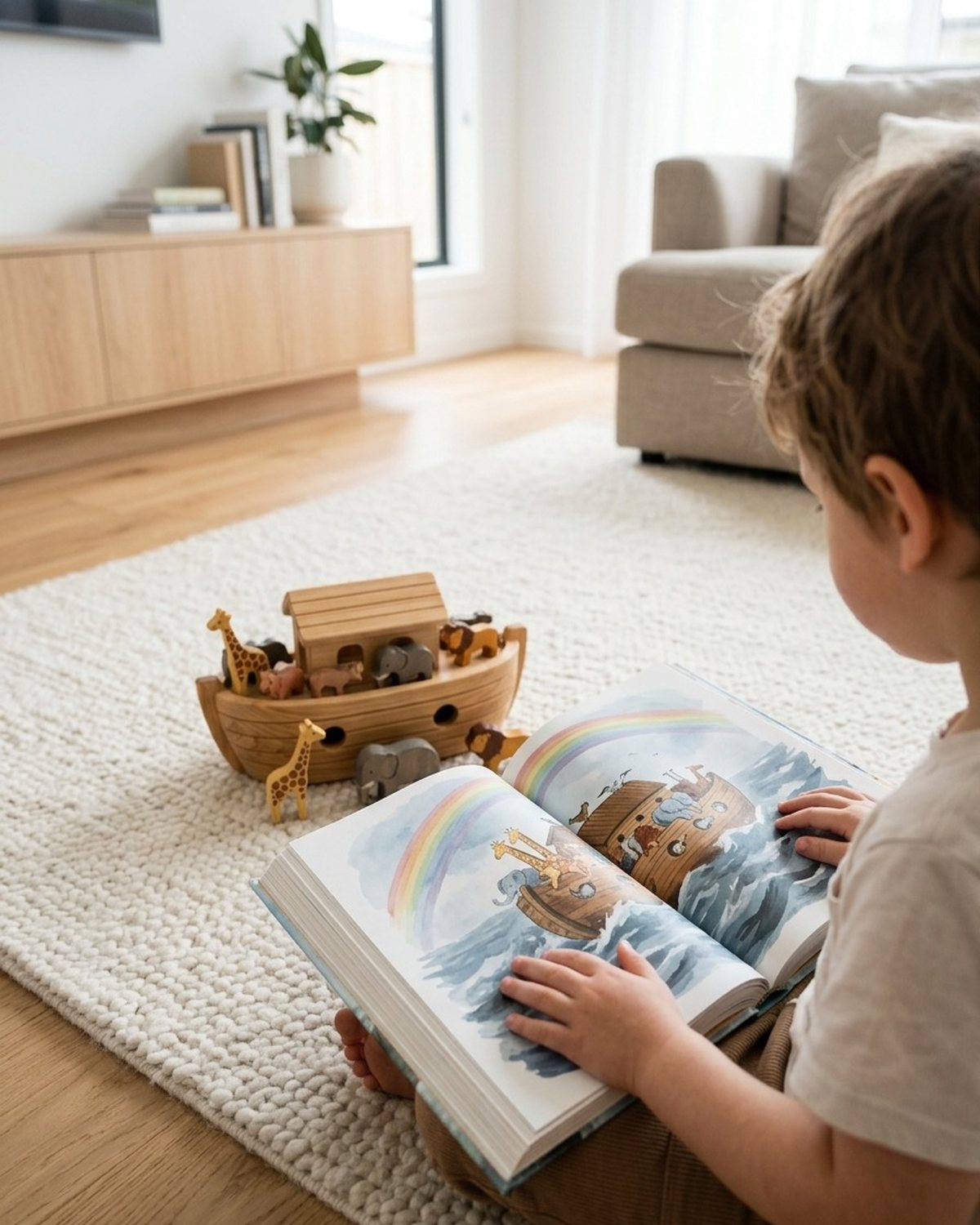
- The Flood (Genesis 6–9). For little ones, the story is the ark, the dove with “a plucked-off olive leaf” (Genesis 8:11) and the bow in the clouds as “a sign of the covenant” (Genesis 9:13). Who drowned can wait until they ask.
- Abraham and Isaac (Genesis 22). God tells Abraham to take “your son Isaac, your only one, whom you love” and offer him (Genesis 22:2). The angel stops him: “Do not lay your hand on the boy” (22:12). We’d leave it to 9 or 10, read together, with time for questions.
- Daniel’s accusers (Daniel 6). A six-year-old can hear that God “sent his angel and closed the lions’ mouths” (Daniel 6:23). The next verses, where the accusers are thrown into the den (6:25), are for older children.
- The Passion. Small children can hear it in a few sentences: Jesus was put to death on a cross, he was buried, and on Sunday the tomb was empty. The angels’ question at the tomb is good for any age: “Why do you seek the living one among the dead? He is not here, but he has been raised” (Luke 24:5–6) Scripture.
If your child asks a hard question you can’t answer, “That’s a good question, let’s find out together” is a complete answer. Ask your parish’s director of religious education, your child’s catechist or your priest.
How to choose a Catholic children’s Bible
We won’t give you a ranking, because we haven’t read them all. Here is what we check.
Translation. In US dioceses the Mass readings come from a lectionary based on the New American Bible; the revised edition, the NABRE, came out in 2011 and is the version on the bishops’ website (Wikipedia). The wording at Mass may differ slightly from what you read at home. That will change: in 2025 the Holy See confirmed a revised translation as the liturgical Bible for the United States, and its readings “will also form the core of the future Lectionary for Mass” (USCCB). It is due out in 2027 as the Catholic American Bible (The Criterion); no date has been set for its use at Mass. In England, Wales and Scotland, the lectionary moved from the Jerusalem Bible to the English Standard Version: Catholic Edition from Advent 2024 (Catholic Herald). All quotations in this post are from the NABRE.
Church approval. Canon law says books of Scripture “cannot be published” without the approval of the Apostolic See or the bishops’ conference (can. 825 §1), and only approved books on religion or morals may be sold or distributed in churches (can. 827 §4, vatican.va) history. The sign of approval is the word imprimatur on the copyright page. It means the bishop’s permission to print after a censor checked “whether the book contains anything that is contrary to Catholic faith and morals.” It says nothing about whether the writing or the pictures are good (Canon Law Made Easy).
A quick check in the store:
- Imprimatur or church approval on the copyright page.
- A chapter reference next to every story.
- No miracles or conversations the Bible doesn’t contain.
- Both Testaments, all the way to the Resurrection.
- Your child wants to open it on their own.
The last one matters most to us. The best children’s Bible is the one you read together.
A five-minute way to tell one story
Reach Out and Read’s milestones sheet for parents says that “a few minutes every day is enough,” that questions can grow from pointing and counting to “why” and “how,” and, for 4- and 5-year-olds, “Let the child lead the reading” (Reach Out and Read Milestones). Bible stories work the same way.
- One story, at bedtime or after prayers. Five minutes, not a lesson.
- Tell it in your own words first, then read one verse from the real text. For the loaves and fishes: “There is a boy here who has five barley loaves and two fish” (John 6:9).
- Ask the question from the table and wait. Skip the moral; “How do you think the father felt?” does more.
- Tell the same story again tomorrow. After a few nights, let your child tell it to you.
- If they don’t want to listen, don’t push. Ask which person they like and start there.
Ready sentences, if you need them:
- For a 3–6-year-old (Zacchaeus): “Zacchaeus was short and couldn’t see Jesus over the crowd, so he climbed a tree. Jesus looked up and said, ‘Zacchaeus, come down quickly, for today I must stay at your house’” (Luke 19:5).
- For a 7–12-year-old (the prodigal son): “Jesus made up this story. The son was still far away when his father saw him and was ‘filled with compassion’ (Luke 15:20). What does that tell you about how God waits for us?”
Jesus himself said, “Let the children come to me; do not prevent them” (Mark 10:14). A story at bedtime is one of the easiest ways to do that.
As of October 2026. Scripture quotations from the New American Bible, Revised Edition.

Eryk Panter
I make HOSANNA! with my family, at our own table. I write the rules, dig through the sources and work on the pictures; the children play first and tell me straight what does not work. Here I write what I was looking for as a dad: how to talk with children about the saints, concretely, with sources and without sugar-coating.
Frequently asked questions
What Bible stories should I start with for a toddler?
Short ones with one clear picture and a good ending: creation (Genesis 1), Noah and the dove (Genesis 6–9), the birth of Jesus (Luke 2), the boy with five loaves and two fish (John 6), Jesus blessing the children (Mark 10:13–16) and the empty tomb (John 20). A few minutes at a time is enough, and toddlers like hearing the same story again.
In what order should I tell Bible stories to children?
There is no official order. A simple path is to follow the child's age (stories of God's care first, stories of choices and forgiveness from about 6, harder chapters from about 9) and the Church year: the Annunciation and the Nativity in Advent, the Passion and the empty tomb in Holy Week and Easter.
Was Jonah swallowed by a whale?
The Book of Jonah says 'a great fish' (Jonah 2:1). The whale comes from the Gospel: in the New American Bible, Matthew 12:40 reads 'Just as Jonah was in the belly of the whale three days and three nights.' Both are in the Bible; the original story says fish.
Are Bible stories just fairy tales for kids?
No. The Catechism teaches that God speaks in Scripture 'in a human way' and that readers must pay attention to what the authors meant and to the literary genres of their time (CCC 109–110). Some stories are parables Jesus told to teach; others tell what God did in the lives of real people. Calling them 'fairy tales' tells a child they are made up.
How do I choose a Catholic children's Bible?
Look for an imprimatur on the copyright page, a chapter reference next to each story, both Testaments up to the Resurrection, and no invented miracles or dialogue. An imprimatur means a censor found nothing contrary to faith and morals; it is not a judgment on the writing or the pictures.
Which Bible translation do Catholics use for Mass?
In the United States the Mass readings come from a lectionary based on the New American Bible; the revised NABRE is the text on bible.usccb.org. In England, Wales and Scotland, the English Standard Version: Catholic Edition replaced the Jerusalem Bible in the lectionary from Advent 2024.
Sources
Marks: [H] — Scripture, document, recorded fact · [T] — tradition, legend, custom · [N] — Church teaching · [D] — study, data.
- HNew American Bible, Revised Edition: Genesis 1; 3; 7; 8; 9; 15; 22 (bible.usccb.org)
- HNew American Bible, Revised Edition: Exodus 14; 1 Samuel 17 with footnote on Goliath's height; 1 Kings 17; Isaiah 1; Daniel 6; Jonah 2 (bible.usccb.org)
- HNew American Bible, Revised Edition: Matthew 2; 3; 12:40 'the belly of the whale'; Mark 10; Luke 1; 2; 10; 15; 19; 24; John 6; 20 (bible.usccb.org)
- HDeuteronomy 6:6–7, 'Keep repeating them to your children', NABRE (bible.usccb.org)
- NCatechism of the Catholic Church 109–114: interpreting Scripture (vatican.va)
- NCatechism of the Catholic Church 2223–2226: parents as first educators in the faith (vatican.va)
- NCode of Canon Law, cann. 822–833: approval of books (vatican.va)
- NCanon Law Made Easy: When does a Catholic book need an imprimatur? (2019)
- HWikipedia: Coat of many colors — KJV, Septuagint, RSV and other renderings
- HWikipedia: New American Bible Revised Edition: NABRE released 2011; the original NAB is the US lectionary text
- HCatholic Herald: New Catholic Lectionary for British churches approved by Vatican (18 Apr 2024)
- DReach Out and Read Milestones: reading tips for parents by age (2025)
- HNew American Bible, Revised Edition: Genesis 37:3 'a long ornamented tunic' (bible.com; bible.usccb.org did not open)
- HDiocese of San Diego: Policy on Length of Sacramental Preparation (19 Nov 2020), First Reconciliation and First Eucharist 'usually celebrated in second grade'
- HUSCCB Committee on Divine Worship Newsletter, May 2025: liturgical Bible confirmed by the Holy See, core of the future Lectionary
- HThe Criterion (Archdiocese of Indianapolis), 12 Nov 2025: new English version to be called The Catholic American Bible, release in 2027