
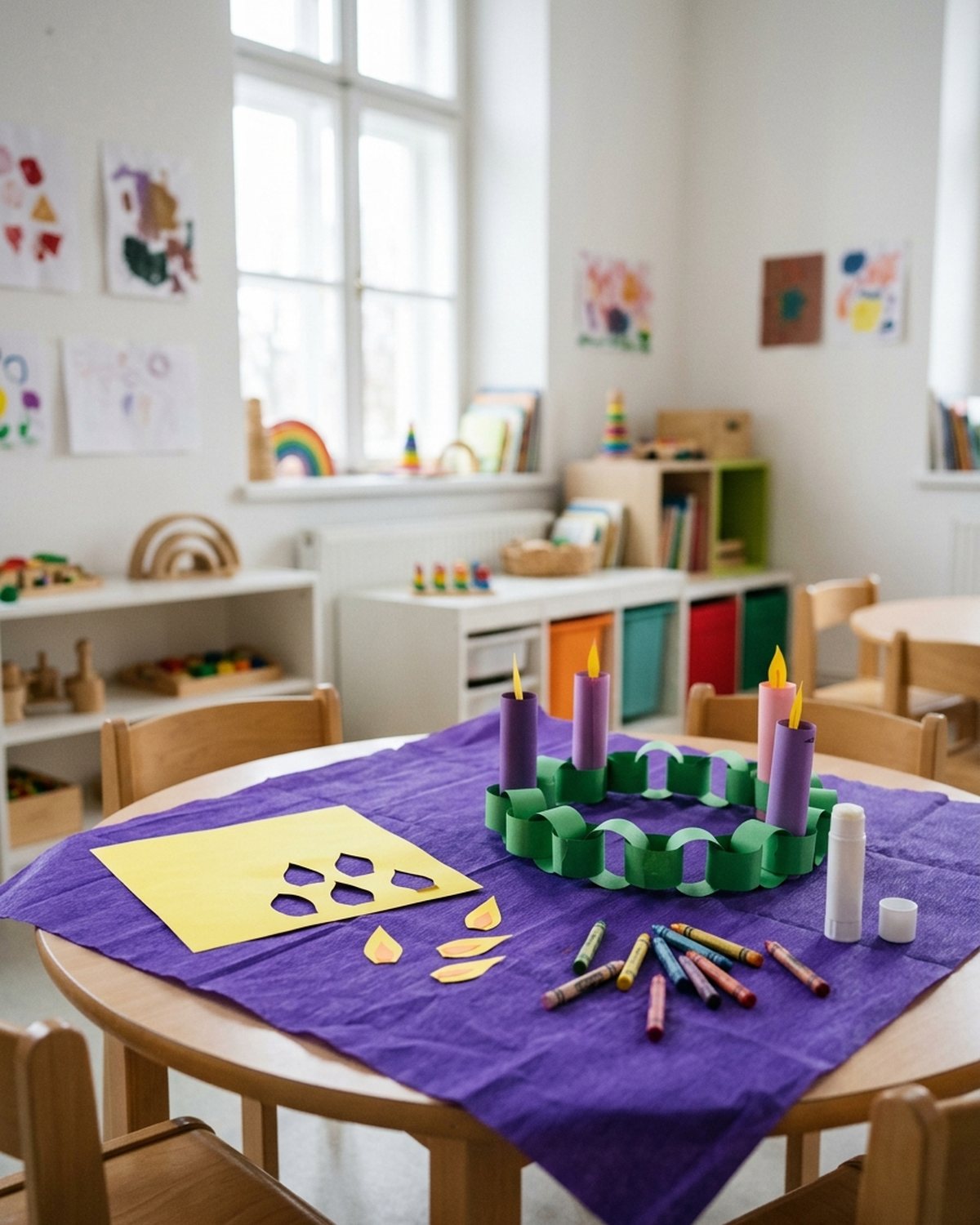
Advent 2026 begins on Sunday, November 29, three days after Thanksgiving, and ends on Thursday, December 24. The fourth week is five days long and for most parish programs and schools it falls inside the Christmas break. Plan four sessions and expect to teach three.
Below is one 45-minute session per week, PreK–K and grades 1–5 side by side, each built on the Gospel the children hear at Mass that Sunday. Materials come from the craft closet: construction paper, glue sticks, crayons, paper plates and a battery tea light.
This is the classroom version. The family side of the season (the wreath at home, the Jesse Tree, December 8 on a school night) is in Advent with kids. Labels as always: Scripture, history, tradition.
Which Gospels do children hear in Advent 2026?
Year B. The USCCB’s calendar gives the Sunday cycle as “Year B” from November 29, 2026 to November 21, 2027, and lists these Gospels (USCCB 2026 calendar): history
| Sunday | Gospel | In one line |
|---|---|---|
| Nov 29, First | Mark 13:33–37 | “Be watchful! Be alert!” |
| Dec 6, Second | Mark 1:1–8 | John in the desert: prepare the way |
| Dec 13, Third (Gaudete, violet or rose) | John 1:6–8, 19–28 | “Who are you?” John points to the light |
| Dec 20, Fourth | Luke 1:26–38 | Gabriel and Mary’s yes |
Two things in that table shape the lessons. John the Baptist gets two Sundays in a row, so week 2 is about what he did and week 3 about who he was. And the Annunciation is read more than once: it is the Gospel of the Immaculate Conception on Tuesday, December 8, one of the options for Our Lady of Guadalupe on Saturday, December 12 (a feast in the US), and the Gospel of the fourth Sunday (USCCB 2026 calendar).
The season has two halves. Up to December 16 it also looks ahead to Christ’s second coming; from December 17 the weekdays are “ordered in a more direct way to preparing for the Nativity of the Lord” (USCCB). history When the Church “celebrates the liturgy of Advent each year, she makes present this ancient expectancy of the Messiah” (CCC 524). For a four-year-old, one sentence every week: Advent is waiting for Jesus’ birthday.
Advent 2026 lesson plans: four 45-minute sessions
Every session has the same six blocks, so the children learn the shape.
| Block | PreK–K | Grades 1–5 |
|---|---|---|
| Gather at the paper wreath | 5 min: count the flames | 5 min: what did you hear at Mass? |
| Gospel | 5 min: told in your own words, with a prop | 10 min: read aloud from the Bible |
| Game or talk | 8 min: a movement game | 8 min: the game, then two questions |
| Craft | 15 min | 15 min, with one written word or line |
| Prayer | 5 min: one line, repeated | 5 min: one line plus a set prayer |
| Take-home question | 2 min | 2 min |
For PreK–K, 45 minutes is long: keep the order and give the spare time to free drawing or a song your parish sings in Advent. Cut the plate centers, cones and hands before class; at three to five, children tear, glue and color, and the scissors work is yours. Scripture is from the New American Bible, Revised Edition.
Week 1 (Nov 29 – Dec 5): Stay awake!
Aim: Advent is waiting for Jesus, and waiting is a job, not doing nothing.
Gospel: Mark 13:33–37. Jesus compares us to servants in a house whose master has gone away; he “orders the gatekeeper to be on the watch” and ends: “What I say to you, I say to all: ‘Watch!’” (Mark 13). Scripture
Game: the gatekeeper. One child guards a “door” made of two chairs. You (or your aide) step out of sight behind the open door as the master of the house, never leaving the children alone, and come back without warning, once after three seconds, once after twenty. The gatekeeper calls “He’s back!” as soon as you appear. Nobody loses; swap gatekeepers after each round. Then: “Watching doesn’t mean being scared. It means being ready, and glad when he comes.” In grades 1–5, first read the passage and have the class count how often it tells us to watch (four times, if you count “be watchful”).
Craft: the paper wreath. A paper plate with the center cut out, covered in torn green paper. Glue on four paper candles, three purple and one pink, and a yellow flame on the first. The wreaths stay in the classroom; a flame is added every week. Grades 1–5 write on the first candle one thing they are waiting for. A real wreath for the room: Advent wreath for kids.
Prayer: “Come, Lord Jesus!” It is the next-to-last verse of the whole Bible (Revelation 22:20), and three words are enough for a three-year-old. Scripture
Take home: “What are we waiting for in Advent? Show me how the gatekeeper watches.”
Week 2 (Dec 6–12): John prepares the way
Aim: meet John the Baptist; “prepare the way” means clearing something out, in our room and in our heart.
Gospel: Mark 1:1–8. Mark opens with Isaiah’s “voice of one crying out in the desert: ‘Prepare the way of the Lord, make straight his paths,’” and then John appears in the desert. He “was clothed in camel’s hair, with a leather belt around his waist. He fed on locusts and wild honey” (Mark 1). Scripture
Prop and talk. Put on a scratchy blanket or a piece of burlap and hold a jar of honey. Tell it: a strange man in the desert, crowds walking out to him, people baptized in the Jordan as they said sorry for their sins. Ask: “How do you get a road ready?” (Pick up the rocks, sweep it.) Then: “John meant a road in our hearts. What could be a rock in there?” Let children give pretend examples; never ask anyone to name their own sins in front of the class.
Craft: the straight road. On gray paper, a strip of yellow paper runs from the bottom corner to a star at the top. Grades 1–5 first scatter “rocks” of crumpled gray paper on the road, write one thing to fix on each, then glue them along the edge: the road is clear. This one goes home.
Prayer: “Jesus, help us get the road ready for you.”
Take home: “Who was John and what did he shout? What could we straighten out at home this week?”
This week: Tuesday, December 8 is a holy day of obligation in the US (USCCB, canon 1246) and your evening class may be at Mass instead. What the feast means, in words a child can hold, is in Immaculate Conception for kids.
Week 3 (Dec 13–19): Gaudete, “Who are you?”
Aim: the third Sunday is the Sunday of joy; John is not the light, he points to it.
Gospel: John 1:6–8, 19–28. “He was not the light, but came to testify to the light.” Priests and Levites ask him: “Who are you?” He says: “I am not the Messiah,” not Elijah, not the Prophet, but “the voice of one crying out in the desert” (John 1). Scripture
Why pink. “Gaudete” is Latin for “rejoice,” the first word of the Mass’s entrance antiphon that day. The rose candle is lit, and the priest may wear rose vestments (USCCB). tradition
Game: “Who are you?” One child is John and stands at the front. The class asks yes-or-no questions the way the visitors did: “Are you the Messiah?” “No!” “Are you Elijah?” “No!” Then John says: “I am the voice. Someone greater is coming.”
Craft: the pointing hand. Each child traces a hand on paper, cuts it out and glues it so the finger points to a paper candle flame. Grades 1–5 write on the palm: “Not me. Him!” The third flame goes on the pink candle of the classroom wreath.
Prayer: “Jesus, you are the light. Help us point to you.”
Take home: “Why was this Sunday pink? What did John say when they asked who he was?”
Week 4 (Dec 20–24): Mary’s yes
Aim: the angel Gabriel comes to Mary, and she says yes to God.
Gospel: Luke 1:26–38, as read at Mass on December 20: “Hail, full of grace! The Lord is with you.” “Do not be afraid, Mary, for you have found favor with God.” And her answer: “Behold, I am the handmaid of the Lord. May it be done to me according to your word” (USCCB readings, Dec 20, 2026). Scripture Your classroom NABRE says “favored one” in verse 28; the Lectionary read at Mass says “full of grace.”
Scene. Two scarves, white for Gabriel and blue for Mary. Two children act it without words while you tell it. In grades 1–5, read the passage and stop before verse 38: “What might Mary have felt? What would you have said?” A child who says “I’d be scared” is right, and that is what makes her yes so big.
Craft: the paper-plate angel. Half a plate cut into two wings, a paper cone for the body, a circle for the face. Grades 1–5 add a speech bubble: “Do not be afraid.” All four flames go on the classroom wreath.
Prayer: one Hail Mary. Its first line, “Hail, Mary, full of grace, the Lord is with thee,” is Gabriel’s greeting from today’s Gospel (USCCB). From December 17, add one verse of “O Come, O Come, Emmanuel”: its verses come from the O Antiphons, and it “genuinely belongs to Advent and not to Christmas” (USCCB). history
Take home: “Who came to Mary, and what did she answer?”
If your last class is in week 3: teach week 3 for 25 minutes and week 4 for 20, and send the angel home with the take-home question for Christmas Eve.
The four weeks on one page, and a materials checklist
| Week | Gospel | Game | Craft | Prayer | Take-home question |
|---|---|---|---|---|---|
| 1 · Nov 29 | Mark 13:33–37 | gatekeeper | paper wreath, first flame | “Come, Lord Jesus!” | What are we waiting for? |
| 2 · Dec 6 | Mark 1:1–8 | “What’s a rock in the heart?” | road with rocks moved aside | “Help us get the road ready” | What can we straighten out at home? |
| 3 · Dec 13 | John 1:6–8, 19–28 | “Who are you?” | hand pointing to the flame | “Help us point to you” | Why was Sunday pink? |
| 4 · Dec 20 | Luke 1:26–38 | Annunciation with two scarves | paper-plate angel | Hail Mary | What did Mary answer? |
Materials for all four weeks:
- paper plates (two per child)
- construction paper: green, purple, pink, yellow, gray, white
- glue sticks, safety scissors, crayons, pencils
- a scratchy blanket or burlap and a jar of honey, kept closed (week 2)
- a picture of John the Baptist with the name covered (week 3)
- two scarves, white and blue (week 4)
- a battery tea light for the closing prayer
- a Bible (NABRE in the US) with the four passages bookmarked
Teaching RE in a Catholic primary school in England or Wales?
The plans fit the new curriculum. Catholic primary schools follow the bishops’ Religious Education Directory (2023), brought in from September 2025; the Diocese of Brentwood told its governors schools must be in “full compliance by September 2025” (Diocese of Brentwood). Its year has six branches, one per half-term, and Advent sits in the second autumn branch, “Prophecy and Promise” (St Malachy’s, Manchester). history Reception uses the PreK–K column; Years 1 to 6 the grades column.
Two differences from the US. The Gospels are the same Year B passages, but parishes in England, Wales and Scotland read them from the English Standard Version Catholic Edition since Advent 2024, replacing the Jerusalem Bible (Catholic Herald); read from the translation your parish uses, so the words in class match the words on Sunday. December 8 is not a holy day of obligation in England and Wales (Liturgy Office).
When the class is short, mixed or noisy
Thirty minutes instead of 45: keep the Gospel, the craft and the prayer; drop the talk block.
Children who don’t go to Mass at home: many won’t have heard the Sunday Gospel. The gathering question becomes “What do you think Advent is?”, and the take-home question is an invitation to the family, never a check-up. Nobody should feel caught out for missing Sunday.
A group that can’t sit: move the game to the start. The gatekeeper, the road and “Who are you?” all work standing up.
Planning the Christmas program too? A 15-minute script with a narrator and short lines is in Nativity play script for kids.
As of October 2026. Dates and readings checked against the USCCB 2026 liturgical calendar. Scripture quotations from the New American Bible, Revised Edition; Luke 1 as printed in the Lectionary for Mass on the USCCB daily readings page.

Eryk Panter
I make HOSANNA! with my family, at our own table. I write the rules, dig through the sources and work on the pictures; the children play first and tell me straight what does not work. Here I write what I was looking for as a dad: how to talk with children about the saints, concretely, with sources and without sugar-coating.
Frequently asked questions
Is Advent 2026 Year A, B or C?
Year B. The USCCB's 2026 liturgical calendar gives the Sunday cycle as Year B from November 29, 2026 to November 21, 2027. The Advent Sunday Gospels are Mark 13:33–37, Mark 1:1–8, John 1:6–8, 19–28 and Luke 1:26–38.
When does Advent 2026 start and end?
It starts on Sunday, November 29, 2026, three days after Thanksgiving, and ends on the evening of Thursday, December 24. The fourth week is only five days long, and in most schools and parish programs it falls in the Christmas break.
How do you teach Advent to preschoolers?
With one sentence, repeated every week: Advent is waiting for Jesus' birthday. Add one Gospel scene told in your own words with a prop, one movement game, a paper craft and a one-line prayer. The PreK–K column fills about 40 of the 45 minutes if you cut the pieces before class; give the rest to free drawing or a song.
What is a good Advent activity for a CCD class?
One that follows the Sunday Gospel, so the children hear the same story at Mass. A gatekeeper game for 'Be watchful!', a paper road cleared of rocks for John the Baptist, a 'Who are you?' guessing game for Gaudete Sunday and a paper-plate angel for the Annunciation all work with construction paper and glue sticks.
Is December 8, 2026 a holy day of obligation?
In the United States, yes: the Immaculate Conception is a holy day of obligation, and in 2026 it falls on a Tuesday. In England and Wales it is not on the list of holy days of obligation.
Do I need the HOSANNA! cards for these lessons?
No. Every session works with paper, crayons and a few props from home. A picture from a children's Bible does the same job as a card.
Sources
Marks: [H] — Scripture, document, recorded fact · [T] — tradition, legend, custom · [N] — Church teaching · [D] — study, data.
- HUSCCB: Liturgical Calendar 2026 (Sunday cycle Year B from November 29, 2026; readings for every day of Advent)
- NUSCCB: Advent (twofold character, December 17–24, wreath, Gaudete, O Antiphons)
- HMark 13, New American Bible, Revised Edition (bible.usccb.org)
- HMark 1, New American Bible, Revised Edition (bible.usccb.org)
- HJohn 1, New American Bible, Revised Edition (bible.usccb.org)
- HUSCCB daily readings: Fourth Sunday of Advent, December 20, 2026 (Luke 1:26–38, Lectionary for Mass)
- HRevelation 22, New American Bible, Revised Edition (bible.usccb.org)
- NUSCCB: Hail Mary
- NUSCCB: Reflection on the O Antiphons
- HUSCCB: Complementary norms, canon 1246 (holy days of obligation in the US)
- HLiturgy Office of England and Wales: Holydays of obligation
- HCatholic Herald: New Catholic Lectionary for British churches approved by Vatican (ESV-CE from Advent 2024)
- DDiocese of Brentwood, Governor News April 2023: Religious Education Directory, full compliance by September 2025
- DSt Malachy's RC Primary School, Manchester: RE curriculum (RED 2023, six branches, Advent in 'Prophecy and Promise')
- NCatechism of the Catholic Church 524 (vatican.va)