Most children meet David and Goliath before they can read, in a picture book, at Sunday school or in a Vacation Bible School skit. What they usually take away is “the small guy beat the big guy.” The chapter itself says something else, and it says it in David’s own words. Below: the story as 1 Samuel 17 tells it, David’s life after that day, ready sentences by age and a five-stone activity. All quotations are from the New American Bible, Revised Edition, the text on bible.usccb.org.
What happens in 1 Samuel 17?
Two armies, one valley. The Philistines and Israel are camped on two hills with a valley between them. “A champion named Goliath of Gath came out from the Philistine camp” (1 Samuel 17:4). The text spends three verses on his bronze helmet, his breastplate, his greaves, a javelin shaft “like a weaver’s beam” and an iron head that the NABRE footnote puts at over fifteen pounds (17:5–7). Scripture
Forty days. Goliath dares Israel to send out one man to fight him. Nobody goes. “The Philistine came forward and took his stand morning and evening for forty days” (17:16).
A shepherd with lunch. David is the youngest of Jesse’s eight sons in Bethlehem: “David was the youngest” (17:14). His three oldest brothers are with Saul’s army; David goes back and forth looking after his father’s sheep. Jesse sends him to the camp with “this ephah of roasted grain and these ten loaves for your brothers,” and “these ten cheeses for the field officer” (17:17–18). David doesn’t arrive as a soldier. He arrives as the kid brother with the food, and hears Goliath.
The lion and the bear. Saul tells him: “You cannot go up against this Philistine and fight with him, for you are only a youth” (17:33). David answers that when a lion or a bear carried off a sheep, he went after it and took the sheep back (17:34–35). Then the sentence the whole chapter turns on: “The same LORD who delivered me from the claws of the lion and the bear will deliver me from the hand of this Philistine” (17:37).
Armor that doesn’t fit. Saul dresses David in his own armor. David tries to walk and takes it off: “I cannot go in these, because I am not used to them” (17:39).
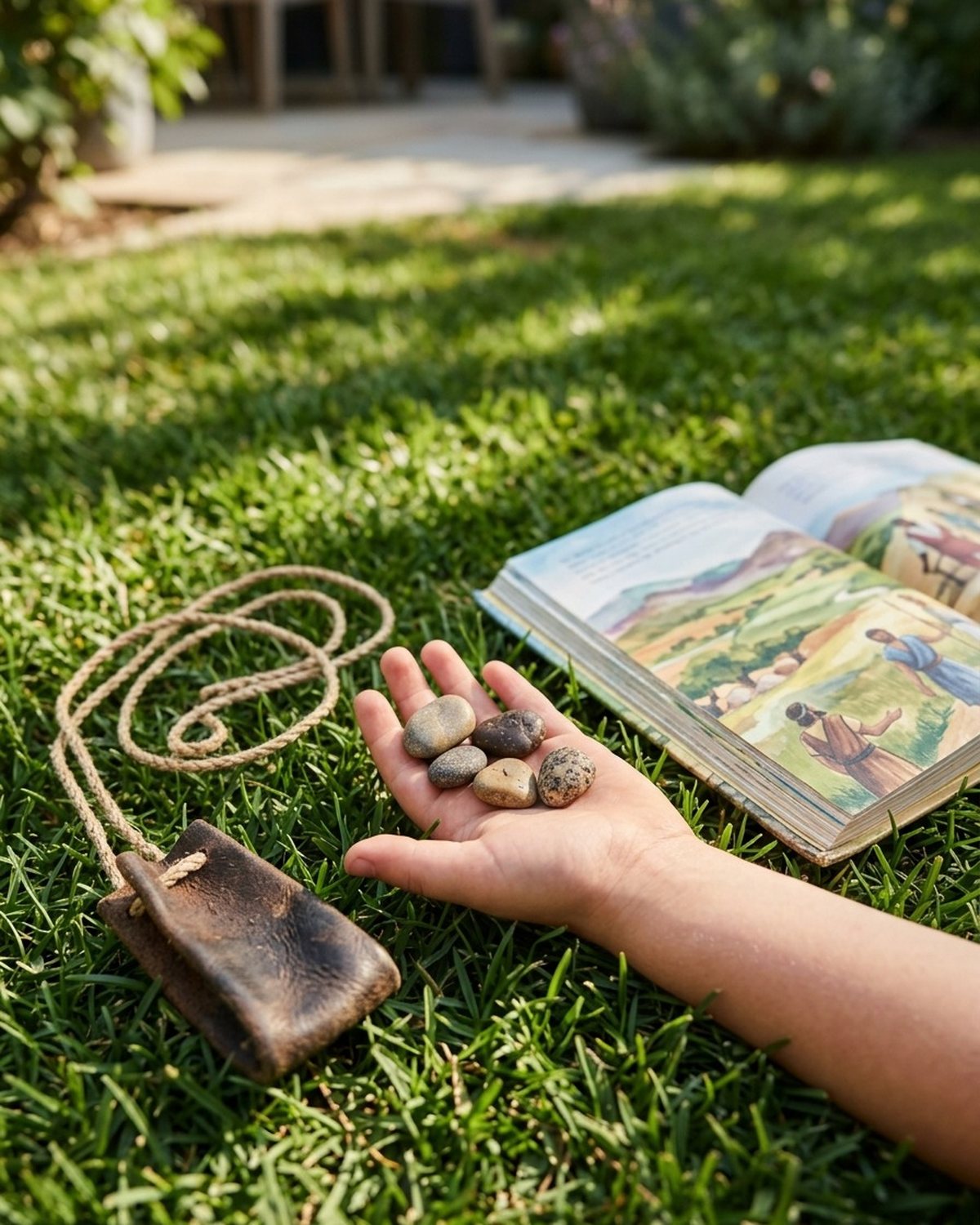
Five smooth stones. “Staff in hand, David selected five smooth stones from the wadi and put them in the pocket of his shepherd’s bag” (17:40). A wadi is a stream bed that fills with water in the rainy season, which is why the stones are smooth.
Two speeches. Goliath looks at David and sees that he is “youthful, ruddy, and handsome in appearance” (17:42), and he mocks him. David answers: “You come against me with sword and spear and scimitar, but I come against you in the name of the LORD of hosts, the God of the armies of Israel whom you have insulted” (17:45). He adds that “it is not by sword or spear that the LORD saves” and that “the battle belongs to the LORD” (17:47).
One stone. “David put his hand into the bag and took out a stone, hurled it with the sling, and struck the Philistine on the forehead. The stone embedded itself in his brow, and he fell on his face to the ground” (17:49). The narrator sums it up: “Thus David triumphed over the Philistine with sling and stone” (17:50). The Philistines run.
A note for grown-ups who read the whole chapter: in verse 55 Saul asks whose son this boy is, though David has been playing the harp for him since chapter 16. The NABRE footnote explains that from verse 12 the final editor brings in a second account of how David met Saul and Goliath (1 Samuel 17, notes) history. If an older child spots the seam, that is the explanation.
How tall was Goliath?
Children always ask. The NABRE text says “six cubits and a span” (17:4), and its footnote converts that to “about nine feet nine inches.” The same footnote adds that the Greek text and a Hebrew manuscript found at Qumran, 4QSama, read “four cubits and a span,” about six feet nine inches (1 Samuel 17, footnote on v. 4) Scripture. So “nine feet” from the cartoons is one reading, and a man the height of a tall basketball player is the other.
For a 10-year-old this is a first look at how the Bible reached us: copied by hand for centuries and compared by scholars today. The footnote also says why the chapter spends so long on Goliath’s size and weapons: to set them against a young David who trusts in God. For more places where the popular version and the text part ways (the apple, the whale, the “three kings”), see our table in Bible stories for kids.
What does David and Goliath mean? Not just “the underdog wins”
Told as a sports story, it’s about a brave boy and a lucky shot. David himself won’t tell it that way. Three times in ten verses he says who is acting: the LORD will deliver me (17:37), I come in the name of the LORD (17:45), the battle belongs to the LORD (17:47). Scripture David is brave, and he is good with a sling, but what he trusts in is God.
The chapter before says the same thing from the other side. When Samuel comes to Jesse’s house to anoint a king, he is impressed by the oldest son, and God tells him: “Do not judge from his appearance or from his lofty stature… God does not see as a mortal, who sees the appearance. The LORD looks into the heart” (1 Samuel 16:7). Pope Francis picked up this scene when he wrote to young people: David was chosen while still a boy out with the flock, and “the glory of youth is in the heart, more than in physical strength or the impression given to others” (Christus vivit 9) history.
The Catechism calls David the king “after God’s own heart” and says his prayer is “a loving and joyful trust in God” (CCC 2579) history. For a child, that becomes: God doesn’t need you to be big. He wants you to trust him.
Who was David after Goliath?
Shepherd and musician. Before the battle, Samuel anointed him “in the midst of his brothers” (16:13), and a servant recommended him to Saul as “a skillful harpist” (16:18). When Saul was troubled, “David would take the harp and play,” and Saul felt better (16:23).
Poet. Many psalms carry his name in their heading, including the one most children learn first: “A psalm of David. The LORD is my shepherd; there is nothing I lack” (Psalm 23:1). The shepherd boy wrote about God as a shepherd. The Catholic Encyclopedia of 1908 notes that the link between David and the psalms was so strong that “many ascribed the whole Psalter to him” (newadvent.org) tradition; the headings are where his name stands, and how many he wrote himself is a question for scholars.
King. “David was thirty years old when he became king, and he reigned forty years” (2 Samuel 5:4), first in Hebron and then in Jerusalem (5:5).
A big sin, and a real sorry. As king, David took another man’s wife, Bathsheba, and then arranged for her husband Uriah to be killed in battle. The Bible says plainly that “in the sight of the LORD what David had done was evil” (2 Samuel 11:27). The prophet Nathan came and told him, “You are the man!” David answered, “I have sinned against the LORD,” and Nathan replied, “the LORD has removed your sin” (2 Samuel 12:7, 13). Psalm 51 is headed as David’s prayer from that moment: “Have mercy on me, God, in accord with your merciful love” (51:3) and “A clean heart create for me, God” (51:12) (Psalm 51). The Catechism lists his repentance alongside his praise as “a model for the prayer of the people” (CCC 2579).
How much of this to say depends on the age. For a 5-year-old: “When David was king, he did something very wrong and hurt people. A prophet helped him see it. David told God he was sorry, and God forgave him.” For a child preparing for First Reconciliation (in second grade in many American dioceses; the Diocese of Toledo calls 2nd grade “the ordinary time”: toledodiocese.org), David is a gift: the hero of the Goliath story also needed to say “I have sinned,” and was forgiven.
Jesus’ ancestor. The first line of the New Testament: “The book of the genealogy of Jesus Christ, the son of David, the son of Abraham” (Matthew 1:1). The next time your child hears “Son of David” in a Gospel, they will know who that is.
How to tell David and Goliath at 3–6 and 7–12
Ages 3–6. Keep the shepherd, the lion and the bear, the big armor that didn’t fit, the five stones and David’s sentence. One sentence is enough for the ending.
“David was a shepherd boy who took care of his dad’s sheep. When a lion came, David saved the sheep, and he knew God helped him. One day a huge soldier called Goliath frightened everyone. David wasn’t afraid, because he trusted God. He took his sling and five smooth stones and said, ‘I come in the name of the Lord.’ One stone hit Goliath, Goliath fell down, and the other soldiers ran away.”
A question to ask afterwards: “What are you scared of? How could God help you with it?”
Ages 7–12. Tell the whole sequence: forty days, the food for the brothers, the lion and the bear, Saul’s armor, the stones, the two speeches. Then let your child read 17:37 and 17:45–47 aloud from a real Bible.
“Goliath had a helmet, armor and a huge spear. David had a stick, a sling and a bag of stones. But listen to what David says: ‘I come against you in the name of the LORD of hosts.’ Who does David think is going to win this fight?”
Questions for this age: Why did David take off Saul’s armor? What does David do in this story, and what does God do?
When your child asks if Goliath died. “Yes. It was a war, and the Bible tells it the way wars were fought then.” No details beyond verse 49, no jokes. Verse 51 tells what David did next with Goliath’s sword; a preschooler doesn’t need it, and an older child will read it on their own when they’re ready. If a child is frightened, go back to the shepherd and the sheep. That’s part of the story too.
Five stones: an activity for the whole family
This is our idea, not a custom from the Bible or from CCD. Before the fight, David remembered how God had helped him before (17:37). You can do the same.
- Find five smooth stones. On a walk, at a creek, in the yard. No stones? Five sticky notes work.
- One thing on each. With a marker or on a slip of paper: five times God helped you. A 4-year-old draws (a hospital, a new baby, a dog that came back). An older child writes one word: “surgery,” “new school,” “Grandma.” You write yours too.
- Tell each stone. One at a time, short: what happened, when.
- A shepherd’s bag. Put the stones in a drawstring pouch or a jar and leave it where everyone can see it.
- When fear comes. Before a test, a doctor’s visit or a first day somewhere new, take out one stone and remember. Then the sentence, modeled on 17:37: “The same God who helped me then will help me now.”
A stone isn’t a lucky charm. It’s a reminder, and your child can add new ones whenever they like. On evenings when the stones come out, Psalm 23 makes a good last prayer; more short ones in bedtime prayers for kids.
A good next story: Noah’s ark for kids.
As of October 2026. Scripture quotations from the New American Bible, Revised Edition.

Eryk Panter
I make HOSANNA! with my family, at our own table. I write the rules, dig through the sources and work on the pictures; the children play first and tell me straight what does not work. Here I write what I was looking for as a dad: how to talk with children about the saints, concretely, with sources and without sugar-coating.
Frequently asked questions
Where is the story of David and Goliath in the Bible?
In the First Book of Samuel, chapter 17. The whole encounter runs from verse 1 to verse 54; the key verses for children are 17:37 (the lion and the bear), 17:40 (five smooth stones), 17:45 (in the name of the LORD of hosts) and 17:49 (the stone in Goliath's forehead).
How tall was Goliath?
The New American Bible, Revised Edition says 'six cubits and a span,' which its footnote converts to about nine feet nine inches. The same footnote says the Greek text and a Hebrew manuscript from Qumran (4QSama) have 'four cubits and a span,' about six feet nine inches. Both readings are old; the NABRE prints the first and gives the second in the note.
Why did David pick up five stones?
The Bible doesn't say. 1 Samuel 17:40 tells us he chose five smooth stones from the wadi and put them in his shepherd's bag, and 17:49 says he took out one stone and slung it. Any reason you hear for the number five is a guess, not Scripture.
How old was David when he fought Goliath?
No age is given. Saul calls him 'only a youth' (1 Samuel 17:33), Goliath sees that he is 'youthful, ruddy, and handsome' (17:42), and he is the youngest of Jesse's sons (17:14). Later we read that he became king of Israel at thirty (2 Samuel 5:4), so the fight with Goliath was years before that.
What is the lesson of David and Goliath for kids?
That God can be trusted. David says the LORD who saved him from the lion and the bear will save him now (17:37) and that 'it is not by sword or spear that the LORD saves' (17:47). The Catechism calls David the king 'after God's own heart' and describes his prayer as 'a loving and joyful trust in God' (CCC 2579).
How do I explain to my child that Goliath died?
Briefly and calmly, in the same voice as the rest of the story: the stone hit Goliath's forehead, he fell, and the Philistines ran away. A preschooler needs nothing more. An older child can hear that this was a war and that the Bible describes it the way wars happened then.
Sources
Marks: [H] — Scripture, document, recorded fact · [T] — tradition, legend, custom · [N] — Church teaching · [D] — study, data.
- HNew American Bible, Revised Edition: 1 Samuel 17 with footnotes on Goliath's height (Greek text and 4QSama) and on the chapter's two accounts (bible.usccb.org)
- HNew American Bible, Revised Edition: 1 Samuel 16, the anointing of David and the harp (bible.usccb.org)
- HNew American Bible, Revised Edition: 2 Samuel 5:3–5, David king at thirty (bible.usccb.org)
- HNew American Bible, Revised Edition: 2 Samuel 11 and 12, David's sin and Nathan (bible.usccb.org)
- HNew American Bible, Revised Edition: Psalm 51 and Psalm 23 (bible.usccb.org)
- HNew American Bible, Revised Edition: Matthew 1:1, Jesus 'the son of David' (bible.usccb.org)
- NCatechism of the Catholic Church 2578–2580: David and the prayer of the king (vatican.va)
- NPope Francis, Christus vivit (2019), no. 9: David chosen as a boy (vatican.va)
- TCatholic Encyclopedia (1908): David (newadvent.org)
- NDiocese of Toledo: First Communion, 2nd grade as the ordinary time, Reconciliation first