In most picture books Noah’s ark is a cheerful boat full of giraffes with a rainbow on top. Genesis tells a longer and quieter story: a man who says nothing and does what God asks, more than a year of waiting, a dove sent out three times, and a promise made to every living creature. Below is the story as the New American Bible tells it, the details picture books added, how the Church reads it, and how to tell it to a 4-year-old and a 10-year-old without the flood taking over.
What does Genesis actually say about Noah’s ark?
The story runs from Genesis 6 to Genesis 9. In order:
God is grieved, and Noah is different. The world is full of wickedness, and “his heart was grieved” (Genesis 6:6). Then: “But Noah found favor with the LORD” (6:8). Noah is “a righteous man and blameless in his generation,” and “Noah walked with God” (6:9). Scripture
The ark. God tells him: “Make yourself an ark of gopherwood” (6:14), three hundred cubits long, fifty wide and thirty high (6:15), with “an opening for daylight,” an entrance on the side, and “bottom, second and third decks” (6:16). The NABRE footnote takes a cubit, elbow to fingertip, as “about eighteen inches” and puts the ark at “approximately 440 × 73 × 44 feet”: longer than a football field with both end zones, and shaped more like a long box than a boat.
Noah obeys. “Noah complied; he did just as God had commanded him” (6:22). Through the whole flood story he doesn’t say a word.
Into the ark. God says the rain will start in seven days (7:4). Noah goes in with his wife, his sons Shem, Ham and Japheth, and their three wives (7:13): eight people. The animals come “two by two, male and female” (7:9). Then a line children remember: “Then the LORD shut him in” (7:16).
The flood. “For forty days and forty nights heavy rain poured down on the earth” (Genesis 7:12), and the waters stay high for a hundred and fifty days (7:24). Everything living on dry land dies; only Noah and those with him in the ark are left (7:23).
God remembers. Chapter 8 turns on its first words: “God remembered Noah and all the animals, wild and tame, that were with him in the ark” (Genesis 8:1). The ark comes to rest “on the mountains of Ararat” (8:4).
The raven and the dove. Noah opens the hatch and sends out a raven, which flies “back and forth” (8:7). Then a dove, which finds nowhere to land, and Noah, “putting out his hand,” draws it back inside (8:9). Seven days later: “In the evening the dove came back to him, and there in its bill was a plucked-off olive leaf!” (8:11). Seven days after that, “it did not come back” (8:12).
Out of the ark, and a promise. Noah waits until God says “Go out of the ark” (8:16). He builds an altar (8:20), and God promises that “seedtime and harvest, cold and heat, summer and winter, and day and night shall not cease” (8:22). Then the covenant with Noah, his descendants and every living creature: never again a flood that destroys all life (9:11). Its sign: “I set my bow in the clouds to serve as a sign of the covenant between me and the earth” (Genesis 9:13). Scripture
Two by two, or seven pairs?
Both are in the Bible. Genesis 6:19 says “two of every kind… one male and one female.” A chapter later God says: “Of every clean animal, take with you seven pairs, a male and its mate,” the same for every bird, “and of the unclean animals, one pair” (7:2–3). Scripture
The NABRE footnote on Genesis 6:5–8:22 explains why. Scholars usually read the flood story as two older accounts woven together, which the notes call the Priestly and the Yahwist sources. In the Priestly account it is one pair of each kind, with no difference between clean and unclean; in the Yahwist account it is seven pairs of the clean animals, and in 7:2 one pair of the unclean. The note on 6:19–21 says why the extra clean animals are there: for food and for the sacrifice Noah offers when he leaves the ark (8:20).
For a small child, “at least two of every kind” is true to both. A 10-year-old will enjoy finding the two verses and reading them side by side. It’s a good first lesson that a Bible has footnotes, and that they’re worth reading.
What did picture books add to the story?
You don’t need to take these away from your child. Just say: “That’s how people usually tell it. Here’s what the Bible says.”
| What we usually hear | What Genesis says (NABRE) |
|---|---|
| The animals went in two by two | Pairs, yes (7:9), and seven pairs of clean animals and birds (7:2–3) Scripture |
| Noah was in the ark for forty days | It rained forty days (7:12); Noah was inside from the 17th day of the second month (7:11) to the 27th day of the second month of the next year (8:13–14), a little over a year Scripture |
| The dove brought an olive branch | “A plucked-off olive leaf” (8:11); the branch is how artists draw it tradition |
| The ark landed on Mount Ararat | “The mountains of Ararat” (8:4); the footnote says this is a region, not a single named peak Scripture |
| A small round boat with a cabin on top | A box about 440 feet long, with three decks and a door in the side (6:15–16) Scripture |
| The unicorns missed the boat | Not in the Bible. It’s “The Unicorn,” a song Shel Silverstein wrote in 1962 and The Irish Rovers made a hit in 1968 (Wikipedia) |
The story also doesn’t end at the rainbow. Genesis 9:20–27 tells a sad family episode after the flood. It can wait until your child reads Genesis on their own.
How do Catholics read the story of Noah?
As a picture of baptism. This reading isn’t a later idea; it’s in the New Testament. The First Letter of Peter speaks of the ark, “in which a few persons, eight in all, were saved through water,” and ties it to baptism (1 Peter 3:20–21). The Catechism says: “The Church has seen in Noah’s ark a prefiguring of salvation by Baptism, for by it ‘a few, that is, eight persons, were saved through water’” (CCC 1219) history, and quotes a prayer over the baptismal water: “The waters of the great flood you made a sign of the waters of Baptism.” The NABRE note on 1 Peter puts it simply: “As Noah’s family was saved through water, so Christians are saved through the waters of baptism” (bible.usccb.org). If you have your child’s baptismal candle or photos, this is the moment to bring them out.
The dove. The Catechism lists the dove among the symbols of the Holy Spirit and joins two scenes: Noah’s dove, which “returns with a fresh olive-tree branch in its beak as a sign that the earth was again habitable,” and the Spirit coming down “in the form of a dove” when Jesus comes up from the water of his baptism (CCC 701) history.
A covenant with everyone. The covenant with Noah, the Catechism says, “gives expression to the principle of the divine economy toward the ‘nations’,” and Scripture honors “the upright ‘Noah, Daniel, and Job’” among the great figures outside Israel (CCC 56, 58). The NABRE footnote on Genesis 9 notices something children love: God makes the covenant “remarkably, with all the animals who come out of the ark.” Scripture
Noah’s faith. The Letter to the Hebrews sums him up: “By faith Noah, warned about what was not yet seen, with reverence built an ark for the salvation of his household” (Hebrews 11:7). Scripture
Older children will ask whether it all happened exactly like this. Take the question seriously. The NABRE footnotes themselves say the story is woven from two sources and shares features with older Mesopotamian flood stories, such as the birds sent out in the Gilgamesh Epic (note on 8:7–12). The Church reads Scripture for what its authors meant to teach; more on that in Bible stories for kids. “Let’s find out together” is a good answer, and so is your parish’s director of religious education.
In Advent, Noah has his own day on many Jesse Tree calendars: on the Catholic Culture version it’s Day 4, with an ark, the animals, a dove with a branch or a rainbow as the ornament, and short readings from Genesis 6–9 that end with the bow in the clouds (9:12–13) tradition. More Advent ideas for home are in Advent with kids.
How do you tell the flood story without scaring your child?
The middle of this story is sad. The spine of it is rescue and a promise, and that’s where to spend your time.
- Start with Noah, not the water. Noah was God’s friend and did what God asked. That’s what a 4-year-old should remember first.
- Keep the middle short and the ending long. “It rained for a very long time, and everyone in the ark was safe” is enough for the flood. Linger over the dove and the rainbow.
- Give them Genesis 8:1. “God remembered Noah” is a good sentence for bedtime, because a child hears in it that God remembers them too. It fits well after bedtime prayers.
- When they ask about the other people and animals, tell the truth calmly: the Bible says they died, and that is sad. Then say what comes next: God’s heart was grieved by the evil in the world (6:6), and afterward he promised never to do it again (9:11).
- If your child is already afraid of storms, go gently. Nemours KidsHealth suggests you “let them know you understand their feelings,” tell them they’re safe once the storm has passed, and learn about storms together, with weather books from the library (KidsHealth).
- If they don’t want to hear it, stop and come back another day.
Noah’s ark by age: what to tell and what to ask
| Age | What to tell | Question to ask | Something to do |
|---|---|---|---|
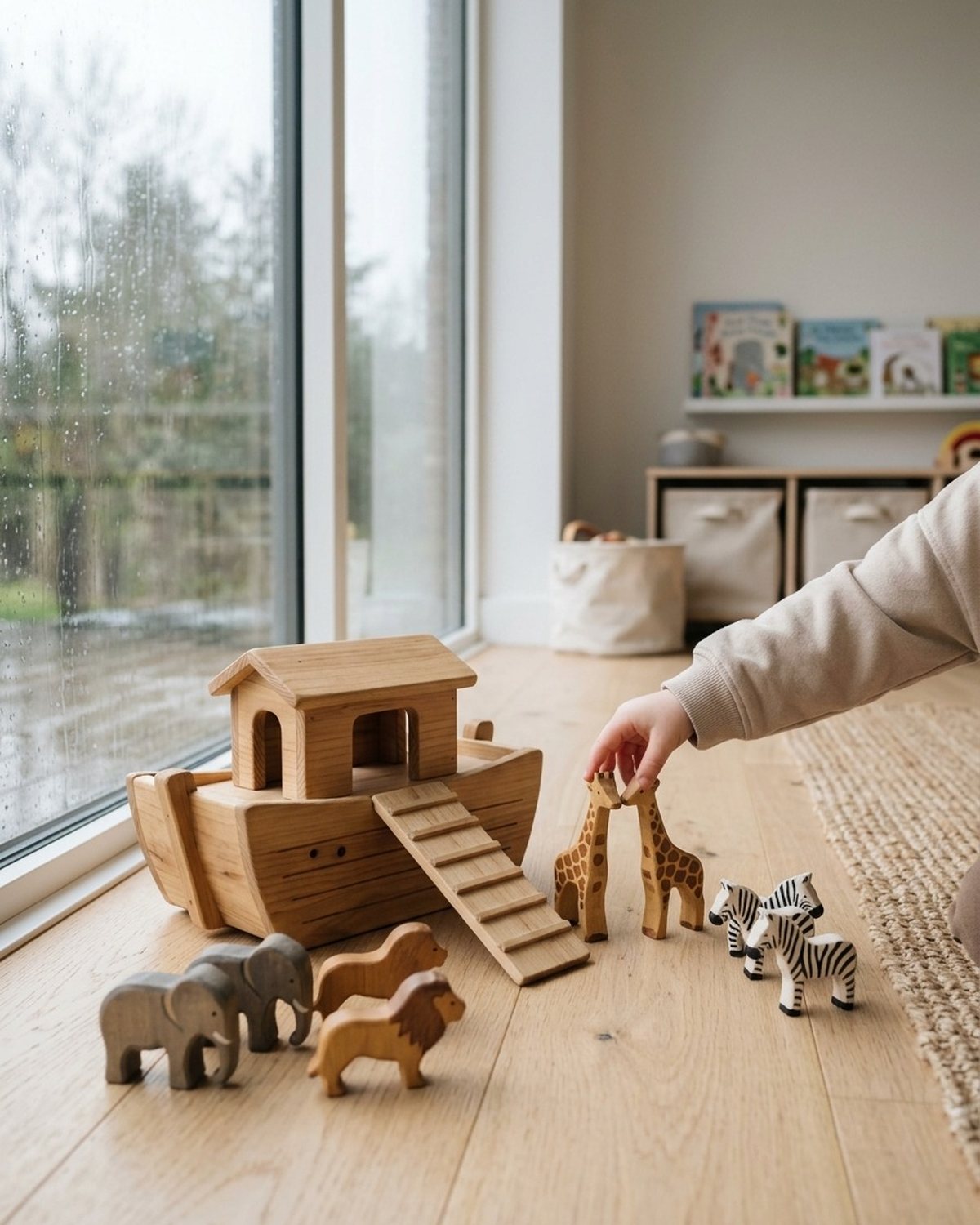
| 3–5 | Noah listened to God and built a big ark. The animals came in pairs. After the rain, the dove brought a leaf, and God put a bow in the sky. | What did the dove bring back? | Find the pairs among toy animals and march them into the ark |
| 6–8 | The whole story in order: seven days of waiting, forty days of rain, the raven, the dove three times, the altar, the rainbow | Why did the dove come back the first time? | Build the shoebox ark below; count the days on a calendar |
| 9–12 | The table of what picture books added, the two counts of animals, the covenant with every creature, the ark and baptism (1 Peter 3:20–21) | Where does the Bible say “two by two,” and where “seven pairs”? | Find Genesis 6–9 in a real Bible and read 8:6–12 aloud |
Ready sentences, if you need them.
For a 3–6-year-old: “Noah loved God, and God asked him to build a big, big boat called an ark. Noah, his family and the animals went inside, and God shut the door. It rained and rained, but in the ark everyone was safe. When the rain stopped, a dove flew out and came back with a green leaf. Then God put a rainbow in the sky and said, ‘I promise.’”
For a 7–12-year-old: “Noah never says a word in the whole flood story. He just does what God asks, and then he waits for more than a year, until God tells him he can come out. What do you think was harder for him: building the ark, or waiting?”
A shoebox ark: a craft for a rainy afternoon
Things you already have, and every step has a verse.
- The box. A shoebox, or any long box. Noah’s ark is 300 by 50 by 30 cubits (6:15), a ratio of 30 : 5 : 3. A model 15 inches long would be only 2½ inches wide and 1½ inches high; your shoebox will be much chubbier, which is worth talking about.
- A door on the side and three decks. Cut a door into the long side (6:16) and tape two strips of cardboard inside as decks.
- A window. Leave a gap under the lid. That’s the hatch Noah opens to send out the birds (8:6).
- The animals. Toy animals, or drawings on scraps of paper, two of each. A younger child finds the pairs and brings them through the door: “one, two.” An older one adds birds by seven pairs (7:3) and counts how many there are altogether.
- The dove and the leaf. Cut a white dove and a small green leaf from paper. First flight: the dove comes back with nothing. Second: with the leaf. Third: it doesn’t come back.
- The rainbow. Draw a bow in rainbow colors over the ark and read Genesis 9:13 together.
When the ark is done, leave it out for a few days. After a night or two, let your child tell you the story, ark in hand.
As of October 2026. Scripture quotations from the New American Bible, Revised Edition.

Eryk Panter
I make HOSANNA! with my family, at our own table. I write the rules, dig through the sources and work on the pictures; the children play first and tell me straight what does not work. Here I write what I was looking for as a dad: how to talk with children about the saints, concretely, with sources and without sugar-coating.
Frequently asked questions
How many animals did Noah take on the ark?
Genesis gives two counts. In Genesis 6:19 and 7:9 the animals come in pairs, 'two by two, male and female' (7:9). In Genesis 7:2–3 God tells Noah to take seven pairs of every clean animal and every bird, and one pair of the unclean animals. The NABRE footnotes explain that two older accounts are woven together here. For a small child, 'at least two of every kind' is true to both.
How long was Noah on the ark?
The rain lasted forty days and forty nights (Genesis 7:12), but Noah was inside for a little over a year. The flood began on the seventeenth day of the second month of his six hundredth year (7:11), and the earth was dry on the twenty-seventh day of the second month of the following year (8:13–14). He came out only when God told him to (8:15–16).
What did the dove bring back to Noah?
On its second flight the dove came back in the evening with 'a plucked-off olive leaf' in its bill (Genesis 8:11, NABRE), and Noah knew the waters had gone down. Pictures usually show a whole olive branch; the Catechism also speaks of a branch (CCC 701). After seven more days the dove flew off and did not come back.
What does the rainbow mean in the story of Noah?
It is the sign of God's covenant with Noah, his descendants and every living creature: 'I set my bow in the clouds to serve as a sign of the covenant between me and the earth' (Genesis 9:13). God promises that a flood will never again destroy all life (9:11), and says that when the bow appears in the clouds he will remember the covenant (9:16).
Why do Catholics connect Noah's ark with baptism?
Because the New Testament does: the First Letter of Peter links the eight people saved through water in the ark to baptism (1 Peter 3:20–21). The Catechism says the Church sees in the ark 'a prefiguring of salvation by Baptism' (CCC 1219), and treats the dove with the olive leaf as one of the symbols of the Holy Spirit (CCC 701).
Did the unicorns really miss Noah's ark?
No, that is not in the Bible. It comes from 'The Unicorn,' a song written by Shel Silverstein in 1962 and made a hit by The Irish Rovers in 1968, in which the unicorns are too busy playing to get on board.
Sources
Marks: [H] — Scripture, document, recorded fact · [T] — tradition, legend, custom · [N] — Church teaching · [D] — study, data.
- HNew American Bible, Revised Edition: Genesis 6, with notes on the two sources of the flood story and on the cubit (bible.usccb.org)
- HNew American Bible, Revised Edition: Genesis 7 (bible.usccb.org)
- HNew American Bible, Revised Edition: Genesis 8, with notes on Ararat and the birds (bible.usccb.org)
- HNew American Bible, Revised Edition: Genesis 9, with note on the covenant (bible.usccb.org)
- HNew American Bible, Revised Edition: 1 Peter 3, note on 3:13–22 (bible.usccb.org)
- H1 Peter 3:20, parallel translations including the NABRE (biblehub.com)
- HNew American Bible, Revised Edition: Hebrews 11:7 (bible.usccb.org)
- NCatechism of the Catholic Church 56–58: the covenant with Noah (vatican.va)
- NCatechism of the Catholic Church 701: the dove (vatican.va)
- NCatechism of the Catholic Church 1219: Noah's ark and Baptism (vatican.va)
- TCatholic Culture: Jesse Tree, Day 4 — Noah
- DNemours KidsHealth: Storm Stress, Helping Kids Stay Calm (reviewed Aug 2023)
- DWikipedia: The Unicorn (song), Shel Silverstein 1962, The Irish Rovers 1968