Two things happen at home in the last week of Advent that a child can actually take part in: the nativity scene fills up, figure by figure, and the family goes to Mass at an unusual hour. Below: who belongs in the manger, when the figures go in, the US bishops’ blessing for the manger, the four Christmas Masses, and a checklist for getting a three-year-old through any of them.
Where does the nativity scene come from?
The custom as we know it goes back to St. Francis of Assisi and Christmas 1223 in Greccio, a hill town north of Rome. Pope Francis retold the story in his 2019 letter on the nativity scene, Admirabile signum: fifteen days before Christmas, Francis asked a local man named John to help him “bring to life the memory of that babe born in Bethlehem,” and when he arrived “he found a manger full of hay, an ox and a donkey.” Mass was celebrated at the manger. history
What stood there is told two ways. The earliest account, by Francis’s first biographer Thomas of Celano (First Life, nos. 84–86), lists only this: “the manger is prepared, the hay is carried in, the ox and the ass are led to the spot,” and Mass is celebrated over the manger. No figure of Mary, Joseph or the Child. The Pope follows him: “At Greccio there were no statues; the nativity scene was enacted and experienced by all who were present.” history The 1908 Catholic Encyclopedia has Francis group “figures of the Blessed Virgin and St. Joseph, the ass, the ox, and the shepherds” around the crib; that is the later telling, not Celano’s. Celano also reports that a man present saw “a little child lying lifeless in the manger” and Francis wake him; the National Catholic Register names him as John (Giovanni Velita). A reported vision, not a figure. tradition
Francis did not invent devotion to the crib: the Encyclopedia calls it “no doubt of very ancient origin,” and relics venerated as boards of the manger were kept at St. Mary Major in Rome, probably since Pope Theodore (640–649). He made it something ordinary people could stand in front of, with less than the set on your mantel: hay, two animals, a Mass.
Who’s who in the nativity scene
| Figure | In the Bible? | One line for a child |
|---|---|---|
| Mary | Scripture Luke 2:7, 2:16 | “She said yes to God, and here is the baby.” |
| Joseph | Scripture Luke 2:16; Matthew 1–2 | “He kept them safe. In the Gospels he never says a word.” |
| Baby Jesus | Scripture Luke 2:7: “wrapped him in swaddling clothes and laid him in a manger” | “God became a baby, as small as you were.” |
| The manger | Scripture Luke 2:7, 2:12, 2:16 | “It’s a feeding box for animals. That was his first bed.” |
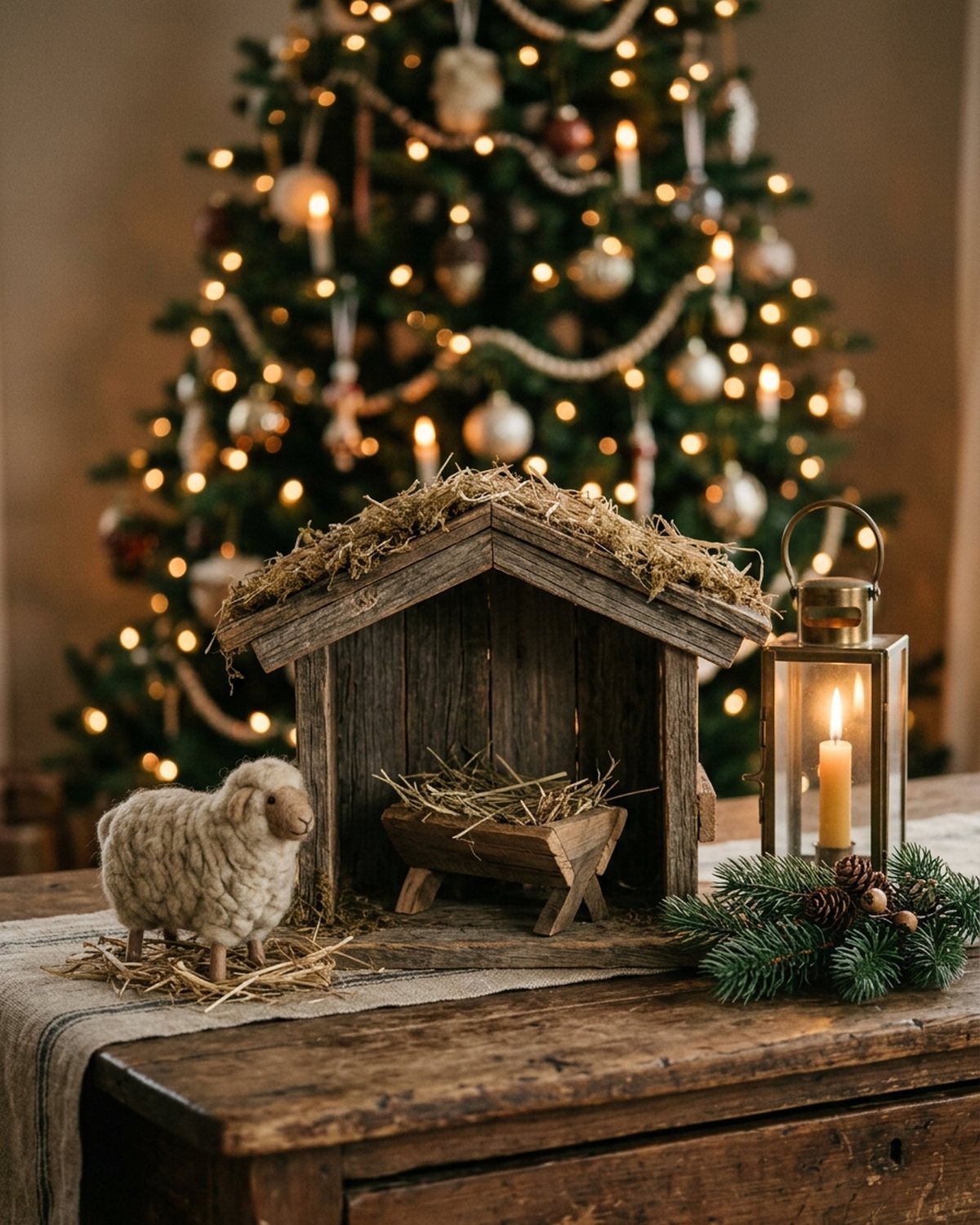
| The stable | tradition Luke has a manger and “no room for them in the inn,” no building | “Nobody knows what it looked like. Somewhere animals eat.” |
| Shepherds and sheep | Scripture Luke 2:8: “keeping the night watch over their flock” | “They were the first visitors, and they came at night.” |
| The angel | Scripture Luke 2:9–14, one angel, then “a multitude of the heavenly host” | “The angel said: don’t be afraid. Then the whole sky sang.” |
| Angel wings | tradition art, not the Gospel text | “Painters gave angels wings to show they come from heaven.” |
| Ox and donkey | tradition Isaiah 1:3: “An ox knows its owner, and an ass, its master’s manger” | “The animals knew who he was before the people did.” |
| The Magi | Scripture Matthew 2:1–11: “on entering the house they saw the child with Mary his mother” | “They came later, from far away, following a star.” |
| Three kings with crowns | tradition Matthew says magi, gives three gifts, no number, no crowns | “Three gifts, so people guessed three visitors.” |
| The star | Scripture Matthew 2:2: “We saw his star at its rising” | “The star was for the Magi. The shepherds got an angel.” |
Sources: Luke 2, Matthew 2, Isaiah 1, all NABRE. The USCCB footnote on Luke 2:7 explains that a manger is a feeding trough and notes a possible echo of Isaiah 1:3; the Catholic Encyclopedia calls the two animals “a very ancient tradition.” So the ox and donkey are a prophecy painted into the scene, and a seven-year-old can take that distinction.
A nativity scene puts everyone in the same room at once; the Gospels do not. Luke’s shepherds come the night of the birth; Matthew’s magi come to a house, and Herod’s order against boys “two years old and under” (Matthew 2:16) suggests time had passed.
When do you add Baby Jesus and the Magi?
None of this is a rule, only a custom that gives children something to do with the set every week of Advent tradition.
- Start of Advent: the empty stable, hay, the ox and the donkey. (For the weeks before this, see Advent with kids.)
- The last days before Christmas: Mary and Joseph. Some families walk them across the house, a shelf a day, as if from Nazareth.
- Christmas Eve: the Baby. Admirabile signum speaks of the moment “when, at Christmas, we place the statue of the Infant Jesus in the manger.” Most families do it after the Vigil Mass or at bedtime. The Diocese of Orange’s OC Catholic has another version: “Some parents add baby Jesus overnight on Christmas Eve as a surprise for the children on Christmas morning.”
- Christmas Day: the shepherds, sheep and angel.
- Epiphany: the Magi. “As the feast of Epiphany approaches, we place the statues of the Three Kings in the Christmas crèche,” the Pope writes. In the United States Epiphany is the Sunday between January 2 and 8, so Sunday, January 3, 2027 (USCCB calendar 2027). In England and Wales it stays on January 6, a Wednesday in 2027, and is a holy day of obligation (CBCEW). The OC Catholic article passes on a game: the Magi start somewhere far from the manger, move to a different room each day, and the children hunt for them each morning until they arrive at Epiphany. What to do when they arrive is in Epiphany: chalk the door.
Which set? Kid-safe or heirloom
With a toddler, both. A sturdy set, resin or wood, goes at child height and may be played with. The heirloom set, the porcelain one from a grandmother, goes on the mantel and is handled with a child’s hand on top of an adult’s. The Baby goes into both on Christmas Eve.
Blessing of the nativity scene at home
The US bishops’ Catholic Household Blessings and Prayers has a Blessing of a Christmas Manger or Nativity Scene for a parent to lead. The rubric says it may take place on the Vigil of Christmas or another suitable time, and that when the manger is set up at home, a parent or another family member blesses it. Everyone makes the sign of the cross; the leader says “Our help is in the name of the Lord” and the family answers “Who made heaven and earth.” Someone reads Luke 2:1–8 (or Isaiah 7:10–15), and the leader, hands joined, prays that God bless all who look on the manger, so that it reminds them of Jesus’ humble birth and lifts their thoughts to him, God-with-us and Savior of all. Everyone says Amen.
Five minutes, one reading, one prayer. A six-year-old can hold the Baby during the reading and put him in at “Amen.”
What are the four Christmas Masses?
The Roman Missal has four different Masses for Christmas, each with its own readings, which is why parish schedules get confusing. Fr. Edward McNamara’s liturgy column at EWTN lays them out: the Vigil Mass on the evening of December 24; the Mass during the Night, the first Mass of December 25, “Midnight Mass” in English though the Latin only says “during the night”; the Mass at Dawn; and the Mass during the Day. The readings move from Matthew’s genealogy at the Vigil to John’s prologue during the Day (Fr. Raymond de Souza). history
What your parish offers varies. Three schedules from Christmas 2025:
| Parish | Christmas Eve | Christmas Day |
|---|---|---|
| Holy Family, Orange, Calif. | 4:00 pm Children’s Mass (and a second 4:00 pm in the hall), 6:00 pm; 11:00 pm Mass during the Night, choir from 10:30 pm | 7, 9, 11 am, 1 pm (Spanish) |
| Sacred Heart, Tampa, Fla. | 4 pm Family, 6 pm, 8 pm; carols at 10:30 pm, 11 pm Mass during the Night | 7:30, 9, 10:30 am, noon |
| St. Peter, Cambridge, Mass. | 4:00 pm Family Mass (“bring a bell to ring”), 6:00 pm Vigil; no Midnight Mass | 10:00 am, the only Mass |
Three things to notice. In all three the 4 pm Christmas Eve Mass is the family Mass; de Souza says parishes moved to early vigils, “sometimes as early as 4 p.m.!”, for convenience, and he is not a fan. “Midnight” Mass is at 11 pm in two and does not exist in the third. Fr. McNamara holds that the Night Mass, as the first Mass of December 25, should not start before midnight, allowing only a start moved slightly forward so that it runs into the night; parishes that schedule 11 pm read it more loosely. And none of the three has an evening Mass on December 25, so a family that sleeps through the morning has missed it.
Whether it counts is not in doubt. Canon 1248 says the obligation is met by Mass “either on the day of the feast or on the evening preceding,” so the 4 pm Vigil fulfills Christmas (Catholic Answers). Christmas is a holy day of obligation everywhere; the USCCB 2027 calendar also marks January 1, 2027, a Friday, as one in the US.
Which one with a small child? The 4 pm Mass is loud, crowded and full of other children. The Night Mass is dark, has carols first, and lands when an overtired three-year-old either falls asleep on you or falls apart. Both are fine; a Dawn Mass, where a parish has one, is the sleeper pick.
Christmas Mass with kids: the checklist
The American Academy of Pediatrics counts a child’s sleep over 24 hours, naps included, and says regular lack of it “often leads to some pretty difficult behaviors” (HealthyChildren.org). So a late Christmas Eve is planned in the afternoon.
By mid-December
- Mass time from the parish bulletin or website, on the calendar with an arrive-by time 20 minutes earlier
- decide: 4 pm, Night, or Christmas morning; for a child under 5, even an 11 pm Mass is a very late night
- if the 4 pm Mass has a children’s pageant, ask the religious education office whether your child can be a sheep; sheep need no lines
December 24, afternoon
- nap, or an hour on the bed with books, before anything festive starts
- tell the child the order: “dark church, singing, Father reads the shepherd story, home, bed”
- set out the last figures together; the Baby waits beside the manger for tonight
Before you leave
- layers: churches are cold at the door and hot in the pew
- pajamas under the coat for the youngest, if you’re going at night
- water bottle, tissues, one quiet board book with a nativity picture; no toys that make noise
- a snack in the car for the way back, not in the pew
At church
- arrive early enough for an aisle seat near the back, the exit for a crying toddler
- visit the parish nativity scene before Mass; that is where “find Joseph” happens
- a whispered “find the…” game during Mass: the star, the manger, the white vestments
- if the child falls asleep in your arms during the Gloria, that is participation; leave them
- the cry room or narthex is not failure; it is where the toddlers go
The longer version, including what the Church asks of children under seven, is in Mass with toddlers.
What to say before the Night Mass
Ages 3–6: “We’re going to church at night, like the shepherds. It will be dark and there’ll be singing. If you get tired, lean on me and close your eyes.”
Ages 7–12: “The shepherds were Jesus’ first visitors, and they came at night, so the Church celebrates at night. Listen for the Gospel: it’s the scene in our nativity set, the manger and the swaddling clothes.”
A footnote from Poland, where HOSANNA! was first printed: there Christmas Eve (Wigilia), a meatless supper at the first star followed by Midnight Mass, is the main event. No need to import it.
A child who moved Mary and Joseph along the bookshelf through Advent puts the Baby in on Christmas Eve, then hears the priest read the line they already know: “She wrapped him in swaddling clothes and laid him in a manger.” If your child’s class is acting it out, the five-scene version is in the nativity play script for kids.
As of October 2026. Mass times are set by each parish; check the bulletin. Scripture quotations from the New American Bible, Revised Edition.

Eryk Panter
I make HOSANNA! with my family, at our own table. I write the rules, dig through the sources and work on the pictures; the children play first and tell me straight what does not work. Here I write what I was looking for as a dad: how to talk with children about the saints, concretely, with sources and without sugar-coating.
Frequently asked questions
Who is in the nativity scene according to the Bible?
From Luke 2: Mary, Joseph, the infant wrapped in swaddling clothes and lying in a manger, the shepherds who kept the night watch, and an angel with a multitude of the heavenly host. From Matthew 2: the magi from the east with gold, frankincense and myrrh, who entered a house, not a stable. The ox and the donkey are not in either Gospel; they come from Isaiah 1:3 and from St. Francis's nativity at Greccio.
When do you put Baby Jesus in the nativity scene?
There is no rule, only a custom. Most Catholic families keep the manger empty through Advent and place the Baby on Christmas Eve, after the Vigil Mass or at bedtime. Some parents put him in overnight so the children find him on Christmas morning. Pope Francis's letter Admirabile signum describes placing the figure of the Infant Jesus in the manger at Christmas.
When do the Wise Men go into the nativity scene?
At Epiphany. In the United States Epiphany is celebrated on the Sunday between January 2 and 8, so in the 2026–27 season it falls on Sunday, January 3, 2027. In England and Wales it is kept on January 6 itself (Wednesday in 2027). Many families start the Magi in a far room after Christmas and move them to a different spot each day until they reach the manger.
What are the four Christmas Masses?
The Roman Missal gives four Mass formularies for Christmas, each with its own readings: the Vigil Mass on the evening of December 24, the Mass during the Night (traditionally 'Midnight Mass'), the Mass at Dawn and the Mass during the Day on December 25. A parish does not have to celebrate all four. Attending any one of them fulfills the Christmas obligation.
What time is Midnight Mass?
Not always midnight. The Latin name is 'Mass during the Night', and many US parishes start it at 11 pm, often with carols or a choir from 10:30. Some liturgists, such as Fr. Edward McNamara, argue it should not begin before midnight. Some parishes have no night Mass at all and run several Christmas Eve Masses instead, starting at 4 pm. Check your parish bulletin or website in mid-December.
Does Christmas Eve Mass count for Christmas?
Yes. Canon 1248 says the obligation is fulfilled by attending Mass on the feast day itself or on the evening of the preceding day. A 4 pm or 6 pm Mass on December 24 counts for Christmas. In a year when Christmas Eve is a Sunday, one Mass cannot cover both the Sunday and Christmas: two obligations, two Masses.
Is Christmas a holy day of obligation?
Yes, everywhere. In the United States the USCCB liturgical calendar for 2027 (which opens with Advent 2026) marks December 25, 2026 and January 1, 2027 (Mary, Mother of God, a Friday) as holy days of obligation. In England and Wales the Epiphany, January 6, is also a holy day of obligation since 2017.
Sources
Marks: [H] — Scripture, document, recorded fact · [T] — tradition, legend, custom · [N] — Church teaching · [D] — study, data.
- HLuke 2 — the birth of Jesus and the visit of the shepherds, New American Bible, Revised Edition (bible.usccb.org)
- HMatthew 2 — the visit of the magi, New American Bible, Revised Edition (bible.usccb.org)
- TIsaiah 1:3 — 'An ox knows its owner, and an ass, its master's manger', NABRE (bible.usccb.org)
- NPope Francis, Apostolic Letter Admirabile signum on the meaning and importance of the nativity scene (1 December 2019, vatican.va)
- HThomas of Celano, First Life of St. Francis, nos. 84–86: Greccio (English text, brothersofpeace.org)
- HCatholic Encyclopedia: Crib (newadvent.org, 1908)
- HNational Catholic Register / CNA: St. Francis and the Story of the First Nativity Scene (Hannah Brockhaus, 23 December 2022)
- NUSCCB: Blessing of a Christmas Manger or Nativity Scene (Catholic Household Blessings and Prayers, PDF)
- HUSCCB: Liturgical Calendar for the Dioceses of the United States of America 2027 (PDF)
- HCatholic Bishops' Conference of England and Wales: Holydays of Obligation — England and Wales
- NCatholic Answers: Christmas Mass Obligation (canon 1248)
- NFr. Edward McNamara, EWTN/ZENIT: Midnight Mass and 9 p.m. (23 December 2008)
- NFr. Raymond J. de Souza, Catholic Education Resource Center: What time is midnight Mass? (Catholic Register, 17 December 2010)
- DHoly Family Catholic Church, Orange, California (Diocese of Orange): The Nativity of the Lord — Christmas Mass schedule 2025
- DSacred Heart Catholic Church, Tampa, FL: Our Christmas Mass Schedule 2025
- DSt. Peter Parish, Cambridge, Massachusetts (Archdiocese of Boston): Christmas Mass Schedule 2025
- TOC Catholic (Diocese of Orange): Catholic Nativity Traditions (Cathi Douglas, 13 December 2018)
- DHealthyChildren.org (American Academy of Pediatrics): Healthy Sleep Habits — How Many Hours Does Your Child Need?