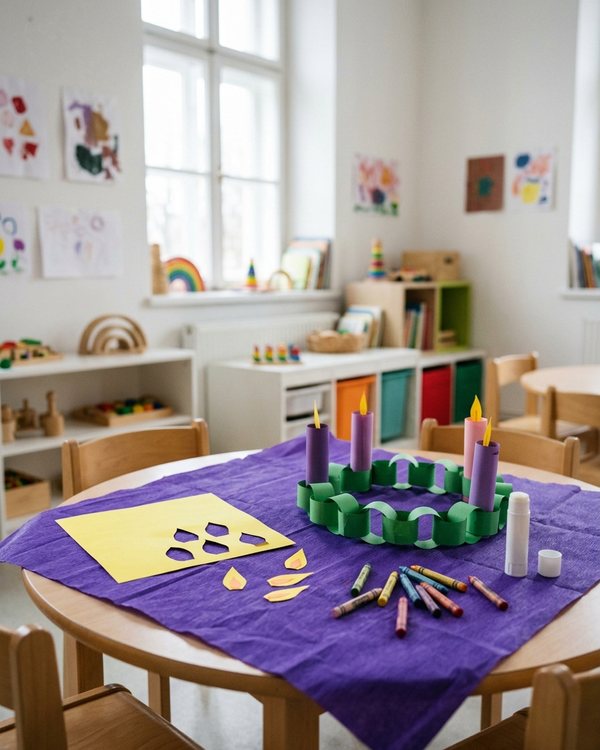

If your child comes home from religious ed and announces that December 8 is “when Mary got pregnant with Jesus,” they are in good company. Plenty of adults think the same. It is wrong, but it is the most natural mistake in the calendar, and clearing it up takes two minutes. Below: what the feast means, the table that keeps it straight, whether Mass on Tuesday, December 8, 2026 is required, and the words for a four-year-old and a ten-year-old.
What is the Immaculate Conception?
In one sentence: Mary, from the very first moment she existed in her mother’s womb, was kept free from original sin.
The definition comes from Pope Pius IX, in the bull Ineffabilis Deus of December 8, 1854. Here it is in full, because the exact words matter: “We declare, pronounce, and define that the doctrine which holds that the most Blessed Virgin Mary, in the first instance of her conception, by a singular grace and privilege granted by Almighty God, in view of the merits of Jesus Christ, the Savior of the human race, was preserved free from all stain of original sin, is a doctrine revealed by God and therefore to be believed firmly and constantly by all the faithful” (Ineffabilis Deus). history
Three phrases in that sentence do most of the work.
- “In the first instance of her conception.” Not at her birth, not at the Annunciation. From the start.
- “In view of the merits of Jesus Christ.” Mary was saved by Jesus too, just earlier and differently than the rest of us. The Catechism says her holiness “comes wholly from Christ: she is ‘redeemed, in a more exalted fashion, by reason of the merits of her Son’” (CCC 492).
- “Preserved free.” Not cleaned up afterward, which is what baptism does for us, but kept clean from the beginning. The Catechism adds that “by the grace of God Mary remained free of every personal sin her whole life long” (CCC 493).
Why would God do this? The Catechism gives a reason a child can understand: “in order for Mary to be able to give the free assent of her faith to the announcement of her vocation, it was necessary that she be wholly borne by God’s grace” (CCC 490). The gift came first, so that the “yes” could be free. That is the sentence to build everything else on.
The feast is much older than the dogma. The Eastern Church kept a feast of Mary’s conception on December 9, centered on her mother, whom tradition names St. Anne; in the West it settled on December 8, nine months before the Nativity of Mary on September 8, and Pope Clement XI made it a holy day of obligation in 1708 (Wikipedia). history Nothing was invented in 1854; the Church wrote down, in binding form, what it had celebrated for centuries.
Immaculate Conception vs. virgin birth: what is the difference?
The Immaculate Conception is about Mary. She had a mother and a father and was conceived the ordinary way. What was extraordinary was her soul: no original sin, from the first instant.
The virginal conception is about Jesus. The Catechism states that “Jesus was conceived solely by the power of the Holy Spirit in the womb of the Virgin Mary” (CCC 496) and quotes the angel’s words to Joseph in Matthew 1:20: “That which is conceived in her is of the Holy Spirit” (CCC 497; the NABRE has “it is through the holy Spirit that this child has been conceived in her”). Scripture That moment is the Annunciation, March 25, exactly nine months before Christmas (USCCB 2026 calendar).
Two different people, two different miracles, two different dates. The nine-month arithmetic is the easiest fix: December 8 to September 8 is Mary; March 25 to December 25 is Jesus.
“Full of grace” or “favored one”? Why your Bible may say something different
The words “Immaculate Conception” are not in the Bible. The starting point is Gabriel’s greeting in Luke 1:28, and here a parent who opens a New American Bible gets a surprise. The NABRE, the Bible most American Catholic families own, says: “Hail, favored one! The Lord is with you.” The Douay-Rheims, and the Hail Mary your child is learning, say: “Hail, full of grace” (Luke 1:28 in parallel translations). At Mass on December 8 you will hear neither exactly: the US Lectionary reads “Hail, full of grace! The Lord is with you” (USCCB readings). Scripture
Both are honest translations of one Greek word, kecharitomene: a perfect passive participle of charitoo, from charis, grace or favor, so a person who has been graced completely and stays that way. St. Jerome rendered it in Latin as gratia plena, “full of grace,” in the fourth century, and the Hail Mary follows him (Catholic Answers). The Catechism says that “through the centuries the Church has become ever more aware that Mary, ‘full of grace’ through God, was redeemed from the moment of her conception” (CCC 491). The verse is the seed; the dogma is what grew from it.
Immaculate Conception: the table that ends the confusion
Tape this inside a kitchen cabinet.
| Feast | What happened | Who it is about | When |
|---|---|---|---|
| Immaculate Conception | Mary conceived without original sin, by her parents | Mary | December 8; dogma 1854 |
| Nativity of Mary | Mary is born | Mary | September 8, nine months later |
| Annunciation | Gabriel’s message; Jesus conceived by the Holy Spirit (the virginal conception) | Jesus | March 25, nine months before Christmas |
| Christmas | Jesus is born of the Virgin Mary (the virgin birth) | Jesus | December 25 |
| Assumption | Mary, at the end of her life, “taken up body and soul into heavenly glory” (CCC 966); dogma 1950 | Mary | August 15 |
Dates from the USCCB 2026 calendar. history The two Marian dogmas, 1854 and 1950, bracket her life: how it began and how it ended.
Is December 8, 2026 a holy day of obligation?
In the United States, yes. The US bishops’ list of holy days of obligation has six entries: January 1, the Ascension, August 15, November 1, December 8 and December 25. The rule that lifts the obligation when a feast lands on a Saturday or Monday names only January 1, August 15 and November 1; the Immaculate Conception is not among them (USCCB, canon 1246). In 2026 the question does not even arise: December 8 is a Tuesday, and the USCCB calendar marks it a solemnity and “Holyday of Obligation” (USCCB 2026 calendar). history
So it is a Mass day in the middle of a school week. Many parishes add an evening Mass; check the bulletin on Sunday the 6th and write the time on the fridge. The whole Advent calendar, with this Tuesday in it, is in Advent with kids.
There is a second reason the day matters in America in particular. Mary, under exactly this title, is the patroness of the United States. The bishops of the Sixth Provincial Council of Baltimore chose her on May 13, 1846, eight years before the dogma, and Pope Pius IX approved the choice on February 7, 1847 (Habig, “Land of Mary Immaculate”, 1954; Archbishop Lori). history
In England and Wales, no. The holydays of obligation there are every Sunday, Christmas, the Epiphany, the Ascension, Sts Peter and Paul, the Assumption and All Saints; the Immaculate Conception is not on the list (Liturgy Office, CBCEW). history Your parish will still have Mass; it is simply not required. Other countries keep their own lists, so check your diocese, not a US website.
Lourdes 1858 and the Miraculous Medal: how the dogma got its pictures
Two apparitions explain why your child’s picture of Mary looks the way it does. Both are approved by the Church: it found nothing in them contrary to faith and allows the devotion. A Catholic is not bound to believe them the way we are bound by the dogma. tradition
Paris, 1830. Catherine Labouré, a young Daughter of Charity, reported that on November 27, 1830, in the chapel on the Rue du Bac, Mary showed her a medal to be struck, with the words “O Mary, conceived without sin, pray for us who have recourse to thee.” The first 1,500 were struck in 1832 and were originally called the Medal of the Immaculate Conception (Wikipedia). Catholics were wearing the doctrine around their necks twenty-two years before it was defined.
Lourdes, 1858. Four years after the dogma, fourteen-year-old Bernadette Soubirous reported eighteen apparitions of a Lady in a grotto, from February 11 to July 16 (Vatican City State). At the sixteenth, on March 25, the Annunciation, the Lady said her name in the local dialect: Que soy era Immaculada Councepciou, “I am the Immaculate Conception.” Bernadette had no idea what it meant; on the way to the parish priest she “constantly repeated these words she did not understand,” and they disturbed him (Sanctuary of Lourdes). Bishop Laurence of Tarbes approved the apparitions on January 18, 1862 (Sanctuary of Lourdes); Bernadette was canonized on December 8, 1933, the feast itself (Vatican City State). history
For a child, Lourdes is the best way into this feast: a girl who could not pronounce the hard words, and Mary, who used them as her own name. One side effect, as Lacy Lynch at Catholic Icing notes: the grown-up Mary in white and blue is the picture kids have of a feast that is really about Mary as a baby (Catholic Icing). Her fix is a paper St. Anne with tiny Mary inside; ours is the table above.
Ready sentences for your child
Ages 3–6
- “Before Mary was even born, when she was tiny inside her mommy, God gave her a special gift: a heart with no sin in it at all. That was her very first present.”
- “God did that so that one day, when the angel came, she could say yes to being Jesus’s mom.”
- “December 8 isn’t Mary’s birthday. Her birthday is in September. On December 8 we say thank you that God gave her a clean heart from the very start.”
Ages 7–12
- “The Immaculate Conception is Mary’s conception, not Jesus’s. Jesus’s is the Annunciation, March 25, nine months before Christmas.”
- “Original sin is what baptism washes away in us. Mary never had it. God kept her free from it from the first moment, because of what Jesus would do on the cross. She still needed Jesus; she just got his gift first.”
- “The Pope defined it in 1854. Four years later, at Lourdes, Mary told Bernadette, ‘I am the Immaculate Conception,’ and Bernadette didn’t even know what the words meant.”
- “In the US it’s a holy day, so we go to Mass on Tuesday. It’s also the feast of the patroness of our country.”
If the child asks, “so was Mary perfect?”, the honest answer is: without sin, yes, and still fully human. She was troubled by the angel’s greeting (Lk 1:29), she asked a question before she answered (Lk 1:34), she lost her twelve-year-old in Jerusalem for three days (Lk 2:41–50). Scripture Sinless does not mean easy.
A family plan for December 8
Keep it to three things. This is a Tuesday in December; the week is already full.
- Mass. Pick the time on Sunday. Tell the children on the way there which Mary this feast is about (“the baby Mary, not the mom Mary yet”).
- A blue candle at dinner. Any candle, with a blue ribbon tied round it. An older custom is the Mary candle: dressed in a white mantle, set before an image of Mary from December 8, lit at meals and evening prayers (Catholic Culture, from Helen McLoughlin’s Family Advent Customs, Collegeville, 1954). tradition White and blue are the only decorations the day needs; the lilies in the picture above are the same idea.
- One Hail Mary, the child leads. “Hail, Mary, full of grace, the Lord is with thee” (USCCB). Before you pray it, point out that the first line is Gabriel’s greeting from Luke 1:28, the verse this feast rests on. If the family already prays a decade, this is the night for the first Joyful Mystery; the words and the beads are in the Rosary for kids.
Optional, if there is energy left: read Luke 1:26–38 aloud, which takes under two minutes, or tie a blue ribbon on the Advent wreath for the week. That is the whole feast. No craft kit required.
As of October 2026. Scripture quotations in the Catechism paragraphs follow the Catechism’s own text; Luke 1:28 is quoted from the New American Bible, Revised Edition, the Douay-Rheims and the US Lectionary as noted.

Eryk Panter
I make HOSANNA! with my family, at our own table. I write the rules, dig through the sources and work on the pictures; the children play first and tell me straight what does not work. Here I write what I was looking for as a dad: how to talk with children about the saints, concretely, with sources and without sugar-coating.
Frequently asked questions
What is the Immaculate Conception, in simple terms?
That Mary was free from original sin from the very first moment she existed in her mother's womb. God gave her this gift ahead of time, because of what Jesus would do, so that she could be the mother of the Savior and say yes freely. The Church defined it as a dogma on December 8, 1854, in the bull Ineffabilis Deus (Catechism 491).
Is the Immaculate Conception the same as the virgin birth?
No. The Immaculate Conception is about Mary's own conception, by her parents, without original sin. The virginal conception is about Jesus, conceived in Mary by the power of the Holy Spirit without a human father (Catechism 496–497). The Church celebrates Jesus's conception on March 25, the Annunciation, nine months before Christmas.
Is December 8, 2026 a holy day of obligation?
In the United States, yes. The Immaculate Conception is one of six holy days of obligation set by the US bishops, and the rule that lifts the obligation on a Saturday or Monday does not apply to it. In 2026 it falls on a Tuesday. In England and Wales it is not on the list of holydays of obligation.
Why is the Immaculate Conception important in the United States?
Because Mary, under this title, is the patroness of the United States. The bishops chose her at the Sixth Provincial Council of Baltimore on May 13, 1846, eight years before the dogma, and Pope Pius IX approved the choice in 1847.
Does the Bible say 'full of grace' or 'favored one'?
Both are translations of one Greek word in Luke 1:28, kecharitomene. The Douay-Rheims and the Hail Mary say 'full of grace,' following St. Jerome's Latin gratia plena; the New American Bible says 'favored one,' though the US Lectionary read at Mass keeps 'full of grace.' The Greek is a perfect passive participle: someone who has been, and remains, completely graced.
What happened at Lourdes in 1858?
Fourteen-year-old Bernadette Soubirous reported eighteen apparitions of a Lady between February 11 and July 16, 1858. On March 25, the Annunciation, the Lady said in the local dialect: 'I am the Immaculate Conception.' Bernadette did not know the words. The bishop of Tarbes approved the apparitions in 1862, four years after the dogma was defined.
Sources
Marks: [H] — Scripture, document, recorded fact · [T] — tradition, legend, custom · [N] — Church teaching · [D] — study, data.
- HPius IX, Ineffabilis Deus, December 8, 1854 (full text, EWTN)
- NCatechism of the Catholic Church 484–507: conceived by the power of the Holy Spirit and born of the Virgin Mary (vatican.va)
- NCatechism of the Catholic Church 966: the Assumption (usccb.org flipbook, p. 254)
- HLuke 1:28 in parallel translations: NABRE, Douay-Rheims, NRSV, KJV, Greek kecharitomene (biblehub.com)
- NFr. John Waiss, Catholic Answers: Does the Bible say Mary was conceived without sin? (Dec 8, 2023)
- HUSCCB: complementary norm to canon 1246, holy days of obligation in the United States
- HUSCCB: Liturgical Calendar 2026 (PDF)
- HLiturgy Office of England and Wales: Holydays of Obligation
- HCBCEW: Holydays of Obligation, England and Wales (Epiphany and Ascension reinstated 2017)
- HMarion A. Habig OFM, 'Land of Mary Immaculate', American Ecclesiastical Review, June 1954 (EWTN library)
- HArchbishop William E. Lori: Solemnity of the Immaculate Conception (archbalt.org)
- TSanctuary of Lourdes: 25th March 1858, the Lady says her name
- HVatican City State, Saint of the day, 11 February: Our Lady of Lourdes (18 apparitions, approval 18 Jan 1862, canonization 8 Dec 1933)
- HSanctuary of Lourdes: the recognition of the Lourdes apparitions (Bishop Laurence, 18 January 1862)
- HUSCCB daily readings, Immaculate Conception (Dec 8, 2025): Lectionary text of Luke 1:28, 'Hail, full of grace!'
- TWikipedia: Miraculous Medal (November 27, 1830; first medals 1832; inquiry 1836)
- HWikipedia: Feast of the Immaculate Conception (Eastern origins, Sixtus IV, Clement XI 1708)
- NUSCCB: The Hail Mary
- TCatholic Culture: Mary Candle (Helen McLoughlin, Family Advent Customs, 1954)
- TCatholic Icing (Lacy Lynch): Immaculate Conception craft for Catholic kids, how to explain the real meaning