If you have ever seen 20+C+M+B+26 chalked over a neighbor’s door and wondered whether it was a code or a leftover from a party: it is a blessing, it is a year old, and on Epiphany you can write a fresh one over your own door with your kids. Below: the date for 2027, what the letters mean, the USCCB blessing step by step, and the honest version of who the Magi were, which is shorter than the pageant suggests.
When is Epiphany 2027?
| Where | Epiphany 2027 | Why |
|---|---|---|
| United States | Sunday, January 3 | In US dioceses Epiphany is moved to the Sunday between January 2 and 8 (USCCB calendar 2027) |
| England and Wales | Wednesday, January 6 | Reinstated as a holy day of obligation from Advent 2017, kept on the 6th unless it falls on a Saturday or Monday (Liturgy Office) |
| Poland | Wednesday, January 6 | A public holiday since 2011, with Three Kings parades in hundreds of towns, 668 of them in 2022 (CNA) |
For an American family January 6 itself is an ordinary Christmas weekday, and the season is not over: it ends with the Baptism of the Lord on Sunday, January 10, 2027 (USCCB). The tree can stay.
Epiphany is one of the three oldest feasts of the Church; in the West it commemorates the visit of the Magi, in the East the baptism of Jesus, and “Twelfth Night” is simply the evening before it (Britannica). The Catechism calls it “the manifestation of Jesus as Messiah of Israel, Son of God and Savior of the world” and sees in the Magi “the first-fruits of the nations” (CCC 528). history For a child: the first people from outside Israel who found Jesus.
Who were the Magi, according to the Gospel?
The whole story is twelve verses, Matthew 2:1–12, the Gospel of that Sunday’s Mass. Reading it aloud takes under three minutes. The surprise, for children and parents, is how much of the pageant is not in there.
| Your child asks | The Gospel says Scripture | Tradition added tradition |
|---|---|---|
| Who were they? | “magi from the east arrived in Jerusalem” (Mt 2:1) | kings |
| How many? | no number | three, from the three gifts |
| What were their names? | no names | Caspar, Melchior, Balthasar |
| What were they looking for? | “Where is the newborn king of the Jews? We saw his star at its rising” (Mt 2:2) | |
| Where did they find him? | “on entering the house they saw the child with Mary his mother” (Mt 2:11) | the stable, with the shepherds |
| What did they bring? | “gold, frankincense, and myrrh” (Mt 2:11) | |
| How did they get home? | “warned in a dream not to return to Herod, they departed for their country by another way” (Mt 2:12) |
Who were “magi”? The note in the New American Bible says the word originally meant the Persian priestly caste and that “Matthew’s magi are astrologers” (NABRE note on 2:1); the old Catholic Encyclopedia agrees that they were “members of the priestly caste”, not magicians (Catholic Encyclopedia, 1910). history For a seven-year-old: scientists of the sky from Persia, who read in a star that a king had been born and went to check.
Were they kings? Were there three?
Neither is in Matthew, and the Church’s own reference works say so plainly. The Catholic Encyclopedia notes that no Church Father held them to be kings; Tertullian went as far as “wellnigh kings”. The crowns come from the liturgy, which reads Psalm 72:10, “The kings of Tarshish and the Isles shall offer gifts”, and Isaiah 60:6, “all from Sheba shall come bearing gold and frankincense”, as pointing to them; both are read at the Epiphany Mass (readings for Epiphany). The NABRE note on 2:11 says it directly: “These Old Testament texts led to the interpretation of the magi as kings” (bible.usccb.org). tradition
The number three probably comes from the three gifts; early Christian art shows two, three, four and even eight Magi, and the Eastern tradition favored twelve. The names Caspar (the Encyclopedia spells it Gaspar), Melchior and Balthasar appear among the Latins from the seventh century; Syrian and Armenian Christians knew them under other names (Catholic Encyclopedia). tradition
None of this is a reason to take the crowns off the pageant kings, only to tell your child, once, that the crowns are a beautiful tradition and the star is Scripture. When the Magi figures should reach the crèche is in the nativity scene and Midnight Mass with kids.
What does 20+C+M+B+27 mean?
The inscription for 2027 is:
20 + C + M + B + 27
The year is split around the letters, and the plus signs are crosses. The letters carry two meanings, and both are official.
The initials of the Magi. C, M, B: Caspar, Melchior, Balthasar, the traditional names. The Liturgy Office of England and Wales, drawing on the Vatican’s Directory on Popular Piety and the Liturgy (2001, no. 118), lists among the Epiphany customs “the blessing of homes, on whose lintels are inscribed the Cross of salvation”, the year, and “the initials of the three wise men (C+M+B)” (Liturgy Office, Christmas Time). tradition
Christus mansionem benedicat. The same passage adds that the letters “can also be interpreted to mean Christus mansionem benedicat, written in blessed chalk”: May Christ bless this house. The Diocese of Portland, Maine, prints both readings side by side in its version of the blessing (Diocese of Portland).
The names of the guests who came to Jesus, and a prayer that Jesus will come to us: one line of chalk, two meanings. The custom is medieval and European; the examples run from Germany, Austria and Italy to Poland, where families kept it up through the communist years. Today Catholics, Lutherans, Anglicans and others do it on Twelfth Night (January 5), on Epiphany, or any day of the season (Wikipedia). tradition Nobody will check the date on your lintel.
Epiphany home blessing: step by step
The prayers below are the USCCB’s Blessing of the Home and Household on Epiphany (usccb.org); the USCCB page names no source, but the Diocese of Portland, Maine, prints the same prayers and credits the bishops’ book Catholic Household Blessings and Prayers. The USCCB text does not itself mention chalk; the inscription is the older custom the Directory describes, and dioceses and parishes join the two, as we do here. Many parishes bless chalk at the Epiphany Mass and leave it in a basket by the door; if yours does not, plain white blackboard chalk works.
What you need
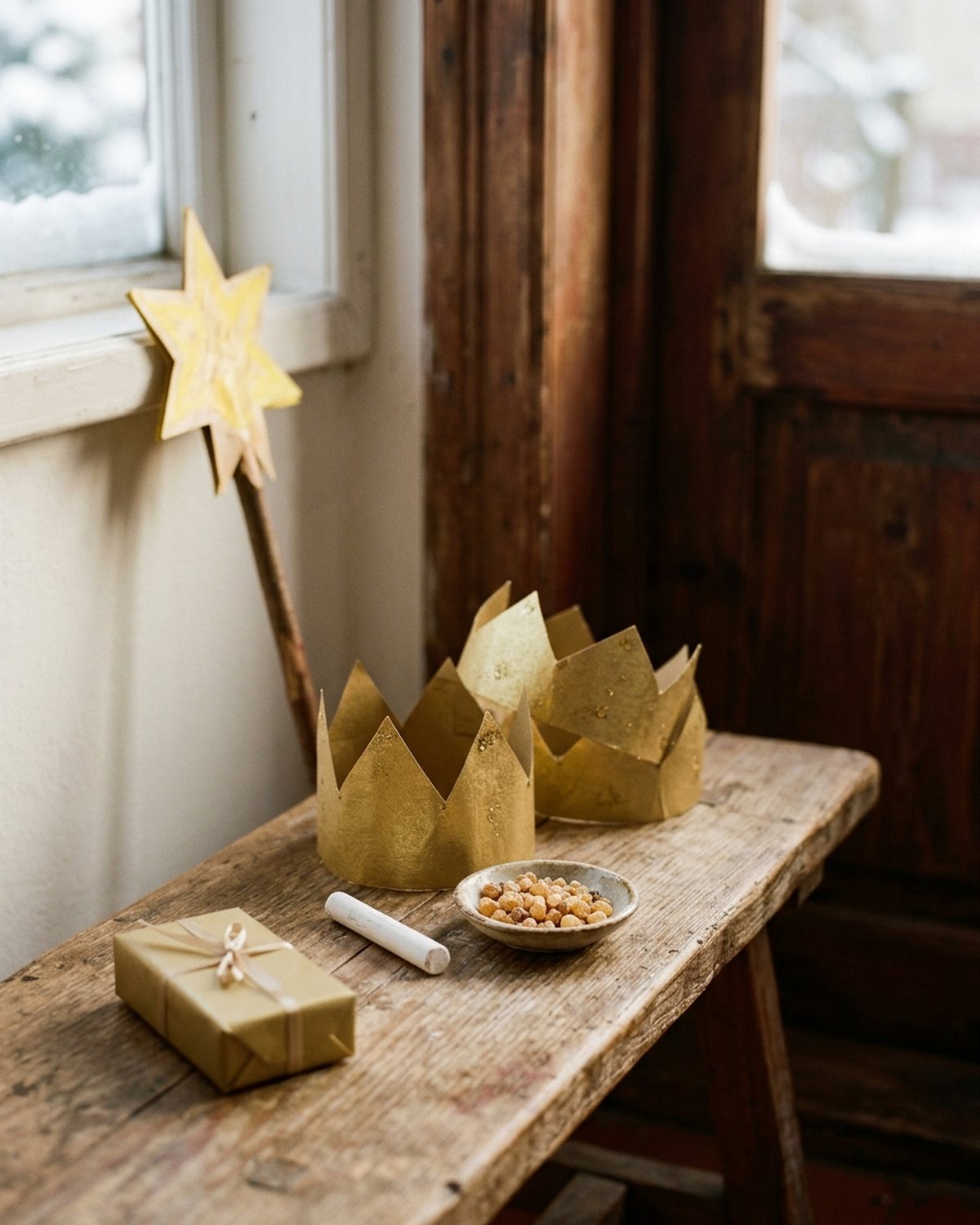
- white chalk (sidewalk chalk is soft and wears off in a week)
- the inscription on a sticky note, so nobody has to remember the order: 20 + C + M + B + 27
- a stable step stool for a child
- a Bible or phone open to Luke 19:1–9 (Zacchaeus, the tax collector who welcomed Jesus into his house; the reading the USCCB gives)
- optional: a few grains of frankincense on a charcoal disc in a metal bowl, lit by an adult, away from curtains
Who says what (five minutes, everyone at the front door, inside or out)
- Leader (a parent, or a child who can read) makes the sign of the cross. All: Amen.
- Leader: “Let us praise God, who fills our hearts and homes with peace.” All: “Blessed be God forever.” The leader then says a few lines of introduction from the USCCB text, ending: “May all who enter this home find Christ’s light and love.”
- Someone reads Luke 19:1–9. With little ones, just verse 5: “Zacchaeus, come down quickly, for today I must stay at your house.” Scripture
- Petitions. The leader reads three short prayers, for the Holy Family to remain in our home, for people without a home, and for the talents of everyone in the house; after each, all answer: “Stay with us, Lord.”
- Our Father, together.
- Leader, hands joined: “Lord God of heaven and earth, you revealed your only-begotten Son to every nation by the guidance of a star. Bless this house and all who inhabit it.” (The full prayer is on the USCCB page.)
- The chalk. Now write 20 + C + M + B + 27 above the door. The adult writes the numbers, each child adds a letter or a cross. This is where the Diocese of Portland, Maine, puts the chalk in its version: “first write the first two numbers of the year (20), then the letters C, M, B”, then the rest of the year, with plus signs for the crosses (Diocese of Portland).
- Closing. Leader makes the sign of the cross: “May Christ Jesus dwell with us, keep us from all harm, and make us one in mind and heart, now and forever.” All: Amen. Then a song; the USCCB page suggests “O Come, All Ye Faithful” or “We Three Kings”.
One line for a 3–6-year-old, said while they hold the chalk: “The wise men walked a long way behind a star to find baby Jesus. We write their letters on our door so Jesus is at home with us too.”
One line for a 7–12-year-old: “C, M, B are Caspar, Melchior and Balthasar, but they also spell a Latin sentence: Christus mansionem benedicat, Christ bless this house. Same letters, two meanings. Which one do you want to mean when you write it?”
The gifts of the Magi: a five-minute activity. Put three things on the table and ask what each says about Jesus. The USCCB’s reading of the gifts (January 6 page):
| Gift | Stand-in at home | What it says |
|---|---|---|
| Gold | a coin, a gold-wrapped chocolate | wealth and power: he is a king |
| Frankincense | a grain of incense, a scented candle | burned as an offering: a symbol of prayer |
| Myrrh | a drop of perfume, a bottle of ointment | used for healing and for burial: it foreshadows his death |
Then the question that makes it worth doing: “What would you bring him?” Write the answers on the back of the sticky note and keep it by the door. Older children can look up the gifts in Matthew 2:11 and Isaiah 60:6 and notice that Isaiah lists only two.
What to do on Sunday, January 3 with kids
At Mass. Two things to listen for: the Gospel is the Magi story they read at home, and in many parishes, right after it, a deacon or cantor sings the Announcement of Easter and the Moveable Feasts, which begins “Know, dear brethren” and gives the dates of Ash Wednesday, Easter and Pentecost, a practice from the days when calendars were scarce (USCCB). A nine-year-old with a job (write down the date of Easter) sits through a lot.
At home. Move the Magi figures into the nativity scene. Chalk the door. Buy or bake something with a crown on it (next section). Then sit down together.
If you kept St. Nicholas Day with shoes by the door, this is the bookend: a bishop who gave in secret at the start of Advent, strangers who gave in the open at the end of Christmas (St. Nicholas Day).
King cake, Rosca de Reyes and other Three Kings Day traditions
Epiphany has a cake almost everywhere, and in the US three traditions live side by side. They belong to the communities that keep them; if one is yours, you know it better than we do.
Rosca de Reyes (Mexico, Mexican American families). An oval sweet bread shaped “to symbolize a crown”, topped with candied fruit for the jewels, eaten on January 6, Día de los Reyes. Small baby Jesus figurines are hidden in the dough, which the tradition links to the flight into Egypt; whoever finds one “is responsible for making tamales and hosting a party on Día de la Candelaria”, February 2 (Smithsonian Folklife). tradition
Three Kings Day gifts (Puerto Rico and much of Latin America). On the evening of January 5 children cut grass and put it in a shoebox for the Kings’ camels; in the morning the grass is gone and gifts are there. On the 6th a parade led by the Three Kings ends in a fiesta in Old San Juan (Vermont Public, Evangelina Holvino). tradition
King cake (New Orleans). January 6, King’s Day, opens the season in which New Orleans bakeries sell king cake until Fat Tuesday: green, purple and gold icing, “the colors of the season”, and a plastic baby, a custom that goes back to a 1940s baker, Donald Entringer (NPR, Eliza Barclay). Whoever gets the baby hosts next year’s party and buys or bakes the next cake (Tasting Table). tradition The religious content is thin by now; a parent can put it back in one sentence: “It’s a king cake because of the kings who visited Jesus. The baby is him.”
When do you take down the tree?
Whenever it is a fire hazard. There is no Church rule about the tree, only the shape of the season: Christmas Time “concludes with the feast of the Baptism of the Lord”, and the Liturgy Office of England and Wales adds, in its own pastoral note on the custom of keeping decorations up until Epiphany, that “it would be even more appropriate to extend this custom through the celebration of the Baptism of the Lord” (Christmas Time). In 2027 that is January 10. A dry tree can go on the 4th; the nativity scene, with the Magi finally in it, stays until the 10th, and the chalk over the door stays all year.
Advent was the waiting (Advent with kids), Christmas the arrival, and Epiphany is the morning after, when the visitors leave by another road and the house settles down with a blessing written over its door.
As of October 2026. Dates checked against the USCCB liturgical calendar for 2027 and the Liturgy Office of England and Wales. Scripture quotations from the New American Bible, Revised Edition.

Eryk Panter
I make HOSANNA! with my family, at our own table. I write the rules, dig through the sources and work on the pictures; the children play first and tell me straight what does not work. Here I write what I was looking for as a dad: how to talk with children about the saints, concretely, with sources and without sugar-coating.
Frequently asked questions
When is Epiphany 2027?
In the dioceses of the United States, Epiphany is transferred to the Sunday between January 2 and 8, so in 2027 it is Sunday, January 3. The traditional date, January 6, falls on a Wednesday. In England and Wales Epiphany is a holy day of obligation kept on January 6 itself (it moves to Sunday only when it falls on a Saturday or Monday), so there it is Wednesday, January 6, 2027. The Christmas season ends with the Baptism of the Lord on Sunday, January 10, 2027.
What does 20+C+M+B+27 mean?
The year 2027 split in two around three letters, with crosses between them. C, M and B are the initials of the three wise men in the traditional names, Caspar, Melchior and Balthasar. The Liturgy Office of England and Wales, citing the Vatican's Directory on Popular Piety and the Liturgy (no. 118), says the letters can also be read as the Latin blessing Christus mansionem benedicat, 'May Christ bless this house'. Both readings are correct and most families teach both.
How do you chalk the door for Epiphany?
Take a piece of plain white chalk (many parishes bless chalk at the Epiphany Mass and hand it out) and write 20 + C + M + B + 27 on the lintel or the wall above your front door. Anyone in the household may write; children can do a letter or a cross. Before or after writing, say the Epiphany blessing of the home: the USCCB version is in this post, step by step, and takes about five minutes.
Were the Magi kings, and were there three of them?
Matthew 2:1–12 calls them 'magi from the east' and never says how many there were, what their names were, or that they were kings. The number three most likely comes from the three gifts; early Christian art shows two, three, four and even eight. The names Caspar, Melchior and Balthasar appear in the Latin West from the seventh century. The kings come from the liturgy applying Psalm 72:10 and Isaiah 60:6 to them. All of that is tradition, and it is fine to say so to a child.
What is Three Kings Day and how is it celebrated?
Three Kings Day, Día de los Reyes, is Epiphany in Spanish-speaking communities. In Mexico and Mexican American families the Rosca de Reyes, an oval sweet bread with a tiny baby Jesus hidden inside, is shared on January 6; whoever finds the baby hosts tamales on February 2. In Puerto Rican tradition children put grass in a shoebox on the night of January 5 for the Kings' camels and find gifts in the morning. In New Orleans January 6 opens the king cake season that runs to Mardi Gras.
When should we take down the Christmas tree?
There is no rule. The Church's Christmas season lasts until the Baptism of the Lord, Sunday, January 10, 2027, and the Liturgy Office of England and Wales, in its own pastoral note, says it would be 'even more appropriate' to keep Christmas decorations up through that feast rather than just to Epiphany. If the tree is dry, take it down earlier and leave the nativity scene out; the Magi figures are the last to arrive anyway.
Sources
Marks: [H] — Scripture, document, recorded fact · [T] — tradition, legend, custom · [N] — Church teaching · [D] — study, data.
- NUSCCB: Liturgical Calendar for the Dioceses of the United States of America 2027 (PDF)
- NUSCCB: January 6, The Solemnity of the Epiphany of the Lord (the three gifts; the season ends with the Baptism of the Lord)
- NUSCCB: Blessing of the Home and Household on Epiphany
- NUSCCB: Announcement of Easter and the Moveable Feasts (read on Epiphany after the Gospel)
- HMatthew 2:1–12, New American Bible, Revised Edition (bible.usccb.org), with the notes on 2:1 and 2:11
- HLuke 19:1–10, Zacchaeus the Tax Collector, New American Bible, Revised Edition (bible.usccb.org)
- HReadings for the Epiphany of the Lord (bible.usccb.org): Isaiah 60:1–6, Psalm 72, Matthew 2:1–12
- NCatechism of the Catholic Church 528 (USCCB flipbook)
- NLiturgy Office of England and Wales: Holydays of Obligation
- NLiturgy Office of England and Wales: Christmas Time (PDF; the C+M+B blessing of homes passage, referenced to the Directory on Popular Piety 108, 111, 118; the decorations note is the Office's own)
- DGCatholic: Liturgical Calendar, England 2027
- TDiocese of Portland, Maine: Epiphany Blessing of Home or Household (20 + C + M + B; credited 'From Catholic Household Blessings & Prayers')
- TWikipedia: Chalking the door
- TCatholic Encyclopedia: Magi (newadvent.org, 1910)
- HEncyclopaedia Britannica: Epiphany
- TSmithsonian Folklife: There's a Baby in My Cake! Luck of La Rosca de Reyes on Three Kings Day (Francesca Galván, 2023)
- TNPR / WWNO: Is That a Plastic Baby Jesus in My Cake? (Eliza Barclay, 2012)
- TTasting Table: Why There Are Babies in King Cake (2025)
- TVermont Public: Holvino, Three Kings Day (2015)
- DCNA (National Catholic Register): Three Kings parades held at more than 600 locations across Poland (January 6, 2022)