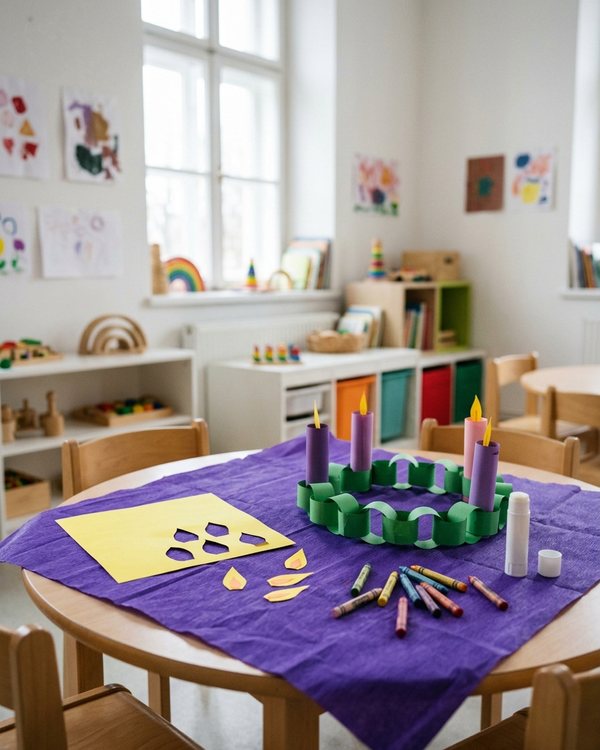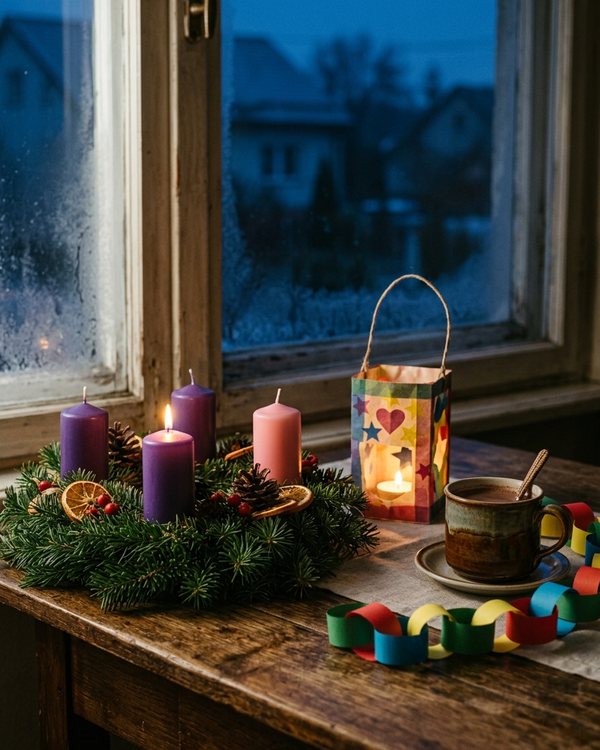
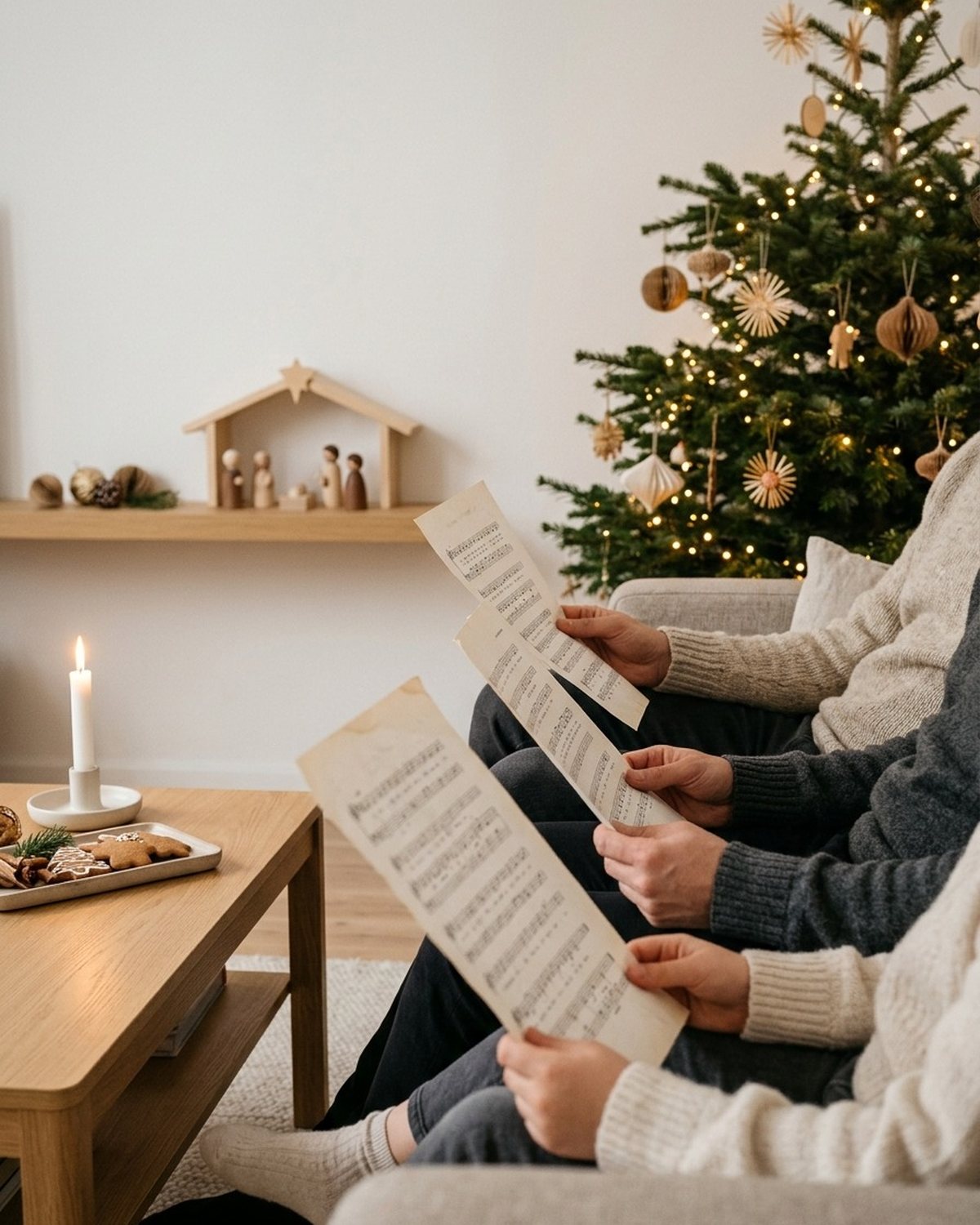
A four-year-old can sing a carol long before she can explain it. Most of the words wash over children: herald, yon, in excelsis. That is fine. But around first grade they start asking, and a parent who can say in one sentence what Gloria in excelsis Deo means, and why nobody sings We Three Kings on Christmas Eve, has most of the Christmas story in hand. Below: twelve carols in one table (the Gospel scene, one line for a child, when it belongs), the three words children trip over, and a short plan for singing at home. All twelve are old enough to print.
Which carols actually tell the Christmas story?
Two Gospels tell it, and they tell different parts. Luke 2 has the census, the manger, the angel and the shepherds; Matthew 2 has the star and the magi. Most carols are Luke. The sign the angel gives the shepherds is the picture every nativity scene copies: “you will find an infant wrapped in swaddling clothes and lying in a manger” (Luke 2:12) Scripture. The Catechism puts the whole night in two sentences: “Jesus was born in a humble stable, into a poor family. Simple shepherds were the first witnesses to this event” (CCC 525) history.
A few things in the carols are not in either Gospel, and it is worth knowing which, because children will ask:
- Three kings. Matthew says magi, gives no number and never calls them kings; the “three” comes from the three gifts (Wikipedia: We Three Kings) tradition.
- The shepherds seeing the star. The First Noel has the shepherds looking up at a star, but the star is Matthew’s and the shepherds are Luke’s; the carol blends the two (Wikipedia: The First Noel).
- Cattle and silence. Luke mentions a manger, not an ox; a baby who makes no crying is the carol’s wish, not the Gospel’s report. None of this is wrong to sing. It is just good to know what is picture and what is text.
12 carols for kids: the list
Every carol here has words and a tune old enough to be in the public domain in the US and the UK (the youngest, Away in a Manger, was printed in the 1880s and its two tunes by 1895), so the words can go on the fridge or in a class packet. A particular hymnal’s harmonization can be newer and still protected, so print the words rather than a scanned page. Dates are the ones hymnary.org and the histories linked below give.
| Carol | Year and author | What it tells | One line for a child | When |
|---|---|---|---|---|
| Silent Night | words Joseph Mohr, 1816; tune Franz Gruber, Christmas Eve 1818, Oberndorf, Austria; English by John F. Young, 1859 | the night itself: Mother and Child, Luke 2:7 | “Jesus is born, and the whole world goes quiet.” | Christmas Eve |
| O Come, All Ye Faithful | Latin Adeste fideles, John Francis Wade’s manuscript c. 1743–1751; English by Frederick Oakeley, 1841 | the walk to Bethlehem, Luke 2:15–16 | “We are going to Bethlehem to see the King.” | Christmas; one verse is kept for Christmas Day |
| Hark! the Herald Angels Sing | Charles Wesley, 1739; tune Mendelssohn 1840, adapted by W. H. Cummings in the 1850s | the angels’ song, Luke 2:13–14 | “The angels shout: the King is born!” | Christmas |
| Joy to the World | Isaac Watts, 1719, a paraphrase of Psalm 98; tune ANTIOCH, Lowell Mason, 1839/1848 | not Luke 2 at all: the Psalm’s “the Lord has come” | “The whole earth is happy, because the Lord has come.” | Christmas |
| O Little Town of Bethlehem | Phillips Brooks, 1868, for his Sunday school in Philadelphia; tune Lewis Redner (US) or FOREST GREEN (UK, 1906) | the sleeping town, Luke 2:4–7 | “Bethlehem was a tiny town, and God chose it.” | Christmas |
| Away in a Manger | anonymous, printed 1882/1885 in America; tune J. R. Murray 1887 (US) or W. J. Kirkpatrick 1895 (UK) | the manger, Luke 2:7 | “Baby Jesus slept in a feeding box for animals.” | Christmas; the first carol for a 3-year-old |
| The First Noel | traditional English (Cornish), printed 1823 | shepherds and the angel, Luke 2:8–11, plus Matthew’s star | “Noel means Christmas. The shepherds heard it first.” | Christmas to Epiphany |
| Angels We Have Heard on High | French Les anges dans nos campagnes, first printed (text only) in Marseille in 1805, with its tune in Paris in 1842; English by Bishop James Chadwick, 1860 | angels over the fields, Luke 2:8–14 | “The angels sang so loud the mountains echoed.” | Christmas |
| O Come, O Come, Emmanuel | Latin hymn from the O Antiphons, printed 1710; English by John Mason Neale, 1851 | the waiting: Isaiah 7:14, Matthew 1:23 | “We are waiting for Jesus. His name means God-with-us.” | Advent only |
| What Child Is This? | William Chatterton Dix, 1865; tune Greensleeves, paired 1871 | Mary’s lap and the shepherds (Luke 2), the gifts (Matthew 2:11) | “Who is this baby? It is Christ the King.” | Christmas to Epiphany |
| Good King Wenceslas | John Mason Neale, 1853; tune a 13th-century spring song from Piae Cantiones, 1582 | not a Gospel scene: a legend of St. Wenceslaus, Duke of Bohemia (d. 935) | “A king walked through the snow to bring a poor man dinner.” | 26 December, St. Stephen’s Day |
| We Three Kings | John Henry Hopkins Jr., 1857, for a Christmas pageant in New York City | the magi and the star, Matthew 2:1–12 | “Wise men followed a star and brought three gifts.” | Epiphany (Sunday 3 January 2027 in the US; 6 January in England and Wales) |
Sources for the dates: hymnary.org, Hymnology Archive and the Wikipedia pages listed under Sources. history
Which do we know? A checklist for the fridge:
- Away in a Manger
- Silent Night
- Angels We Have Heard on High (the refrain counts)
- O Come, All Ye Faithful
- Hark! the Herald Angels Sing
- Joy to the World
- O Little Town of Bethlehem
- The First Noel
- What Child Is This?
- We Three Kings
- Good King Wenceslas
- O Come, O Come, Emmanuel
The first four are enough for a whole Christmas with a preschooler. A child who sings half a verse and hums the rest is singing.
What does “Gloria in excelsis Deo” mean?
It is Latin for “Glory to God in the highest”, the first words the angels sang over the shepherds’ field: “Glory to God in the highest and on earth peace to those on whom his favor rests” (Luke 2:14) Scripture. In excelsis is “in the highest”; Deo is “to God”. The refrain of Angels We Have Heard on High stretches the one word Gloria over a long run of notes, which is why children love it and why it is the easiest Latin they will ever learn.
The same words open the Gloria at Mass, a hymn the Church was singing in Greek by the third century; tradition credits St. Hilary of Poitiers with the Latin in the fourth (Catholic Encyclopedia, Wikipedia) history. One thing you can point out to a child in church: the Gloria is left out on the Sundays of Advent and comes back at Christmas (GIRM 53 via EWTN, OCP). When the choir starts Glory to God in the highest at the Christmas Vigil, that is the angels’ song returning after four Sundays without it.
Two more words children trip over:
- Noel. English carols spelled it Nowell. It comes from the French Noël, “Christmas”, and further back from the Latin natalis, “birthday” (Wikipedia: The First Noel) history. So The First Noel means “the first Christmas”, and the angel’s message to the shepherds was the first Christmas greeting.
- Emmanuel. Hebrew for “God is with us”. Matthew quotes Isaiah’s prophecy when he tells of Jesus’ birth: “they shall name him Emmanuel,” which means “God is with us” (Matthew 1:23, NABRE; the prophecy is Isaiah 7:14) Scripture. For a child: “Emmanuel is not his everyday name. It is what his name means: God came to be with us.”
Advent or Christmas: when do we sing which?
In church the answer is clear, and it is worth passing on gently rather than as a rule for the living room. Advent (from Sunday 29 November 2026) is the season of waiting, with its own hymns; Christmas Time begins with the vigil Masses on Christmas Eve and runs to the Baptism of the Lord, Sunday 10 January 2027 (USCCB, USCCB calendar 2027). Epiphany is Sunday 3 January 2027 in the United States; in England and Wales it stays on Wednesday 6 January and is a holy day of obligation (Liturgy Office).
That gives the carols a natural order:
- Advent: O Come, O Come, Emmanuel. Its verses come from the O Antiphons, which the Church has sung before Christmas since at least the eighth or ninth century (Wikipedia) history. Its mood is longing, not arrival. If you sing one carol in December, make it this one, and tell your child why: “We’re not there yet.”
- Christmas Eve and Christmas Day: the Luke 2 carols. Silent Night was written for exactly this evening, first sung at the Christmas Eve service in Oberndorf in 1818 to a guitar; the popular story that the organ had broken is doubtful (Hymnology Archive) tradition. The last verse of O Come, All Ye Faithful, the one that greets the Lord “born this happy morning”, is traditionally kept for Christmas itself (Wikipedia).
- 26 December: Good King Wenceslas. Not a Christmas scene: a story about a real saint, Wenceslaus, Duke of Bohemia, murdered by his brother in 935, feast on 28 September (Catholic Encyclopedia, 1912) history. The carol sets him on the Feast of Stephen, carrying food to a poor man through the snow; the footprints come from a children’s story Neale himself published in 1849 (Hymnology Archive) tradition. A good carol for the day the wrapping paper is still on the floor: “What did the king do with his Christmas? He gave it away.”
- Epiphany: We Three Kings and the last verse of What Child Is This?, with its gold, incense and myrrh. Hopkins, then music teacher at the General Theological Seminary, wrote We Three Kings in 1857 for a Christmas pageant in New York City (Wikipedia) history. Its verses explain the three gifts one by one, the right carol to sing while your child moves the magi the last few inches to the crib. If you chalk your door that day, the carol fits the same ten minutes: Epiphany: chalk the door.
At home, none of this is a law. If carols are on in the car from Thanksgiving, nobody needs to feel guilty. But a child who hears O Come, O Come, Emmanuel in December and Joy to the World only on Christmas morning learns the shape of the season through her ears. More on the four weeks of waiting: Advent with kids.
Church or home: the Lessons and Carols tradition
If your parish or a nearby church holds a Lessons and Carols service in December, take the children. The form is simple: nine short Bible readings, from the fall to the birth of Jesus, each followed by a carol. It began in 1880 in Truro, Cornwall, where Bishop E. W. Benson held it at 10 pm on Christmas Eve in a wooden shed that served as his cathedral; in 1918 Eric Milner-White, the new Dean of King’s College, Cambridge, planned the version the world knows, and the BBC has broadcast it from King’s every year since 1928, except 1930 (King’s College) history. Anglican by origin, it has spread to Catholic churches in England and Wales and to many other churches, and is traditionally held on or near Christmas Eve (Wikipedia). Check the start time: if the one near you runs past bedtime, the home version below takes fifteen minutes.
The same shape works at the kitchen table, shortened to three readings. A home Lessons and Carols, about fifteen minutes, for Christmas Eve after dinner:
- In the morning, print three carols, one verse each. The youngest colors the sheet.
- After dinner, before presents: lights off except the tree and one candle.
- First reading: an older child reads Luke 2:1–7, the census and the manger. Then Away in a Manger or O Little Town of Bethlehem. The youngest picks.
- Second reading: Luke 2:8–14, the shepherds and the angels. Then Angels We Have Heard on High, everyone on the refrain.
- Third reading: Luke 2:15–16, “Let us go, then, to Bethlehem.” Then O Come, All Ye Faithful while the youngest puts the Jesus figure in the crib.
- Finish with Silent Night, quietly, the way it was first sung. Nobody corrects the words.
If your family goes to the Vigil or to Midnight Mass, the plan moves to the afternoon and the last carol is the one the choir will sing that night: the nativity scene and Midnight Mass with kids.
Easy Christmas carols for children: what to say when they ask
Ages 3–6. One verse, one refrain, one picture. Away in a Manger: “A manger is a box animals eat from. Jesus’ first bed was a feeding box.” Silent Night: “Everyone is asleep except Mary and Joseph and the baby.” Angels We Have Heard on High: “Gloria means glory. The angels were singing it to God.” That is the whole catechesis, and it is enough.
Ages 7–12. Now the odd words become the lesson. Hark! is “listen”; a herald is a messenger who announces a king. “God and sinners reconciled” is the carol’s one-line summary of why Christmas matters: God and people are friends again. In Joy to the World, ask what “let every heart prepare him room” means, since Watts wrote it from Psalm 98, not about a stable, and did not write it for Christmas (hymnary.org) history. Older children like knowing that Away in a Manger was printed for decades as “Luther’s Cradle Song” and that Martin Luther never wrote it (Wikipedia).
When your child won’t sing. Let it go. A child can hold the candle, read a verse, ring a bell on the Gloria, or just listen; a carol heard every year at the same table stays for life. If your church or school is putting on a pageant, the carols carry it: here is a nativity play script for kids.
Mary, Did You Know, The Little Drummer Boy and the modern songs
Two songs children ask for by name are not free to print. Mary, Did You Know? has words by Mark Lowry from 1984 and music by Buddy Greene from 1991 (Wikipedia); The Little Drummer Boy was written by Katherine Kennicott Davis in 1941 as “Carol of the Drum” (Wikipedia). Both are under copyright, so for a class or a parish party the words come from a licensed songbook, not a printout off the internet. Neither is a Gospel scene: the drummer boy is a story, and the questions in Mary, Did You Know? are a songwriter’s reflection. Good songs to listen to; the twelve above are the ones to print, sing and explain.
As of October 2026. Scripture quotations from the New American Bible, Revised Edition.

Eryk Panter
I make HOSANNA! with my family, at our own table. I write the rules, dig through the sources and work on the pictures; the children play first and tell me straight what does not work. Here I write what I was looking for as a dad: how to talk with children about the saints, concretely, with sources and without sugar-coating.
Frequently asked questions
What does Gloria in excelsis Deo mean?
It is Latin for Glory to God in the highest, the first words the angels sang to the shepherds in Luke 2:14. It is the refrain of Angels We Have Heard on High and the opening line of the Gloria sung at Mass. The Church leaves the Gloria out of Sunday Mass during Advent, so when it returns at Christmas, children hear the angels' song come back.
What are the easiest Christmas carols for children to learn?
Away in a Manger (three short verses, one picture: a baby in a feeding trough), Silent Night (slow, six lines), the refrain of Angels We Have Heard on High (one Latin word stretched over many notes, which children love) and the refrain of O Come, All Ye Faithful. For a 3-to-6-year-old, one verse and one refrain is a whole carol.
Which Christmas carols actually come from the Bible?
Most tell the night of Luke 2: the manger (Away in a Manger, Silent Night), the angels and shepherds (Hark! the Herald Angels Sing, Angels We Have Heard on High, The First Noel) and the walk to Bethlehem (O Come, All Ye Faithful). We Three Kings and the last verse of What Child Is This come from Matthew 2. Joy to the World is a paraphrase of Psalm 98, and Good King Wenceslas is a legend about a tenth-century saint, not a Gospel scene.
Is O Come, O Come, Emmanuel a Christmas carol?
It is an Advent hymn. The words come from the O Antiphons, prayers the Church has sung before Christmas for well over a thousand years, and John Mason Neale translated them into English in 1851. It is in most Christmas songbooks, but its mood is waiting, not arrival, so it fits the four weeks before Christmas best.
When is it OK to start singing Christmas carols with kids?
There is no rule for your living room. In church, the Christmas season runs from the vigil Masses on Christmas Eve to the Baptism of the Lord (10 January 2027), and Advent before it has its own hymns. Many families learn the carols in December and sing them for real from Christmas Eve, so children feel the change. If carols are already playing in your car in November, nobody is sinning.
Can I print the words of Christmas carols for a party or a class?
The twelve carols in this post have words and tunes old enough to be in the public domain in the US and UK (the newest, Away in a Manger, was printed in the 1880s with tunes from 1887 and 1895), so you can print the words. A modern hymnal's harmonization or arrangement of the tune can still be under copyright, so print the words, not a scanned hymnal page. Modern songs such as Mary, Did You Know (1984/1991) and The Little Drummer Boy (1941) are protected; use a licensed songbook or the publisher's sheet music for those.
Sources
Marks: [H] — Scripture, document, recorded fact · [T] — tradition, legend, custom · [N] — Church teaching · [D] — study, data.
- HLuke 2:1–14, New American Bible Revised Edition — Mass During the Night readings (bible.usccb.org)
- HLuke 2:15–20, New American Bible Revised Edition — Mass at Dawn readings (bible.usccb.org)
- HMatthew 1:23 in NABRE, RSVCE and NRSVCE (biblegateway.com)
- HIsaiah 7:14 in NABRE and Douay-Rheims (biblehub.com)
- HCatechism of the Catholic Church 525 (vatican.va, Part One, Section Two, Chapter Two, Article 3)
- NUSCCB: Christmas (Christmas Time begins with the vigil Masses and ends on the Baptism of the Lord)
- NUSCCB: Liturgical Calendar for the Dioceses of the United States of America 2027 (PDF)
- NLiturgy Office of England and Wales: Holydays of Obligation (Epiphany on 6 January)
- NEWTN / Fr. Edward McNamara: Omitting or Adding the Gloria (GIRM 53), 1 July 2013
- NOCP: Advent liturgical tips for Catholic parishes (the Gloria is omitted in Advent)
- HCatholic Answers Encyclopedia (1907–1912): Gloria in Excelsis Deo
- HWikipedia: Gloria in excelsis Deo
- HHymnary.org: Silent Night! Holy Night! (Mohr 1818, Gruber 1818, Young 1863 alt.)
- HHymnology Archive: Stille Nacht / Silent Night (Mohr 1816, Gruber 24 Dec 1818, Young 1859)
- HWikipedia: Silent Night (public domain; Austria’s national intangible-heritage inventory 2011)
- HHymnary.org: O Come, All Ye Faithful (Wade c. 1743–1751, Oakeley 1841)
- HWikipedia: O Come, All Ye Faithful (Portuguese Hymn, Oakeley 1841, Christmas-Day verse)
- DWikisource: The Army and Navy Hymnal — O Come, All Ye Faithful (public-domain text)
- HHymnary.org: Hark! the Herald Angels Sing (Wesley 1739, Mendelssohn; Cummings's arrangement dated 1850 here, 1856 on the text page)
- HWikipedia: Hark! The Herald Angels Sing (Whitefield 1753, Mendelssohn 1840; Cummings dated 1855 here)
- HHymnary.org: Joy to the World (Watts 1719, Psalm 98, not written for Christmas)
- HWikipedia: Joy to the World (Mason's ANTIOCH 1839/1848, Handel attribution uncertain)
- HHymnology Archive: O Little Town of Bethlehem (Brooks 1868, Redner, FOREST GREEN 1906)
- HWikipedia: O Little Town of Bethlehem
- HWikipedia: Away in a Manger (anonymous, 1882/1885; Murray 1887; Kirkpatrick 1895; the Luther myth)
- HWikipedia: The First Noel (traditional, printed 1823; the meaning of Nowell; shepherds and the star)
- HWikipedia: Angels We Have Heard on High (French text printed 1805, with tune 1842; Chadwick 1860)
- HHymnology Archive: Angels We Have Heard on High (Marseille 1805, Chadwick 1860)
- HWikipedia: O Come, O Come, Emmanuel (O Antiphons, Latin print 1710, Neale 1851; the tune's origin disputed)
- HHymnary.org: O Come, O Come, Emmanuel (Psalter Hymnal 331; Scripture: Isaiah 7:14, 11:1)
- HWikipedia: What Child Is This? (Dix 1865, Greensleeves 1871)
- TWikipedia: Good King Wenceslas (Neale 1853, Piae Cantiones 1582, the legend)
- THymnology Archive: Good King Wenceslas (Deeds of Faith 1849, Svoboda 1847)
- HHymnary.org: Good King Wenceslas (Neale, TEMPUS ADEST FLORIDUM, Piae Cantiones 1582)
- HCatholic Encyclopedia (1912): St. Wenceslaus (died 28 September 935, feast 28 September)
- HWikipedia: We Three Kings (Hopkins 1857, Christmas pageant in New York City, published 1863; Matthew 2 names no kings)
- HKing's College, Cambridge: A History of A Festival of Nine Lessons and Carols
- HWikipedia: Nine Lessons and Carols (Truro 1880; adopted by Catholic churches)
- DWikipedia: Mary, Did You Know? (Lowry 1984, Greene 1991)
- DWikipedia: The Little Drummer Boy (Davis 1941)