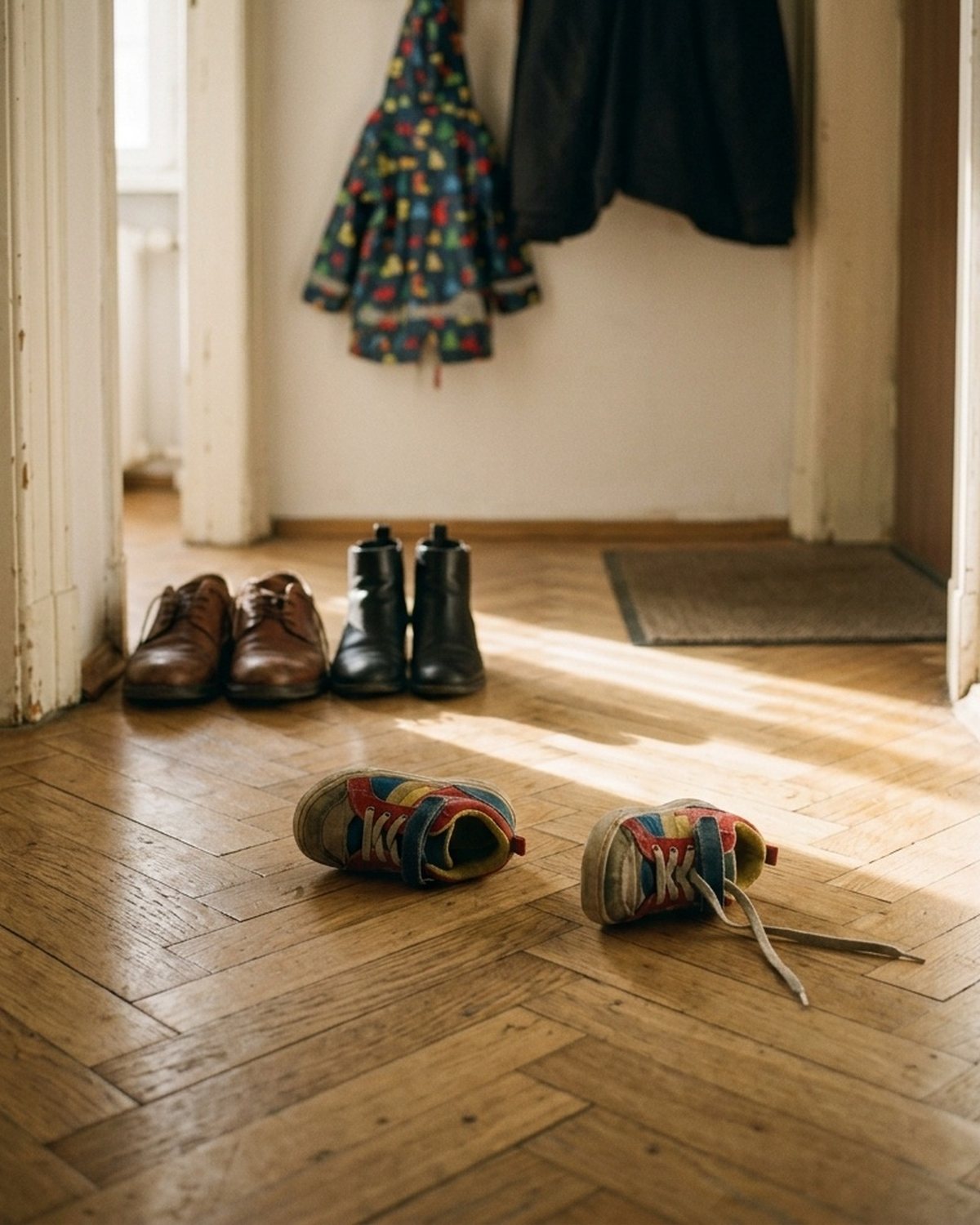
Everyone has their shoes on, and one child is sitting on the hallway floor saying “I’m not going.” This post is not about winning that argument. It covers what the Church actually asks (precisely, without softening it), what “I don’t want to” usually means, and what you can try together with a toddler, a child of 6 to 9 and a tween.
Does my child have to go to Mass? What the Church says
Three things are true at once, and it helps to hold them together.
The obligation is real. “On Sundays and other holy days of obligation, the faithful are obliged to participate in the Mass” (canon 1247, vatican.va). It is a merely ecclesiastical law, and such laws bind those baptized in the Catholic Church who “possess the efficient use of reason, and, unless the law expressly provides otherwise, have completed seven years of age” (canon 11, vatican.va). history A 5-year-old has no obligation of their own. A 9-year-old and a 13-year-old do. The Catechism adds that a serious reason excuses, “for example, illness, the care of infants,” and that those who deliberately fail in this obligation commit a grave sin (CCC 2181, vatican.va). That sentence tells you how much Sunday weighs. It is not a sentence to throw at a child in the hallway.
Holy days differ by country. In the US the rest of 2026 brings December 8 and December 25 (USCCB 2026 liturgical calendar); in England and Wales, most holy days that fall on a Saturday or Monday move to the Sunday, though Christmas never does (Liturgy Office, CBCEW).
Parents are responsible for handing on the faith. “Parents have the first responsibility for the education of their children,” the Catechism says, and they “should initiate their children at an early age into the mysteries of the faith,” beginning “in the child’s earliest years” (CCC 2223, 2225, 2226, vatican.va). history The same paragraph 2223 contains a line most parents skip: we teach by example, and parents who can admit their own failings to their children are better able to guide them.
Faith cannot be forced. The Council taught that “no one therefore is to be forced to embrace the Christian faith against his own will” (Dignitatis humanae 10, vatican.va). The Catechism repeats it: “the act of faith is of its very nature a free act” (CCC 160, vatican.va). Pope Francis, writing to families, put the same thing in parents’ language: “Spiritual experience is not imposed but freely proposed” (Amoris laetitia 288, quoted in the Dicastery for Laity, Family and Life notes).
Should I force my child to go to church?
The honest answer has two parts.
Bringing your child to Mass is not forcing faith on them. A parent who tells a 7-year-old “on Sunday we go together” is doing what the Church asks, the same way they take that child to school and to the dentist. Sunday together is part of family life.
But you have no power over what your child believes inside. You can get a body into a pew; you cannot make a child pray. The older the child, the clearer this gets: a 12-year-old dragged to church after a shouting match may remember the shouting longer than the Gospel, and a tween pushed without a conversation sometimes just stops telling you what they think.
What you do at home weighs more than any single Sunday. The US National Study of Youth and Religion first surveyed teenagers in 2002–2003 and followed them into their mid- to late twenties; its lead researcher, Christian Smith of Notre Dame, called the link between parents’ faith and their children’s “nearly deterministic.” In The ARDA’s summary of the latest wave, 82 percent of children whose parents talked about faith at home, valued their beliefs and were active in their congregation were religiously active as young adults; among teens whose parents attached little importance to religion, just 1 percent were highly religious in their twenties. “Parents just dominate,” Smith said (The ARDA, 2014). The two figures measure slightly different things, come from a news summary rather than a published paper, and show a correlation, not a guarantee. Still, they say where to put your energy: less into winning Sunday morning, more into talking about faith on an ordinary weekday.
What is behind “I don’t want to go”?
“I don’t want to go” is usually shorthand for something else, and each needs a different answer.
| What your child says | What may be behind it | What you can say or do |
|---|---|---|
| “It’s boring.” | Can’t see anything from the back, doesn’t know what comes next, too long sitting still. | Sit closer to the altar, give one job (“listen for a name in the Gospel”), try a Mass with Children’s Liturgy of the Word if your parish has one. |
| “I don’t understand anything.” | The words of the liturgy are foreign; the readings are heard cold. | Read the Sunday Gospel on Saturday evening and tell it in three sentences. In church they will hear something they already know. |
| “Everyone is looking at me.” | Embarrassment: the only one from class, a mistake at the altar, First Communion nerves. | Ask in private, with no audience. Another time or another church for a while is not a defeat. |
| “I don’t like Father / that CCD teacher.” | A conflict with a real person, a hurtful word in religious ed or the sacristy. | Listen to the end, and separate the person from God: “If that person hurt you, that wasn’t God doing it.” If an adult has harmed your child, this is about safety, not persuasion: believe your child (Stop It Now), keep them away from that person and report it to the police first, then to the diocese (The Catholic Project). In England and Wales: 999 if anyone is in immediate danger, the police before the diocese (Diocese of Shrewsbury). |
| “You don’t want to go either.” | They see your reluctance or your absence. | Admit it: “You’re right, sometimes I don’t feel like it. I go because…” and say why. |
| “I’d rather sleep / I have a game.” | Sunday loses to something they love more. | Choose the time together: the Saturday vigil counts (canon 1248 §1). |
| “I don’t believe it.” | Unanswered questions, a push for independence, or real doubt. | A serious conversation, no panic, no threats. Ready sentences are below, in the tween section. |
How to help, by age
Under 7: make the place familiar
A preschooler has no Sunday obligation, so the goal is not “sit through it” but “get to know the place”, and a 3-year-old who cannot sit still for an hour is normal. Sit where the altar is visible, near an aisle so you can step out, bring two quiet things, and come back in for the blessing. The full list, plus a whisper script for every part of Mass, is in Mass with toddlers.
Ready sentences for ages 3–6:
- “We’re going to Jesus’ house. Let’s find the candles.”
- “You can sit on my lap. Let’s watch what Father does at the altar.”
- “You don’t have to sing. You can hold my hand.”
Ages 6–9: questions, boredom and “I don’t get it”
These are the First Communion years and the years of the first “why”. From the seventh birthday the obligation is the child’s own, and what helps most is preparing the readings at home. Take this coming Sunday: 1 November 2026 is All Saints, and the Gospel is Matthew 5:1–12a, the Beatitudes (Universalis). On Saturday evening, read it aloud and ask one question: “Which of these is easiest? Which is hardest?” On Sunday your child hears a text they already have an opinion about.
The colors on Father’s vestments and the seasons they mark are explained in the liturgical year for kids. Many children go more willingly with a place in the parish: altar server, children’s choir, bringing up the gifts. Ask your child before you ask the parish.
Ready sentences for ages 7–9:
- “What part of Mass is the most boring for you? Let’s figure out one thing that would help.”
- “Tomorrow’s Gospel is about who God calls happy. Want to guess before we hear it?”
- “You can tell me you don’t want to go. I’ll listen. We’re still going, and afterward we’ll talk.”
Tweens, 10–13: autonomy, real conversation, your example
A tween is bound like an adult, while you have fewer ways to enforce it and more reasons to talk. Pediatricians describe the age plainly: “Pre-teens feel an increased need for privacy,” their thinking is still “concrete, black-and-white,” and they “may push boundaries and may react strongly if parents or guardians reinforce limits” (HealthyChildren.org, AAP). Pushback is development, not a verdict on you.
Even the Holy Family had a 12-year-old who went his own way. Jesus stayed behind in Jerusalem, and when Mary and Joseph found him in the temple after three days, he was “listening to them and asking them questions.” Mary said: “Your father and I have been looking for you with great anxiety.” Then: “they did not understand what he said to them,” and “his mother kept all these things in her heart” (Lk 2:46–51, NABRE). Scripture Not understanding your child at first is not the end of the story.
What helps with a tween:
- Ask before you answer. “What changed? Since when?” Listen to the end, even if it hurts.
- No ultimatum. “As long as you live under my roof” can close the conversation for years.
- Talk about yourself. Not “you have to”, but “this is what Sunday means to me”. Your week counts more than a sermon in the car.
- Show other doors. A youth group, another Mass time, another parish. Sometimes a tween is not running from God but from a dull hour in the same pew. If Confirmation prep is coming, choosing a patron saint can be the first faith conversation they lead.
- Pray for them. Quietly, without reporting it.
Ready sentences for a hard conversation:
- “I’m not going to scare you. I want to know what you think.”
- “It makes me sad, because this matters to me. But I’d rather you tell me the truth than pretend.”
- “You don’t need all the answers now. I don’t have all of them either.”
- “The door is open. If you want to come with me, just say so.”
What not to say or do
- Don’t use God or hell as a threat. A child can learn that God means punishment rather than a Father.
- Don’t compare. “Your cousin goes without complaining” adds resentment, not faith.
- Don’t shame in public: not in church, not in front of grandparents, not in the family group chat.
- Don’t make Mass a punishment (“for that, you’re going twice”) or skipping it a reward.
- Don’t argue in the hallway. The real conversation doesn’t fit in the three minutes before you leave; have it that evening.
- Don’t pretend all is well if you have been going for months without conviction yourself. Children notice. A bedtime prayer you say together on weeknights can do more than one more lecture on Sunday.
A plan for next Sunday
One Sunday, step by step. Not all at once: pick what fits your child’s age.
- On a weeknight: one calm question, no coats and no rush: “What bothers you about Sunday?”
- Find the row in the table above that fits, and one thing to change.
- Saturday: the Sunday Gospel in three sentences at dinner, with one question.
- Choose together the time and the church. The Saturday vigil counts.
- One job for the younger one, one invitation for the older one (“Will you come with me?”).
- In church: a seat with a view of the altar; the narthex without shame.
- After Mass: your family’s Sunday thing (donuts in the parish hall, pancakes, the playground) and one question instead of a quiz.
- That night: a short prayer for your child, even if this Sunday didn’t go well.
One Sunday decides nothing. What matters is that your child knows they can say “I don’t want to” and be heard.
As of October 2026. Canon law, the Catechism and Dignitatis humanae from the texts at vatican.va; Scripture quotations from the New American Bible, Revised Edition. The sentences to say to your child are ours.

Eryk Panter
I make HOSANNA! with my family, at our own table. I write the rules, dig through the sources and work on the pictures; the children play first and tell me straight what does not work. Here I write what I was looking for as a dad: how to talk with children about the saints, concretely, with sources and without sugar-coating.
Frequently asked questions
Should I force my child to go to church?
Bringing your child to Mass is part of your job as a Catholic parent: the Catechism gives parents the first responsibility for their children's education in the faith (CCC 2223–2226), and from age 7 the Sunday obligation binds the child too (canons 11 and 1247). Forcing faith is a different thing, and the Church rejects it: nobody is to be forced to embrace the faith against his will (CCC 160, Dignitatis humanae 10). The older the child, the more the conversation matters and the less the pressure works.
At what age is a Catholic child obliged to go to Mass on Sunday?
Merely ecclesiastical laws, the Sunday obligation among them, bind baptized Catholics who have the efficient use of reason and have completed seven years of age (canon 11). A 5-year-old has no obligation of their own; parents bring them so church becomes familiar. A 9-year-old and a 13-year-old are bound like adults.
My child says Mass is boring. What can I do?
Ask what exactly is boring. Often it is the view from the back pew, not knowing what comes next, or hearing the readings cold. Sit where the altar is visible, read the Sunday Gospel at home the evening before, and give a younger child one thing to listen or look for. Mass is not built to entertain, but a child who knows the story already hears it differently.
What if my tween says they don't believe in God?
Don't panic and don't threaten. Ask what they don't believe and since when, listen to the end, and say calmly that your faith matters to you. Leave the door open, skip the ultimatum, pray for them. Sometimes 'I don't believe' covers something concrete: a person, a hurt, or a question nobody answered.
Does Saturday evening Mass count, or Mass at another parish?
Yes to both. Canon 1248 §1 says the obligation is satisfied by assisting at a Mass celebrated anywhere in a Catholic rite, either on the feast day itself or in the evening of the preceding day. A different parish, a different time or the Saturday vigil are honest options when the problem is the hour, the crowd or a particular person.
Sources
Marks: [H] — Scripture, document, recorded fact · [T] — tradition, legend, custom · [N] — Church teaching · [D] — study, data.
- NCode of Canon Law, canons 1244–1253, incl. canons 1246–1248 (vatican.va, English)
- NCode of Canon Law, canons 7–22, incl. canon 11 (vatican.va, English)
- NCatechism of the Catholic Church 2180–2183: the Sunday obligation (vatican.va)
- NCatechism of the Catholic Church 2214–2231: the duties of parents (vatican.va)
- NCatechism of the Catholic Church 153–165: the characteristics of faith, incl. 160 (vatican.va)
- NSecond Vatican Council, Dignitatis humanae (7 Dec 1965), no. 10 (vatican.va)
- NDicastery for Laity, Family and Life: Amoris laetitia, episode 8, study notes quoting AL 287–288 (PDF, 2021)
- HSt. Augustine, Confessions, Book III, chapters 11–12 (New Advent)
- HLuke 2:41–52, New American Bible, Revised Edition (bible.usccb.org)
- DThe ARDA, David Briggs: Parents No. 1 influence helping teens remain religiously active as young adults (29 Oct 2014)
- DHealthyChildren.org (American Academy of Pediatrics): Stages of Adolescence
- NArchdiocese of Saint Paul and Minneapolis: Holy Days of Obligation (2025–2026)
- NLiturgy Office of the Bishops' Conference of England and Wales: Holydays of Obligation
- DUniversalis: Mass readings for Sunday 1 November 2026, All Saints
- DThe Catholic Project (Catholic University of America): Reporting Child Sexual Abuse
- NUSCCB: Liturgical Calendar for the Dioceses of the United States, 2026 (PDF)
- DStop It Now: What do I say to a child who talks about being abused?
- NDiocese of Shrewsbury: How to report a safeguarding concern (follows the CSSA National Safeguarding Standards)