
The Church keeps its own calendar. This year it starts on the Sunday after Thanksgiving, not on January 1, and instead of months it has seasons that change color. Children get this faster than adults: they notice the priest is wearing purple before they notice anything in the homily. Below: the whole 2026–27 year in one table, what the colors mean according to the Roman Missal, why this coming year is “Year B”, and three small things to do at home that need nothing from the parish gift shop.
Where we are today: until Saturday, November 28, 2026 the Church is still in Year A. The last Sunday of that year is the Solemnity of Christ the King, November 22, 2026 (USCCB 2026).
What are the seasons of the liturgical year?
Six, and they are defined in the Universal Norms on the Liturgical Year and the General Roman Calendar of 1969 (text). history
- Advent begins on the evening before the Sunday closest to November 30 and ends before Evening Prayer of Christmas on December 24 (no. 40).
- Christmas Time runs from that Evening Prayer to the Sunday after Epiphany, the Baptism of the Lord (no. 33).
- Lent runs from Ash Wednesday up to, but not including, the Mass of the Lord’s Supper on Holy Thursday (no. 28).
- The Easter Triduum goes from that Mass to Evening Prayer on Easter Sunday, “the high point of the entire liturgical year” (nos. 18–19).
- Easter Time is the fifty days from Easter to Pentecost, celebrated “as one feast day” (no. 22).
- Ordinary Time is everything else: 33 or 34 numbered weeks in two blocks, after the Baptism of the Lord and after Pentecost (nos. 43–44).
The Catechism puts the logic in one line: the year begins “with the Easter Triduum as its source of light,” and every feast unfolds a different side of the same Paschal mystery (CCC 1168, 1171). For a four-year-old, that is a circle: “In church the year goes round like a wheel. First we wait for Jesus, then we celebrate that he was born, then we walk with him to Easter, and then we just live with him every day.” A seven-year-old can draw the wheel; the craft is at the end.
The liturgical year 2026–27 in one table
Dates are from the US bishops’ calendars for 2026 and 2027. Colors are from the General Instruction of the Roman Missal, no. 346 (next section); the missing Gloria and Alleluia are its nos. 53 and 62: the Gloria is sung “on Sundays outside Advent and Lent,” and the Alleluia “in every time of year other than Lent” (GIRM, Chapter II). The fourth column is what your child will actually see when you walk in.
| Season | Dates 2026–27 | Color | What a child sees in church | One sentence for your child |
|---|---|---|---|---|
| Advent | Sun Nov 29 – Thu Dec 24, 2026 | violet; rose possible on Dec 13 | purple vestments, the Advent wreath by the altar, one more candle lit each Sunday, no Gloria | We are waiting for Jesus’ birthday. |
| Christmas Time | Dec 24 evening – Sun Jan 10, 2027 (Baptism of the Lord) | white | white and gold, the Nativity scene, the Gloria is back, Epiphany on Sun Jan 3 | Jesus is born, and the whole church is celebrating. |
| Ordinary Time, part 1 | Mon Jan 11 – Tue Feb 9, 2027 | green | green vestments, nothing extra, a “normal” Sunday | We live with Jesus on ordinary days. |
| Lent | Wed Feb 10 (Ash Wednesday) – Thu Mar 25, 2027 | violet; rose possible on Sun Mar 7; red on Palm Sunday, Mar 21 | ashes on foreheads, purple again, fewer flowers, no Alleluia, palms on Mar 21 | We get ready for Easter and practice giving. |
| Easter Triduum | Thu Mar 25 evening – Sun Mar 28, 2027 | white Thursday, red Friday, white at the Easter Vigil | washing of feet, a bare altar and a kissed cross on Friday, fire and a big candle in the dark on Saturday night | The Last Supper, the cross, the empty tomb. |
| Easter Time | Sun Mar 28 – Sun May 16, 2027 (Pentecost) | white; red on Pentecost | the tall Paschal candle lit at every Mass, lilies, Alleluia everywhere; red on the last day | Jesus is alive, and we celebrate for fifty days. |
| Ordinary Time, part 2 | Mon May 17 – Sat Nov 27, 2027 | green | green all summer and fall, with white or red on a saint’s day; Christ the King on Sun Nov 21 | We grow in faith, like a plant. |
The year ends with Christ the King on November 21, 2027, the 34th Sunday in Ordinary Time, and Year C begins on November 28, 2027. Two US footnotes. Epiphany is not a holy day of obligation in the US, and where it is not, the Universal Norms assign it to “the Sunday that falls between 2 January and 8 January” (no. 7): January 3 in 2027. The Ascension is Thursday, May 6 only in the provinces of Boston, Hartford, New York, Omaha and Philadelphia; everywhere else it moves to Sunday, May 9 (USCCB 2027, note 6b).
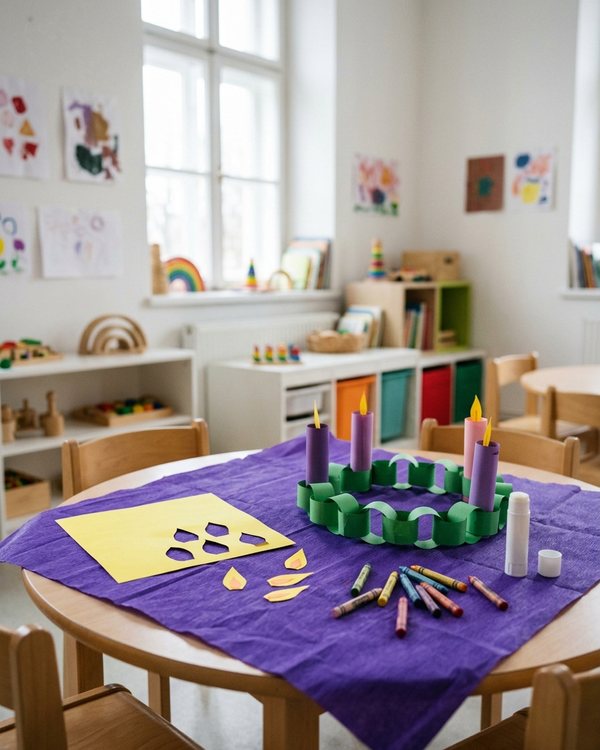
The napkin is the simplest tool there is. One piece of cloth in the color of the season, in the middle of the table where you eat. You do not have to explain it; sooner or later a child asks why it is purple today, and that is the conversation. No cloth? Construction paper under the fruit bowl works.
What liturgical year is it in 2026: A, B or C?
On Sundays the Church reads the Gospels in a three-year cycle: Year A is Matthew, Year B is Mark, Year C is Luke, with John read at Easter every year and filling in for the shorter Mark in Year B (USCCB). The cycle changes on the First Sunday of Advent, not on New Year’s Day. history
Weekdays have a two-year cycle for the first reading: Cycle I in odd-numbered years, Cycle II in even-numbered years. It matters only in Ordinary Time; Advent, Christmas and Lent have their own seasonal readings, which is why the USCCB calendar prints the cycle only over the Ordinary Time weeks.
| until Nov 28, 2026 | from Nov 29, 2026 | |
|---|---|---|
| Sundays | Year A (Matthew) | Year B (Mark), through Nov 21, 2027 |
| Weekdays in Ordinary Time | Cycle II | Cycle I: Jan 11 – Feb 9 and May 17 – Nov 27, 2027 |
Both lines come straight from the USCCB calendars (2026, 2027). The first Gospel of Year B, on November 29, 2026, is Mark 13:33–37, Jesus telling his disciples to stay awake (Loyola Press). Scripture
For a child, “Year B” is an abstraction; “this year we listen to Mark” is not. Mark is “this shortest of all New Testament gospels,” as the New American Bible’s introduction puts it, the one “where one incident follows directly upon another” (USCCB), which makes it the easiest to retell on the drive home.
What do the liturgical colors mean?
The colors are not the priest’s choice. They are set by the General Instruction of the Roman Missal, no. 346, which in the US edition adds two local permissions (USCCB, GIRM Chapter VI). Their purpose, says no. 345, is to show outwardly “Christian life’s passage through the course of the liturgical year.” The third column is the catechetical reading families and classrooms use; the Missal gives the rule, not the symbolism. history
| Color | When (GIRM 346) | What it says to a child |
|---|---|---|
| white | Easter Time and Christmas Time; Trinity Sunday; feasts of the Lord other than his Passion; Mary, the angels, saints who were not martyrs; All Saints | the biggest joy |
| red | Palm Sunday, Good Friday, Pentecost, the Lord’s Passion, apostles and evangelists, martyrs | the fire of the Holy Spirit and the blood of the martyrs |
| green | Ordinary Time | hope and growing |
| violet (purple) | Advent and Lent; may also be used at Masses for the dead | getting ready, saying sorry |
| rose | may be used, “where it is the practice,” on Gaudete Sunday (Third of Advent) and Laetare Sunday (Fourth of Lent) | joy peeking through the waiting |
| black | in the US, white or black may be used, besides violet, at funerals and Masses for the dead | rare today; you may never see it |
| gold or silver | in the US, on more solemn occasions; festive vestments may be used “even if not of the color of the day” | the best clothes for the biggest day |
Three things children ask about:
- “Why is Father in gold?” Because it is a big day and the parish owns a fancier vestment (346 g and h).
- “Why is it blue?” Blue is not on the list. If you see it on a Marian feast, it is a local habit, not the Missal.
- “Why is it pink?” The two rose Sundays this year are December 13, 2026 and March 7, 2027. The USCCB calendar lists both as “violet or rose”: a permission, not a rule, so a pastor in purple that day has done nothing wrong.
What color is it today? A game for the car
First the season: violet, white or green from the big table. Then the day: a martyr’s memorial turns green into red; a feast of Mary or a non-martyr saint turns it white. The USCCB calendar PDF prints the color next to every day of the year, so it is a one-line check on your phone (USCCB 2027).
With children it becomes a Sunday game: guess the color. On the way to Mass, everyone says what color the priest will be wearing and why. Whoever is right picks the napkin for the coming week. The point is not winning; it is that your child walks into church with a question already in their head and looks for the answer at the altar. If Sunday mornings are a struggle in your house anyway, guessing the color is a better opener than an order; more on that in Mass with toddlers.
Holy days of obligation in 2026–27, and the Saturday-Monday rule
In the US there are six holy days of obligation besides Sundays: January 1, the Ascension, August 15, November 1, December 8 and December 25. Since January 1, 1993 the US bishops have one extra rule: when January 1, August 15 or November 1 falls on a Saturday or a Monday, the obligation to attend Mass is lifted (USCCB, complementary norm on canon 1246). The rule does not touch Christmas or December 8; a 1999 decree on the same page lets each province move the Ascension to Sunday. history
For this liturgical year: Tue Dec 8, 2026, Fri Dec 25, 2026 and Fri Jan 1, 2027 all hold. The Ascension, Thu May 6, 2027, holds in the five provinces above and is Sunday, May 9 elsewhere. Aug 15, 2027 is a Sunday anyway. Mon Nov 1, 2027, All Saints, is the one the rule catches; the calendar says it in so many words, “not a Holyday of Obligation this year” (USCCB 2027). Go if you can; it is the best day of the year to bring the saints out at home. Wed Dec 8 and Sat Dec 25, 2027 hold, and the Sunday after Christmas is a separate obligation.
In England and Wales the list is different: Christmas, Epiphany (January 6), the Ascension, Sts. Peter and Paul (June 29), the Assumption and All Saints; Epiphany and the Ascension were reinstated as holydays from the First Sunday of Advent 2017. The transfer rule, a bishops’ decision of 1984, runs the other way from the American one: Epiphany, Peter and Paul, the Assumption or All Saints falling on a Saturday or Monday is moved to the Sunday, not dropped; Christmas is never moved (CBCEW, Liturgy Office). So in 2027 All Saints is kept on Sunday, October 31, and Epiphany on Wednesday, January 6.
A liturgical wheel from a paper plate
Catholic Icing’s version uses two matching paper pieces joined with a brad, the top one with a window cut in it: “You can turn it and just see one season at a time!” (Catholic Icing). A paper plate works the same and is sturdier; that part is our adaptation. tradition
- Bottom plate: seven wedges with a ruler: Advent, Christmas, Ordinary Time, Lent, Triduum, Easter, Ordinary Time again, colored violet, white, green, violet, white, white, green. Make the two green wedges the biggest; Ordinary Time is more than half the year, and a child who colors that in understands it better than one who is told.
- Top plate: cut a window the size of one wedge and push a brass brad through both centers.
- Hang it on the fridge. On the first day of a new season (dates in the table), the child turns the window. Seven turns a year.
Older kids can add a dot for each rose Sunday and a red stripe for Palm Sunday, Good Friday and Pentecost.
How to walk through the year without doing everything
One thing per season, the same thing every year. Children prefer repetition to novelty, and so do tired parents.
- Before Nov 29: the wreath and a violet napkin. Where to get a wreath, which candles, and what to say each Sunday: Advent with kids.
- Dec 24: a white tablecloth that stays on through the Baptism of the Lord, January 10.
- Jan 3 (Epiphany in the US): chalk over the front door, the one tradition that takes four minutes: Epiphany chalk the door.
- Jan 11: green, and a houseplant your child waters.
- Feb 10: violet, and a jar for slips of paper with good deeds.
- Mar 7: a rose ribbon on the violet napkin for one Sunday.
- Mar 25–28: three short evenings, one sentence each from the table. On Friday, a bare table with no decoration at all.
- Mar 28 – May 16: white and a candle at Sunday dinner; on Pentecost, a red ribbon.
- May 17: green until the end of November, and a saint’s “mini-holiday” or two along the way.
A napkin does not replace the conversation. It starts it, which on a school night is most of the job.
As of October 2026. Dates checked against the USCCB liturgical calendars for 2026 and 2027.

Eryk Panter
I make HOSANNA! with my family, at our own table. I write the rules, dig through the sources and work on the pictures; the children play first and tell me straight what does not work. Here I write what I was looking for as a dad: how to talk with children about the saints, concretely, with sources and without sugar-coating.
Frequently asked questions
What liturgical year is it in 2026: A, B or C?
Until Saturday, November 28, 2026 it is Year A (weekday Cycle II). From the First Sunday of Advent, November 29, 2026, it is Year B, with the Sunday Gospel mostly from Mark; weekdays in Ordinary Time 2027 use Cycle I. Year C begins November 28, 2027.
What are the seasons of the liturgical year, in order?
Advent, Christmas Time, Ordinary Time (first part), Lent, the Easter Triduum, Easter Time and Ordinary Time (second part). Ordinary Time has 33 or 34 numbered weeks; its last Sunday is the Solemnity of Christ the King.
What do the liturgical colors mean?
White for Christmas, Easter and feasts of the Lord, Mary and saints who were not martyrs; red for Palm Sunday, Good Friday, Pentecost, apostles and martyrs; green for Ordinary Time; violet for Advent and Lent; rose, optionally, on the Third Sunday of Advent and the Fourth Sunday of Lent. The list is in the General Instruction of the Roman Missal, no. 346.
When does Advent 2026 start?
Sunday, November 29, 2026, the Sunday after Thanksgiving. It ends before Evening Prayer of Christmas on December 24. The Third Sunday of Advent, when the priest may wear rose, is December 13, 2026.
When are Ash Wednesday and Easter in 2027?
Ash Wednesday is February 10, 2027. Palm Sunday is March 21, Holy Thursday March 25, Good Friday March 26 and Easter Sunday March 28, 2027. Pentecost is May 16, 2027.
What are the holy days of obligation in 2027 in the US?
January 1 (Friday), the Ascension (Thursday, May 6, in the provinces of Boston, Hartford, New York, Omaha and Philadelphia; elsewhere it moves to Sunday, May 9), December 8 (Wednesday) and December 25 (Saturday). August 15 falls on a Sunday. November 1 falls on a Monday, so by the US bishops' rule the obligation is lifted that year.
Sources
Marks: [H] — Scripture, document, recorded fact · [T] — tradition, legend, custom · [N] — Church teaching · [D] — study, data.
- DUSCCB: Liturgical Calendar for the Dioceses of the United States of America 2027 (PDF)
- DUSCCB: Liturgical Calendar for the Dioceses of the United States of America 2026 (PDF)
- NUSCCB: General Instruction of the Roman Missal, Chapter VI, nos. 345–346 (color of sacred vestments)
- NUSCCB: General Instruction of the Roman Missal, Chapter II, nos. 53 and 62 (the Gloria omitted in Advent and Lent; the Alleluia replaced in Lent)
- NUSCCB, New American Bible: introduction to the Gospel according to Mark ('this shortest of all New Testament gospels')
- NUniversal Norms on the Liturgical Year and the General Roman Calendar (1969), nos. 1–44 (Liturgy Office of England and Wales, PDF)
- NUSCCB: Complementary norm on canon 1246 §2 — holy days of obligation in the United States (decree of 1991, in force since 1993)
- NUSCCB: Questions about the Scriptures used during Mass (Sunday cycles A, B, C; weekday cycles I and II)
- NLoyola Press, Sunday Connection: First Sunday of Advent, Cycle B (Mark 13:33–37)
- NCatechism of the Catholic Church, 1163–1173: the liturgical year, the Lord's Day, the saints (vatican.va)
- HCongregation for Divine Worship, decree of May 29, 2014: St. John XXIII (October 11) and St. John Paul II (October 22) inscribed in the General Roman Calendar as optional memorials
- HJohn Paul II, homily at the beginning of his pontificate, St. Peter's Square, 22 October 1978: 'Do not be afraid' (vatican.va)
- NCatholic Bishops' Conference of England and Wales: Holydays of Obligation — England and Wales (2017)
- NLiturgy Office of England and Wales: Holydays of Obligation (list and the Saturday/Monday transfer rule)
- TCatholic Icing: Catholic Liturgical Season Craft (the two-circle wheel with a brad)