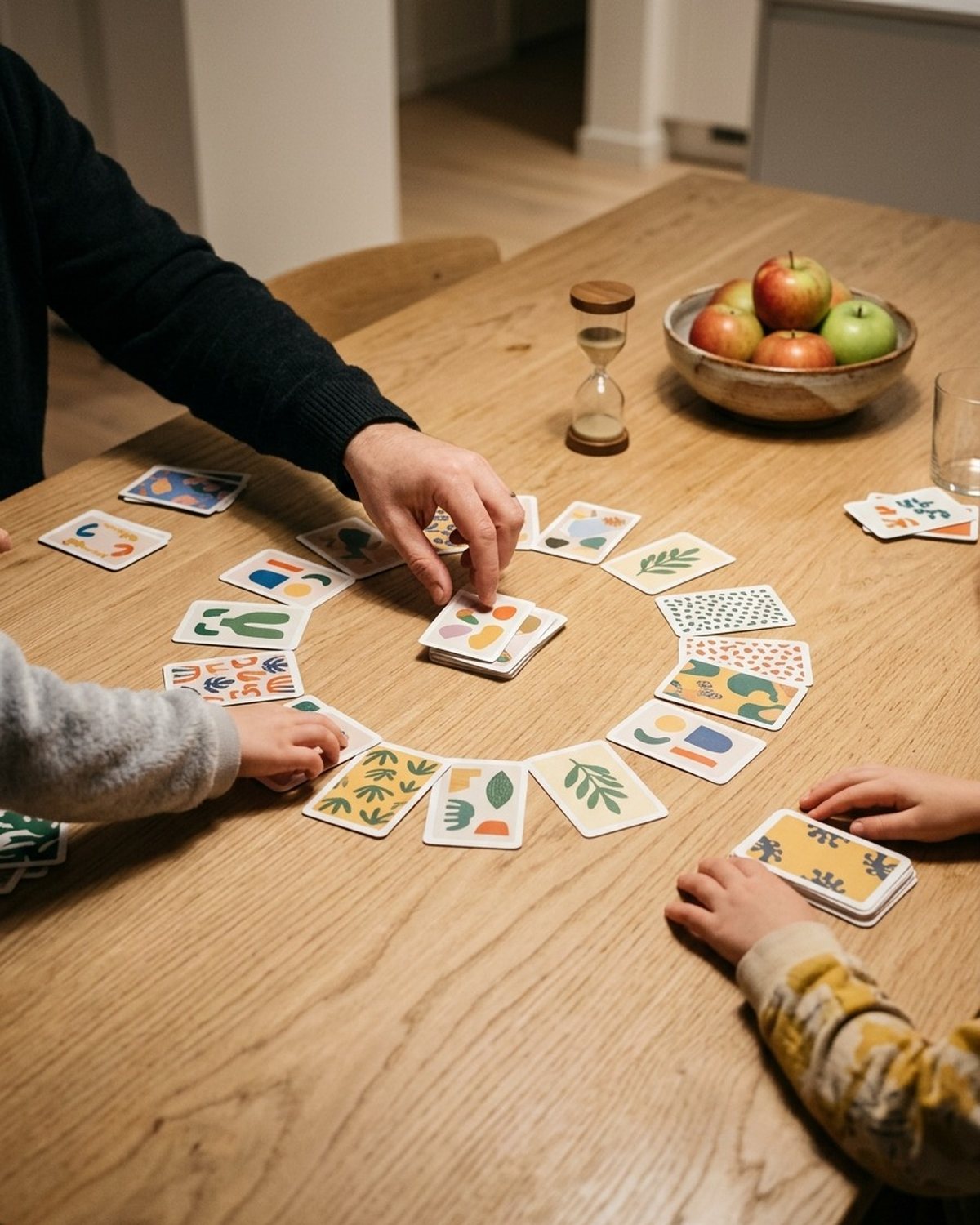
None of the fifteen games below needs a box. Most need nothing at all; the rest need a stuffed animal, index cards or a roll of tape. They are grouped by age, each with where it works best (home, CCD class, the car, the pew) and with what the child actually takes away from it, because “it’s a Bible game” doesn’t tell you much.
Two rules hold for all of them. Keep a round short: ten minutes with a preschooler, fifteen with a ten-year-old. And give points for knowing or spotting something, never for being holier than your brother. In one of our playtests a new rule came up at the table, and we have kept it ever since: you can ask someone for help, and if you answer together, the helper scores too.
Why play games about faith at all?
The Catechism says plainly that “parents have the first responsibility for the education of their children” (CCC 2223) and that education in the faith “should begin in the child’s earliest years” (CCC 2226). history It doesn’t say that has to look like a lesson. The American Academy of Pediatrics writes that “play is not frivolous”: it builds the social-emotional, language and self-regulation skills behind executive function (Yogman et al., Pediatrics, 2018). A game won’t replace Mass, prayer or CCD; it gives you ten minutes in which a story gets told three times.
Games for ages 3–6: point, move, find
At this age nothing should depend on reading. The child answers by pointing, running or making an animal noise.
1. The lost sheep (home, 2 minutes of prep). Hide a stuffed sheep (or any soft toy) while your child covers their eyes. When it’s found, read or tell Luke 15:4–6: the shepherd leaves the ninety-nine and goes after the lost one “until he finds it”, then carries it home on his shoulders “with great joy” (Luke 15). Scripture Then swap: your child hides it, you search. What they learn: the parable by heart, and the feeling at the center of it, that being found is a party.
2. Two by two (car or kitchen). “Into the ark went two lions.” The next player repeats it and adds a pair: “two lions and two ducks”. Keep going until someone forgets. God tells Noah to bring “two of every kind” (Genesis 6:19–20). Scripture What they learn: memory, turn-taking, and one detail of the Flood story they will never lose. For the full story, see Bible stories for kids.
3. Color hunt at Mass (the pew). Before Mass, ask: “What color will Father wear today?” Then look for the same color on the banners, the cloth hanging from the ambo or the front of the altar. The colors follow the season: green in Ordinary Time, violet or purple in Advent and Lent, white at Christmas and Easter, red on Palm Sunday, Good Friday, Pentecost and the feasts of martyrs and apostles. Rose “may be used” on the third Sunday of Advent and the fourth of Lent, and in US dioceses gold or silver may be worn on more solemn occasions (GIRM 346). history This season gives you a good run: white for All Saints on Sunday 1 November, green again, white for Christ the King on 22 November, violet from the First Sunday of Advent on 29 November, and maybe rose on 13 December. What they learn: that the year has seasons and the church shows them. More in the liturgical year for kids.
4. I spy in church (before or after Mass). “I spy something where the water for baptism is kept.” Walk over to the font, the tabernacle with its lamp, the ambo where the readings are read, the altar. What they learn: the words for the places they see every Sunday, which makes the Mass less of a long wait.
5. Homemade saint memory (home, 15 minutes of prep, once). Take ten index cards. On five, draw a saint’s sign: keys, a sling and five stones, a little wolf, a lily, a fish. On the other five, write the name and a stick figure: Peter, David, Francis, Joseph (the lily, by tradition) and the archangel Raphael (the fish from Tobit 6). Play memory: a pair is a sign plus its saint. What they learn: that saints are recognized by a sign, which is how they will meet them in every church and stained-glass window.
Games for ages 6–9: guess, act out, put in order
6. Saint charades (home or CCD, two teams). Whisper a saint to one player, who acts out the sign, not the name. Peter holds up keys, because Jesus says “I will give you the keys to the kingdom of heaven” (Matthew 16:19). Scripture David picks up five stones and swings a sling (1 Samuel 17:40). Scripture Francis talks to birds or calms a wolf. (A longer list of saints and their signs is in saints for kids.) Those two stories come from what the Catholic Answers encyclopedia calls “the early legends”, not from a dated record (Catholic Answers). tradition What they learn: attributes, and, if you say “the story goes…”, the difference between Scripture and legend.
7. Story in order (home or CCD, 5 minutes of prep). Draw four quick scenes from one story on four cards: David with his sheep, the giant, the five stones, the giant falling. Shuffle; your child lays them in order and tells the story from the cards. What they learn: sequence and retelling, the two skills a child needs before they can say “this is a story about trusting God”.
8. What happened next? (bedtime or the car). Start a parable and stop at the turning point: “The shepherd has a hundred sheep. One is gone. What does he do?” Let your child guess, then finish it. What they learn: parables are stories with a twist, and listening for the twist is half the meaning.
9. Bible 20 questions (the car). One player thinks of a person from the Bible. The others ask yes-or-no questions: “Is it a man?” “Old Testament?” “Was there an animal in the story?” Twenty questions to guess. Let a six-year-old pick from a short list you say out loud first. What they learn: to sort what they know (Old or New Testament, before or after Jesus), which is exactly how a fact sticks.
10. Who am I? (CCD or a family party). Tape a saint’s or a Bible person’s name on each player’s back. Everyone walks around asking yes-or-no questions until they guess who they are. Pick names the group has met. What they learn: the questions themselves. “Did I live before Jesus?” “Was I a martyr?” are the categories of the faith.
Games for ages 9–12: sort, scramble, check
11. Alphabet of saints (the car). Take turns going through the alphabet: Agnes, Benedict, Cecilia, Dominic… Stuck on a letter? Bible people count, and so does “Blessed”. What they learn: how many saints they already know, and the urge to look up the ones they don’t.
12. The Mass in order (CCD or home, 10 minutes of prep). The Mass “consists in some sense of two parts, namely the Liturgy of the Word and the Liturgy of the Eucharist”, with “certain rites that open and conclude the celebration” (GIRM 28). history Write those four headings on four cards: Introductory Rites, Liturgy of the Word, Liturgy of the Eucharist, Concluding Rites. On slips write ten moments: the Sign of the Cross, the Gloria, the first reading, the Gospel, the homily, the Creed, the Holy, Holy, Holy, the Our Father, the sign of peace, the final blessing. Players sort the slips under the headings, then in order. Check against the missalette in your pew. What they learn: the shape of the Mass, which helps a lot in the year before First Communion (second grade in many US dioceses; the Diocese of Toledo calls it “the ordinary time”) and again before Confirmation.
13. Verse scramble (CCD, pairs). Write a short verse word by word on slips, for example Matthew 16:18: “You are Peter, and upon this rock I will build my church.” Mix them up; pairs race to put it right. Then read it once together from the Bible. What they learn: one verse by heart, and the habit of checking the words against the book.
14. Which commandment? (CCD). Read short, everyday situations: “Sam took his sister’s candy and said the dog ate it.” Teams hold up fingers for the commandment it touches (sometimes two). Argue it out; there are no trick answers. What they learn: that the commandments are about real life, not a list for a test.
15. In the Bible or not? (the car or the dinner table). Say a sentence; everyone answers “Bible” or “not Bible”. “Adam and Eve ate an apple.” (Not in the text: Genesis 3 just says fruit.) “There were three wise men.” (Matthew 2 names three gifts, not three men.) “Noah took two of every animal.” (Yes, Genesis 6:19, and Genesis 7:2 adds seven pairs of the clean ones.) Scripture Do the same with saints: “St. Francis tamed a wolf.” (Tradition: a lovely story, not a record.) What they learn: the most useful habit in this whole post, telling what the Bible says from what we have heard about it.
All 15 games on one page
| # | Game | Age | Where | Prep | What the child learns |
|---|---|---|---|---|---|
| 1 | The lost sheep | 3–6 | home | one soft toy | the parable of the lost sheep (Lk 15) |
| 2 | Two by two | 3–8 | car, kitchen | none | memory, turn-taking, the Flood |
| 3 | Color hunt at Mass | 3–8 | the pew | none | liturgical seasons and their colors |
| 4 | I spy in church | 3–7 | church | none | font, tabernacle, ambo, altar |
| 5 | Saint memory | 3–7 | home | 10 index cards | saints are known by a sign |
| 6 | Saint charades | 5–10 | home, CCD | none | attributes; Scripture vs legend |
| 7 | Story in order | 5–8 | home, CCD | 4 drawn cards | sequence and retelling |
| 8 | What happened next? | 5–10 | bedtime, car | none | the twist in each parable |
| 9 | Bible 20 questions | 6–12 | car | none | sorting: Old/New Testament |
| 10 | Who am I? | 7–12 | CCD, party | tape, names | the questions of the faith |
| 11 | Alphabet of saints | 8–12 | car | none | names of saints |
| 12 | The Mass in order | 8–12 | CCD, home | 14 cards/slips | the four parts of the Mass |
| 13 | Verse scramble | 9–12 | CCD | slips | one verse by heart |
| 14 | Which commandment? | 9–12 | CCD | a few situations | the commandments in real life |
| 15 | In the Bible or not? | 8–12 | car, table | none | Bible text vs what we heard |
Sentences that keep a game warm:
- for ages 3–6: “You found it! The shepherd was this happy too.”
- for ages 7–12: “I didn’t know that. Let’s look it up after.”
- for anyone who loses: “Rematch? You pick the saint.”
Should you buy a Catholic board game?
You don’t need one to do any of the above. If you do want a boxed game, perhaps for Christmas or a First Communion gift, check it the way you would check any game, plus a few questions that matter for a faith game:
- Does your child have to read? If yes, can they, or can they play in a team with an adult?
- Are the facts careful? A good Bible game says which translation it uses; a good saints game says “legend” where it means legend.
- What earns points: knowing and noticing, or “being good”? The second turns a game into a ranking.
- Can a round fit before bedtime, about 20 minutes?
- If there is a toddler at home, check the age label and any small-parts warning on the box.
- Read a few cards yourself before the first game.
We name no products here. We make a card game about saints ourselves (you saw it once above), so we are not a neutral judge, and we have not played enough of the English-language games to rank them fairly.
As of October 2026. Liturgical dates checked against the USCCB 2026 liturgical calendar. Scripture quotations from the New American Bible, Revised Edition.

Eryk Panter
I make HOSANNA! with my family, at our own table. I write the rules, dig through the sources and work on the pictures; the children play first and tell me straight what does not work. Here I write what I was looking for as a dad: how to talk with children about the saints, concretely, with sources and without sugar-coating.
Frequently asked questions
What are good Catholic games for kids with no prep?
Saint charades, Bible 20 questions, 'Who am I?' with saints, a liturgical-color hunt at Mass and the alphabet of saints need nothing at all. A lost-sheep hide-and-seek needs one stuffed animal; a Mass-in-order game needs a handful of index cards.
What religious games work for CCD or a religious education class?
Games where the whole group plays at once: charades in two teams, 'Who am I?' with a name taped on the back, sorting the parts of the Mass into four piles, or a verse scramble raced in pairs. Each takes 10 to 15 minutes and needs paper, tape and a marker.
What Catholic games can we play in the car?
Games played by voice: Bible 20 questions, the alphabet of saints, Noah's ark two by two (each player adds an animal pair and repeats the list), and 'In the Bible or not?'. None needs reading, so younger siblings can play with an adult.
Should religious games have winners and losers?
They can, as long as points go for knowing something or spotting something, never for being 'the best Catholic'. With younger children, play in teams of a child and an adult, and let a player ask for help.
Do games really help children learn their faith?
They help children remember stories and words, and the American Academy of Pediatrics says play builds language, social and self-regulation skills. But the Catechism puts the first responsibility on parents, beginning in the earliest years, so a game works best as one more way of talking about faith together, not as a replacement for it.
Sources
Marks: [H] — Scripture, document, recorded fact · [T] — tradition, legend, custom · [N] — Church teaching · [D] — study, data.
- NGeneral Instruction of the Roman Missal, 346: liturgical colors, incl. US adaptations (usccb.org)
- NUSCCB, Liturgical Calendar 2026 (All Saints 1 Nov, Christ the King 22 Nov, Advent 29 Nov, 3rd Sunday of Advent 13 Dec)
- NGeneral Instruction of the Roman Missal, 28: the structure of the Mass (usccb.org)
- NDiocese of Toledo: First Communion, 2nd grade as the ordinary time
- HTobit 6:3–4, the fish, New American Bible (bible.usccb.org)
- NCatechism of the Catholic Church, 2221–2231: the duties of parents (vatican.va)
- DYogman M. et al., The Power of Play: A Pediatric Role in Enhancing Development in Young Children, Pediatrics 2018;142(3):e20182058, doi:10.1542/peds.2018-2058
- TCatholic Answers Encyclopedia: St. Francis of Assisi (early legends: the wolf of Gubbio, the birds)
- HLuke 15:4–6, the lost sheep, New American Bible (bible.usccb.org)
- HGenesis 6:19–20, two of every kind, New American Bible (bible.usccb.org)
- HMatthew 16:18–19, the keys to the kingdom, New American Bible (bible.usccb.org)
- H1 Samuel 17:40, five smooth stones, New American Bible (bible.usccb.org)