Before you pull a sheet out of the linen closet, ask the teacher or the catechist one question: what will your child do on stage? An angel who spreads her arms and points to the sky needs different wings from an angel standing in the back row of the choir. A wise man who kneels at the manger will lose his crown unless it has elastic. The costume has to fit the movement, not just the part.
Below are the parts that turn up in almost every nativity play, whether it’s a Catholic school, a CCD class or a parish pageant. For each one: what to make it from with no sewing, the one object that tells the audience who it is, and where that object comes from: the Gospel text or later tradition. The whole play, with a narrator and carols, is in our simple nativity play script for kids.
The base for everyone: a bedsheet tunic
Shepherds, Mary, Joseph and the wise men all wear more or less the same thing. Fold an old flat sheet in half, cut a head hole on the fold, tie it at the waist with rope, and trim the hem above the ankle. The step-by-step is in All Saints’ Day costumes for kids; if your child was a saint on November 1, the tunic may still be in the closet.
The parts differ only in color and in one object. In Britain the classic shortcut is a tea towel on a shepherd’s head; Christianity Today, while warning that precise statistics are hard to come by, wrote in 2023 that before the pandemic around 8 in 10 UK parents said their children had taken part in a nativity play (Christianity Today). In the US a dish towel and a headband do the same job.
Below, Scripture marks a detail that comes straight from the Gospel text, and tradition one that art, liturgy or legend added later.
Nativity costume table: one object for each part
| Part | From things at home | The one object | Where it comes from |
|---|---|---|---|
| Shepherd | brown or gray tunic, a fleece or throw over the shoulders, dish towel on the head | a crook (cardboard tube or broom handle in brown paper) | shepherds keeping watch: Scripture Luke 2:8; the crook: tradition |
| Sheep | white hoodie, white leggings, paper ears pinned to the hood | ears on the hood (no mask) | the flock: Scripture Luke 2:8 |
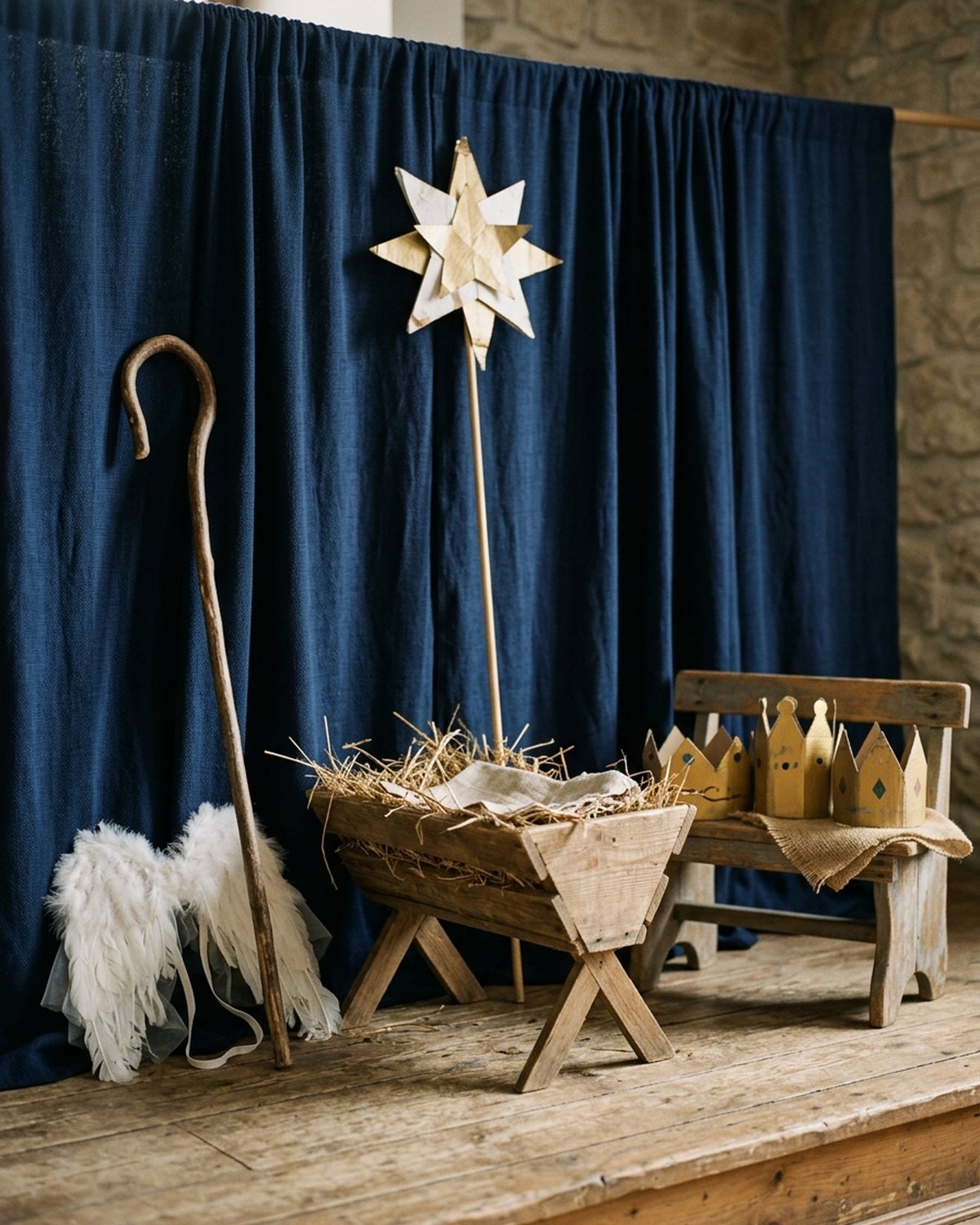
| Angel | white tunic or an adult’s white T-shirt, gold ribbon at the waist, foil halo on a headband | wings on elastic straps | the angel and the heavenly host: Scripture Luke 2:9–13; wings: tradition |
| Mary | light long dress or white tunic, blue scarf or shawl over head and shoulders | a doll wrapped in a cloth | swaddling clothes and the manger: Scripture Luke 2:7; blue: tradition |
| Joseph | brown tunic, a darker blanket pinned at one shoulder as a cloak | a staff (a lily if you like) | Joseph and the carpenter’s trade: Scripture Mt 13:55; staff and lily: tradition |
| Wise man | tunic in a strong color, a bedspread or curtain as a cloak | a crown or turban and a gift box | magi, star, gold, frankincense, myrrh: Scripture Mt 2:1–11; crowns, three of them: tradition |
| Star | yellow or navy T-shirt | a gold star on a stick, carried in front of the wise men | the star going before them: Scripture Mt 2:9 |
| Ox, donkey | brown or gray hoodie, paper ears | ears on the hood | tradition: Isaiah 1:3 and Greccio, 1223 |
Shepherds and sheep
Shepherd. The fleece over the shoulders reads as a sheepskin from the back row. The crook is the object to get right: light, and shorter than the child.
Luke says the shepherds were “living in the fields and keeping the night watch over their flock” (Luke 2:8, NABRE). Scripture A lamb carried to the manger is a later addition: Luke says only that they “went in haste and found Mary and Joseph, and the infant lying in the manger” (Luke 2:16) and mentions no gifts. tradition A stuffed lamb is lovely; it just isn’t a quote from the Gospel.
Sheep. Sheep have no lines, which makes this the right part for three-year-olds and shy children. Leave the face uncovered; the youngest sheep will look for you in the audience anyway.
Angels: do angels have wings in the Bible?
Luke’s angels have light, not wings: “The angel of the Lord appeared to them and the glory of the Lord shone around them,” and then “a multitude of the heavenly host” joined him (Luke 2:9, 13). Scripture Scripture does give wings to some heavenly beings, for example Isaiah’s seraphim: “each of them had six wings” (Isaiah 6:2). The wings on the angel at Bethlehem come from Christian art. tradition
So the most biblical part of an angel costume is the shine: a gold ribbon, a foil halo. The wings make the audience smile, and that’s fine too. Cut them from a cardboard box covered in white paper, or bend two wire hangers and pull white tights over them; attach them with two wide elastic loops like backpack straps.
Mary
A light, long dress or a white tunic, and a blue or navy scarf over the head and shoulders. In her arms, a doll wrapped in a cloth diaper or a small towel.
The wrapped baby is the one detail straight from the Gospel: Mary “wrapped him in swaddling clothes and laid him in a manger,” and the angel gives exactly that to the shepherds as their sign (Luke 2:7, 12). Scripture The blue is from art. The Brooklyn Museum explains it by the sky, since painters showed Mary as Queen of Heaven, and by price: blue pigment, made from lapis lazuli, was expensive and was often saved for the holiest figures in a scene (Brooklyn Museum). tradition
One detail for older children: when the wise men arrive, Matthew says that “on entering the house they saw the child with Mary his mother” (Mt 2:11). Scripture A nativity play puts the shepherds and the magi around the manger on the same night; Matthew’s magi find the child in a house, not at the manger. When to move the wise men in your crèche at home is in our post on the nativity scene and Christmas Mass.
Joseph
A brown tunic, a darker blanket pinned at one shoulder as a cloak, rope at the waist. A beard of cotton balls glued to a strip of card on elastic is optional.
The object is a staff: the same as the shepherd’s crook, only taller and straight. To add something, tape white tissue-paper flowers to the top, or give him a paper lily. The University of Dayton’s Marian Library lists both among Joseph’s symbols in art: a white lily “as a symbol of his virtue, holiness, innocence, and obedience to God,” and “a flowering staff,” linked to the story of his betrothal to Mary (Marian Library). tradition In the oldest telling we could open, the apocryphal Protoevangelium of James, it is not a flower but a dove: “a dove came out of the rod, and flew upon Joseph’s head” (ch. 9). tradition The flower arrives later: in the Golden Legend, a 13th-century collection of saints’ stories, Joseph brings out his rod and “anon it flowered, and a dove descended from heaven thereupon” (Golden Legend). tradition
The same book has Joseph say, “I am an old man, and she is a young girl.” tradition The Catholic Encyclopedia (1910) calls an elderly Joseph at his marriage improbable (Catholic Encyclopedia: St. Joseph), and from the 17th century painters showed him “youthful, vigorous and very practical” (Marian Library). What Scripture does give is his trade: “Is he not the carpenter’s son?” (Mt 13:55). Scripture
Wise men: were they kings, and were there three?
A tunic in a strong color, a bedspread or curtain as a cloak, a cardboard crown in gold foil held on with elastic, and a gift: a tea tin in gold paper, a small jar. Give one wise man a scarf turban instead of a crown, so the three don’t look as if they came off one assembly line.
Matthew writes of “magi from the east” and their gifts of “gold, frankincense, and myrrh” (Mt 2:1, 11). Scripture He does not call them kings and does not say how many there were. The NABRE note on the word says that magi was “originally a designation of the Persian priestly caste” and that “Matthew’s magi are astrologers” (USCCB). history
The crowns came later. The same NABRE note points to Psalm 72 and Isaiah 60 and says, “These Old Testament texts led to the interpretation of the magi as kings.” Psalm 72 says “the kings of Sheba and Seba offer gifts” (Ps 72:10). tradition The Catholic Encyclopedia (1910) adds that no Father of the Church held them to be kings, that Fathers who spoke of three “are very likely influenced by the number of gifts,” and that the names Gaspar, Melchior and Balthasar appear in the West from the seventh century (Catholic Encyclopedia: Magi). tradition
The star
A yellow or navy T-shirt and a gold-foil cardboard star taped to a wooden dowel. The star walks in front of the wise men, which is exactly how Matthew tells it: the star “preceded them, until it came and stopped over the place where the child was” (Mt 2:9). Scripture This is the part for the child who cannot stand still.
The animals: ox, donkey and camels
With a lot of preschoolers, add an ox and a donkey: brown and gray hoodies with paper ears pinned to the hood. The Gospels don’t mention them. They come from a prophecy: “An ox knows its owner, and an ass, its master’s manger” (Isaiah 1:3), and from Greccio, where in 1223 St. Francis “found a manger full of hay, an ox and a donkey” (Admirabile signum, 2). tradition
Camels are not in Matthew either. They probably walked in from Isaiah 60:6, “Caravans of camels shall cover you… All from Sheba shall come bearing gold and frankincense” (Isaiah 60), one of the texts the NABRE note links to the magi. tradition Pope Francis has nothing against extras: he writes that children “often love to add to the nativity scene other figures that have no apparent connection with the Gospel accounts” (Admirabile signum, 6). A camel, a cat, a little drummer: all welcome.
Stage safety
No real candles. Sheet tunics, tissue paper and straw in the manger don’t belong near a flame. The London Fire Brigade calls flameless LED candles “a much safer alternative to real candles or tea lights” and advises keeping candles away from “curtains, papers, furniture, and clothes” (LFB). The US Consumer Product Safety Commission recommends flame-resistant fabrics such as nylon or polyester and warns about costumes brushing against candles (CPSC).
Wings and headgear that don’t block the view. Wings no higher than the head and no wider than the child’s elbows, on elastic over the shoulders, never ribbon around the neck. The CPSC advises tying hats and scarves securely so they don’t slip over children’s eyes.
Length and props. The tunic ends above the ankle, because children kneel by the manger. The CPSC says props should be “made of soft, flexible material”; crooks and stars should also be shorter than the child carrying them.
Small parts. For three-year-olds, no beads or sequins that can come off and go into a mouth. The American Academy of Pediatrics advises avoiding “toys with small or detachable parts” for young children (HealthyChildren.org).
Checklist for the day of the play
- tunic tried on at the dress rehearsal and trimmed above the ankle
- rope or belt at the waist
- the one object: crook, wings, swaddled doll, staff, crown and gift, star
- spare elastic for crowns and wings
- a few safety pins in a small box
- battery tea light or flashlight, if the scene needs light
- warm socks or slippers
- a bag with your child’s name on it, so costumes don’t get mixed up in the classroom
What to tell your child about their part
For a 3- to 6-year-old, one sentence they can say if anyone asks “Who are you?”:
- Shepherd: “I looked after sheep at night, and an angel told me Jesus was born.”
- Angel: “I brought the good news. Don’t be afraid!”
- Mary: “I am Jesus’ mother. I wrapped him up and laid him in the manger.”
- Joseph: “I am Joseph. I took care of Mary and baby Jesus.”
- Wise man: “I followed the star and brought a present for Jesus.”
For a 7- to 12-year-old, one question: “Find your part in Luke 2 or Matthew 2. What does the Gospel say about you, and what did people add later?” A shepherd finds the flock but no lamb; a wise man finds the gifts but no crown.
A costume doesn’t have to be beautiful. It’s enough if your child can walk, kneel and sing in it, and the audience knows at once who is standing by the manger.
As of October 2026. Scripture quotations from the New American Bible, Revised Edition.

Eryk Panter
I make HOSANNA! with my family, at our own table. I write the rules, dig through the sources and work on the pictures; the children play first and tell me straight what does not work. Here I write what I was looking for as a dad: how to talk with children about the saints, concretely, with sources and without sugar-coating.
Frequently asked questions
How do I make a shepherd costume for a nativity play without sewing?
A brown or gray tunic from an old sheet, tied with rope; a fleece or small blanket over the shoulders as a sheepskin; a dish towel or tea towel on the head held with a headband. The one thing that matters is the crook: a cardboard tube or broom handle wrapped in brown paper, always shorter than the child.
How do I make angel wings that don't get in the way?
Cut them from a cardboard box or bend two wire hangers and pull white tights over them, then attach them to the back with two wide elastic loops worn like backpack straps. Keep them no higher than the top of the head and no wider than the child's elbows, and never tie anything around the neck.
Were there really three wise men, and were they kings?
Matthew's Gospel calls them magi from the east and does not give their number. The Catholic Encyclopedia says Fathers who spoke of three were very likely influenced by the three gifts, and that no Father of the Church held them to be kings. The royal image came from Psalm 72 and Isaiah 60, which the liturgy applied to them. Crowns are a fine tradition, just not the text of Scripture.
Are the ox and the donkey in the Bible?
Not in the Christmas story. The Gospels do not mention them. They come from Isaiah 1:3, 'An ox knows its owner, and an ass, its master's manger', and from the manger St. Francis prepared at Greccio in 1223 with an ox and a donkey.
Does Joseph need a gray beard?
No. An apocryphal book from the early centuries has Joseph call himself an old man, and medieval art often painted him that way. From the 17th century artists also showed him young and strong. A brown cloak and a staff are enough; a cotton-ball beard is optional.
Can we use real candles in a nativity play?
We would not. Sheet tunics, tissue paper and straw by the manger sit too close to a flame. The London Fire Brigade calls flameless LED candles a much safer alternative, and the US Consumer Product Safety Commission has long warned about costumes brushing against candles. A battery tea light or a flashlight under gold foil works just as well on stage.
Sources
Marks: [H] — Scripture, document, recorded fact · [T] — tradition, legend, custom · [N] — Church teaching · [D] — study, data.
- HLuke 2 — New American Bible, Revised Edition (bible.usccb.org)
- HMatthew 2, with notes on the magi — New American Bible, Revised Edition (bible.usccb.org)
- HMatthew 13:55 — New American Bible, Revised Edition (bible.usccb.org)
- TIsaiah 1:3 — New American Bible, Revised Edition (bible.usccb.org)
- TIsaiah 6:2 — New American Bible, Revised Edition (bible.usccb.org)
- TIsaiah 60:6 — New American Bible, Revised Edition (bible.usccb.org)
- TPsalm 72:10 — New American Bible, Revised Edition (bible.usccb.org)
- TCatholic Encyclopedia: Magi (newadvent.org, 1910)
- HCatholic Encyclopedia: St. Joseph (newadvent.org, 1910)
- TProtoevangelium of James, ch. 9 (apocryphal; newadvent.org)
- TUniversity of Dayton, Marian Library: The Silent Saint (17 March 2025)
- TBrooklyn Museum: Why is Mary often depicted in blue?
- TJacobus de Voragine, The Golden Legend (13th c.), Caxton translation: The Nativity of Our Lady, the miracle of Joseph's rod
- HPope Francis, Apostolic Letter Admirabile signum (1 December 2019), nos. 2, 5, 6 (vatican.va)
- DChristianity Today: Nativity plays in UK schools (12 December 2023)
- DUS Consumer Product Safety Commission: Halloween costume and decoration safety, release 11-026 (28 October 2010)
- DLondon Fire Brigade: Candles
- DHealthyChildren.org (American Academy of Pediatrics): Choking Prevention