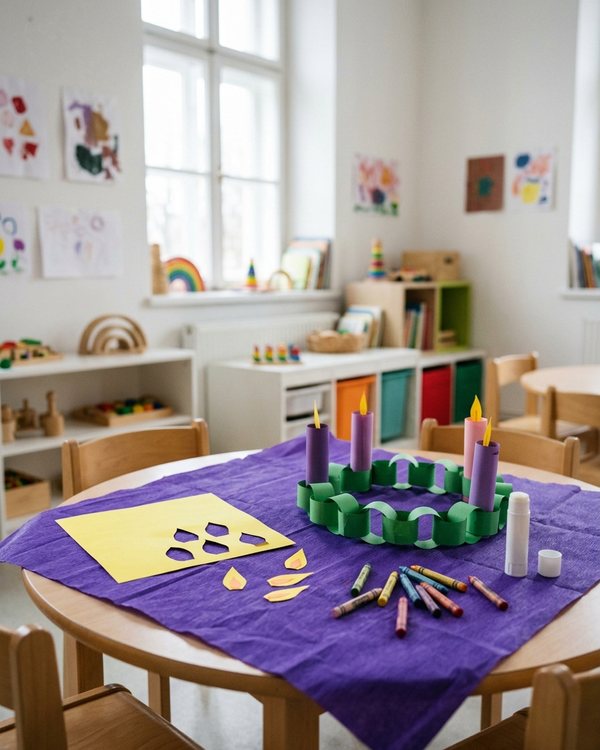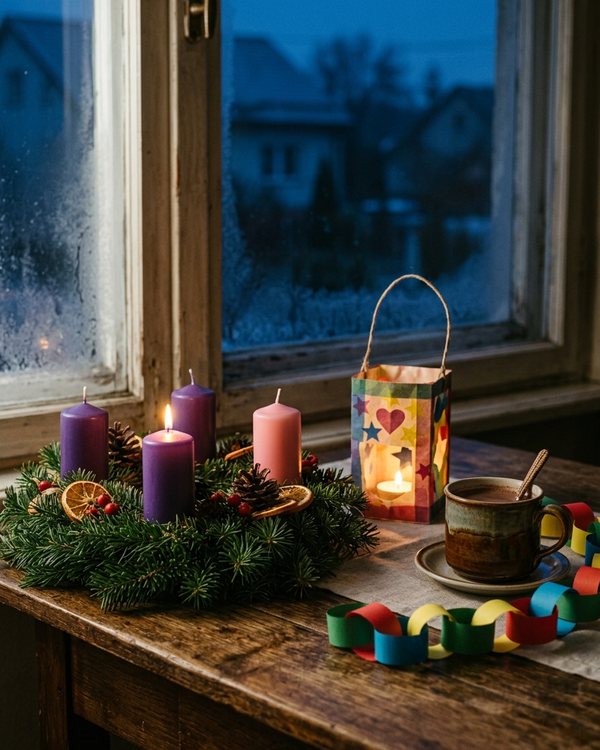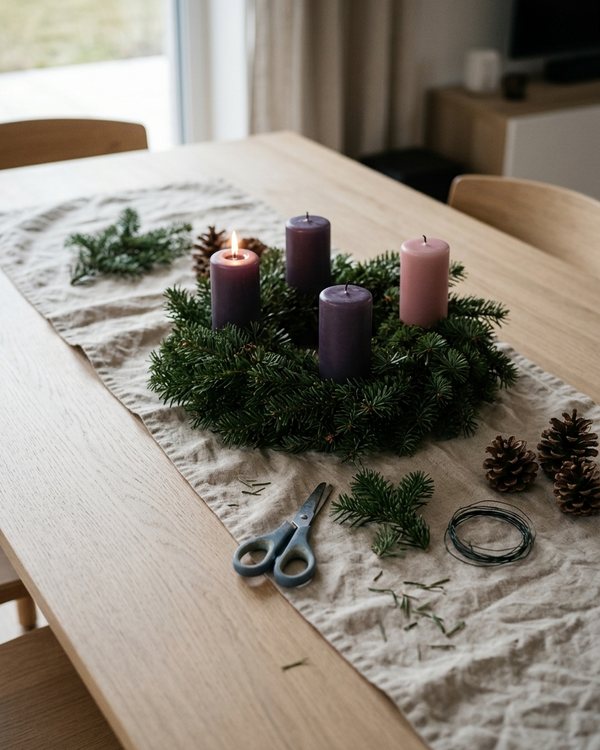

For many Catholic children the Angel of God is the first prayer they can say alone. It rhymes, it is four lines long, and it is addressed to someone who is right there in the dark with them. Below are the words as the US bishops print them, what each line means in language a six-year-old can use, where the prayer came from, what the Church actually teaches about guardian angels, and a bedtime routine that takes about thirty seconds.
Angel of God: the prayer and a parent’s cheat sheet
The wording on the USCCB prayer card (Prayer to Your Guardian Angel, usccb.org):
Angel of God, my guardian dear, to whom God’s love commits me here, ever this day be at my side, to light and guard, to rule and guide. Amen.
At bedtime say “ever this night”. That is not a modern tweak: some Latin prayer books add hodie or hac nocte, “today” or “tonight”, and English prayer books print “this day (or night)” (Catholic Culture). The Church’s current Manual of Indulgences gives the Latin without either word. Some prayer books put a comma after “day”; the USCCB card does not. The words are the same.
Children repeat sounds long before they understand them. “Commits me here” and “to rule” mean nothing to a five-year-old until somebody translates them once, calmly, preferably in daylight and not during the prayer itself. This table is for that conversation.
| Line | What it means | How to say it to a child |
|---|---|---|
| Angel of God, my guardian dear | I am talking to the angel God gave me to look after me. | “God gave you an angel. He watches over you, and you can talk to him.” |
| to whom God’s love commits me here | God, because he loves me, handed me into this angel’s care. | “God loves you so much that he asked an angel to take care of you.” |
| ever this day (night) be at my side | Please stay close to me the whole time. | “Stay next to me all night.” |
| to light | Help me see what is good and true. | “Help me see what is right.” |
| and guard | Keep me safe. | “Keep me safe.” |
| to rule | Help me stay on the right path when I want to go the wrong way. | “Help me choose the good thing, even when I don’t feel like it.” |
| and guide | Lead me to God. | “Bring me to Jesus.” |
| Amen | Yes, I really mean it. | “Amen means: yes, I want that.” |
The four verbs are the heart of the prayer. If your child remembers nothing else, “show me, keep me, steer me, bring me home” is the whole thing.
Where does the Guardian Angel prayer come from?
The English is a rhymed translation of the Latin Angele Dei: Angele Dei, qui custos es mei, me tibi commissum pietate superna illumina, custodi, rege et guberna. Amen (the text of the current Manual of Indulgences; older prayer books add hodie, “today”, before illumina, Catholic Culture). You can hear the four verbs in the last line: illumina, custodi, rege, guberna.
Who wrote it is not certain. history The prayer was long attributed to St. Anselm of Canterbury, the eleventh-century Benedictine. More recent scholarship points to Reginald of Canterbury, a monk of the same period, whose Life of St. Malchus contains a prayer to the angels that closely resembles ours. Aleteia puts it carefully: “It is uncertain if Reginald composed the Angel of God prayer” (Aleteia). Some websites name Reginald without that caveat; we keep it.
Two more things worth knowing. The Church attaches a partial indulgence to reciting an approved prayer to one’s guardian angel, the Angele Dei among them (Catholic Culture, Wikipedia). And EWTN goes further than “recommended”: praying it twice a day, morning and evening, “should not be an option” (EWTN), which is why it sits so naturally at the two ends of a child’s day.
Do Catholics believe in guardian angels?
Yes, and more firmly than the greeting-card version suggests.
The Catechism says the existence of “the spiritual, non-corporeal beings that Sacred Scripture usually calls ‘angels’ is a truth of faith” (CCC 328). They are “purely spiritual creatures” with “intelligence and will”, “personal and immortal” (CCC 330). And then the paragraph every parent should know, CCC 336: “From its beginning until death, human life is surrounded by their watchful care and intercession. Beside each believer stands an angel as protector and shepherd leading him to life” (Catechism, USCCB edition; press.vatican.va). history
The second sentence is a quotation from St. Basil the Great, bishop of Caesarea, who died in 379 (the Catechism’s footnote points to his Against Eunomius, book III; Catholic Answers Encyclopedia), which tells you how old the belief is. history
The simplest words, though, are Jesus’ own. Speaking of children, he says: “See that you do not despise one of these little ones, for I say to you that their angels in heaven always look upon the face of my heavenly Father” (Matthew 18:10, NABRE). Scripture It is the Gospel read at Mass on 2 October, the memorial of the Holy Guardian Angels (Matthew 18:1-5, 10; Catholic Culture, 2 October, Vatican City State). The Old Testament line most often printed on holy cards is Psalm 91: “For he commands his angels with regard to you, to guard you wherever you go” (Psalm 91:11, NABRE). Scripture
Does every child have one, or only the baptized? The common opinion of Catholic theologians, following Thomas Aquinas, is that all people have a guardian angel at least from birth; the idea that the angel arrives at baptism is “a speculation, not a teaching of the Church” (Catholic Answers). So your child’s friend who is not Catholic has one too, which is a good thing to be able to say when the question comes up in the car.
Is St. Michael a guardian angel?
Children mix these up, and so do a lot of adults, because the one angel with a sword and a name is the one on the stained glass. He is not a guardian angel. Michael, Gabriel and Raphael are archangels, named in Scripture with jobs of their own: Michael fights the dragon in Revelation and appears in Daniel and Jude; Gabriel brings messages, to Daniel, to Zechariah and to Mary; Raphael travels with Tobias in the Book of Tobit. Their names mean “Who is like God?”, “God is my strength” and “God has healed” (Catholic Culture). Scripture The Church keeps their feast on 29 September, three days before the Guardian Angels; in England the day is still called Michaelmas.
Your child’s guardian angel has no name that we know. The Church has never given guardian angels names, and your child does not need to make one up. “My angel” is enough.
How to pray the Guardian Angel prayer at bedtime: a 30-second routine
The American Academy of Pediatrics’ bedtime advice fits in three words: Brush, Book, Bed. What makes it work is a “predictable series of steps” that help a child wind down, at the same time each night (AAP, Brush, Book, Bed). A prayer slots into that series without adding anything to fight about, as long as it stays short and comes in the same place every night, after the book and before the light goes off.
The routine, in real time:
| Seconds | What happens |
|---|---|
| 0–5 | Light down, child under the covers. You sit on the edge of the bed. |
| 5–10 | Sign of the Cross together. “In the name of the Father…” |
| 10–25 | Angel of God, said together, with “ever this night”. |
| 25–30 | One sentence of your own: “Thank you, God, for today. Please take care of Grandpa.” Then “Amen.” |
| after | A hand on the duvet, a kiss, and you leave or stay as you normally would. |
Thirty seconds is the whole point. If you make it longer, the prayer gets dropped on the nights when everyone is late and tired, and those are precisely the nights it belongs. The AAP’s other warning applies as well: no wrestling or tickling right before, because “active play may make your child too excited to sleep” (AAP, Bedtime Trouble).
By age:
| Age | What to do | What to let go of |
|---|---|---|
| 2–3 | You say it, your child lies against you. After a week or two they fill in the rhymes: “…dear”, “…here”, “…side”, “…guide.” | Correcting every word. The rhyme carries it. |
| 4–6 | Say it together, then let your child lead the first line alone. Go through the table above one line per week, in the daytime. | Making it a test. Questions like “where is he right now?” are good, not interruptions. |
| 7–9 | Your child leads, you answer. Add one sentence in their own words. Around First Communion the prayer often turns into “homework from religious ed”; at bedtime let it stay a conversation. | Checking whether it was said “properly”. |
| 10–12 | Show them the Latin and tell them nobody knows who wrote it. Let them decide when they want to pray it. | Reminding. When they stop, ask why. Curiosity works better than nagging. |
A few questions for the daytime, one is enough:
- “What do you think your angel might have helped you with today?”
- “What do you want to ask your angel for tonight?”
- “Who else should your angel look after? Grandpa? Your friend?”
- “Do you remember what ‘to guard’ means?”
If you want to build a fuller evening prayer around it, with the Our Father and a short examen for older children, see bedtime prayers for kids.
What to say when your child asks about their angel
These are the questions that come after the light is off. Short answers, because a long one keeps a child awake.
“Can I see my angel?” No, and neither can I. Angels do not have bodies, so there is nothing to see; the Catechism calls them “purely spiritual creatures” (CCC 330). “Your angel is like a thought from God that is always with you. You can’t see him, but you can talk to him, and he hears you.” Pictures of angels with wings are how artists show something invisible, the way we draw a heart to mean love.
“Does my angel see everything I do?” Yes, and it is not a camera. Children sometimes hear “angel watching” as surveillance. Turn it around: “He’s on your side. When you do something wrong, he doesn’t write it down. He wants to help you fix it.” The Catechism’s words are “protector and shepherd” (CCC 336), not inspector.
“Does my angel have a name?” “We don’t know it. The Bible only tells us the names of a few angels, like Michael and Gabriel. You can just say ‘my angel’.”
“Does Grandma’s angel still look after her?” The Catechism says the angel’s care runs “from its beginning until death” (CCC 336). “Her angel walked with her all her life, right to the end. Now she’s with God, and she doesn’t need guarding any more.” Keep it to that.
“If my angel guards me, why did I fall off my bike?” This one matters, because it is where a child decides whether the prayer is true or magic. Do not promise that nothing bad will ever happen. The Church speaks of care and intercession, not of a world without scraped knees. “Your angel doesn’t stop every fall. He stays with you when it hurts, and he helps you get up.” A child who was told “nothing will happen” and then something happens stops praying. A child who was told “he’s with you” keeps going.
When fear comes back every night. The prayer is a good first thing to reach for in the dark, and worth encouraging: “We’ll say Angel of God together, and then I’ll sit with you until you’re asleep.” But a fear that returns every night for weeks and does not ease is a conversation with your pediatrician or someone who knows your child, not a longer prayer.
Jesus’ sentence from Matthew is the one to leave your child with: their angels always see God’s face. Whatever is in the room at night, the angel in it is looking at God.
If your child likes this prayer, the next step is a saint: someone with a name, a story and a face. Saints for kids explains how to choose one, and Carlo Acutis for kids is a good first one, because he wore sneakers.
As of October 2026. Scripture quotations from the New American Bible, Revised Edition.

Eryk Panter
I make HOSANNA! with my family, at our own table. I write the rules, dig through the sources and work on the pictures; the children play first and tell me straight what does not work. Here I write what I was looking for as a dad: how to talk with children about the saints, concretely, with sources and without sugar-coating.
Frequently asked questions
What are the words of the Guardian Angel prayer?
Angel of God, my guardian dear, to whom God's love commits me here, ever this day be at my side, to light and guard, to rule and guide. Amen. This is the wording in the USCCB's prayer card. At night you may say 'ever this night' instead of 'ever this day'; the Latin original allows both.
What does 'to light and guard, to rule and guide' mean?
Four things we ask the angel for: light (help me see what is good), guard (keep me safe), rule (help me stay on the right path when I want to go wrong), guide (lead me to God). In a child's words: show me, keep me, steer me, bring me home.
Do Catholics believe in guardian angels?
Yes. The Catechism calls the existence of angels a truth of faith (328) and says that beside each believer stands an angel as protector and shepherd leading him to life (336). Jesus himself speaks of children's angels who always look upon the face of the Father (Matthew 18:10). The common view of Catholic theologians, following Thomas Aquinas, is that every person has a guardian angel from birth, not only the baptized.
Who wrote the Angel of God prayer?
Nobody knows for certain. The Latin Angele Dei was long attributed to St. Anselm of Canterbury; scholars now point to a very similar prayer in the Life of St. Malchus by Reginald of Canterbury, a Benedictine monk of the same period (eleventh century). Whether Reginald wrote the version we pray is uncertain.
When is the feast of the Guardian Angels?
2 October, the memorial of the Holy Guardian Angels. The archangels Michael, Gabriel and Raphael have their own feast three days earlier, on 29 September (Michaelmas in England).
Is St. Michael my guardian angel?
No. Michael is an archangel named in Scripture (Daniel, Jude, Revelation) with his own role; Gabriel and Raphael are archangels too. Your child's guardian angel has no name we know. The Church has never named guardian angels, and a child does not need to invent one.
Sources
Marks: [H] — Scripture, document, recorded fact · [T] — tradition, legend, custom · [N] — Church teaching · [D] — study, data.
- NUSCCB: Prayer to Your Guardian Angel (prayer card, PDF)
- NCatholic Culture: Angel of God (Angele Dei) — English and Latin text, Enchiridion of Indulgences 1968
- NCatechism of the Catholic Church 334–338, 2nd edition, USCCB online flipbook p. 89 (wording quoted: 'From its beginning until death'; fn. 203 St. Basil, Adv. Eunomium III, 1)
- NCatechism of the Catholic Church 328–336, Paragraph 5 'Heaven and Earth', first English edition (press.vatican.va; reads 'From infancy to death')
- HCatholic Answers Encyclopedia: St. Basil the Great — bishop of Caesarea, b. c. 329, d. 1 January 379
- NCatholic Culture: 2 October 2026, Memorial of the Holy Guardian Angels — Gospel Mt 18:10
- HMatthew 18:10 — NABRE, RSVCE and NRSVCE side by side (Bible Gateway; bible.usccb.org not reachable at review)
- HPsalm 91:11 — NABRE and RSVCE (Bible Gateway)
- NVatican City State: 2 October, Holy Guardian Angels
- HAleteia: Who composed the Angel of God prayer? (2 Oct 2017)
- HWikipedia: Angel of God — Latin text, attribution, indulgences, day/night variant
- TCatholic Culture: 29 September, Feast of Sts. Michael, Gabriel and Raphael — names, Scripture, Michaelmas
- NCatholic Answers: If we are given a guardian angel at baptism, do non-Christians have one? (Aquinas, ST I:113:4)
- TEWTN: The Guardian Angels — praying it morning and evening 'should not be an option'
- DAAP HealthyChildren.org: Brush, Book, Bed — a predictable bedtime routine
- DAAP HealthyChildren.org: Toddler Won't Go to Sleep? 7 Tips to Help End Bedtime Battles