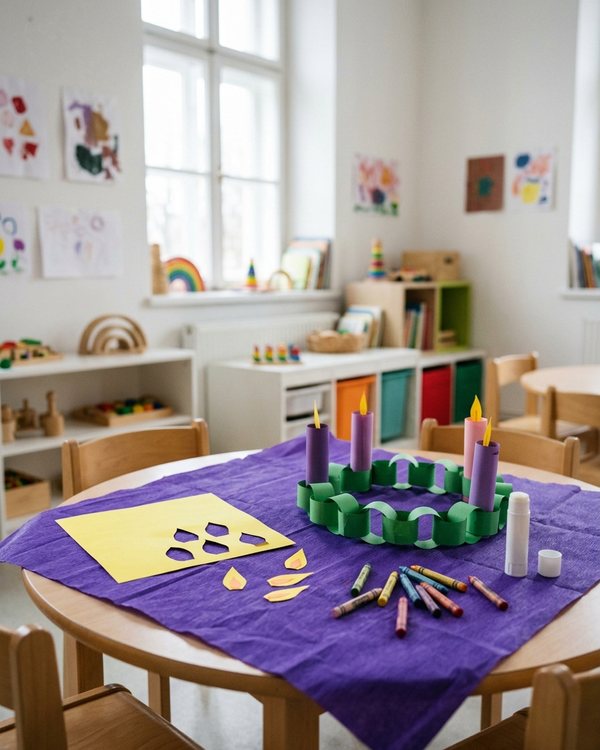
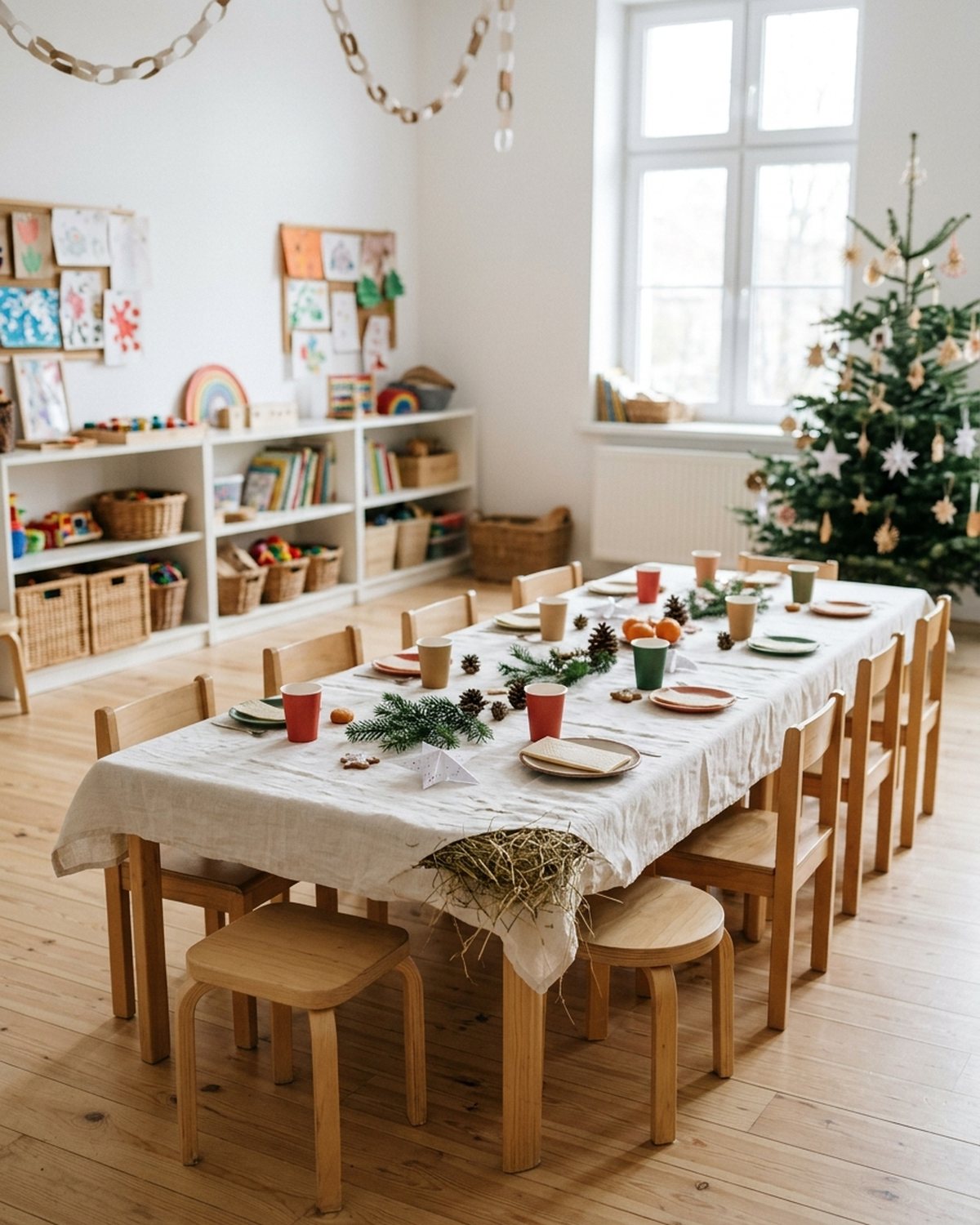
The email from the room parent usually says three things: the date, “please sign up for a snack,” and the price cap for the gift exchange. It does not say what happens during the hour. This post is for whoever runs that hour: a Catholic school teacher, a CCD catechist, a homeschool co-op parent, or a volunteer at a Catholic primary in England. Below: a minute-by-minute plan, games, a snack table, gift rules and a straight answer about public schools.
Labels used: Scripture, history, tradition.
Is a class Christmas party actually in Advent?
Almost always. Most schools hold the party in the last days before winter break, and the Church’s Christmas season has not started yet: it “begins with the vigil Masses on Christmas Eve” and runs to the Feast of the Baptism of the Lord (USCCB). history
That does not make the party wrong. It makes it the last stop of Advent, a party that looks forward to the manger: one candle, the story told as something about to happen, and a closing sentence that sends the children home to the feast. If your class has been following an Advent plan, the party is its last session (Advent lesson plans).
The 45–60-minute plan
For one adult and about twenty children in grades K–4, or the oldest preschool group. With older grades, add talk; with 3- and 4-year-olds, shorten the games. You need: a tablecloth (paper is fine), a handful of straw or raffia on a plate, a battery candle, a small speaker, a bowl with numbered slips for the gifts and two spare wrapped gifts.
| min | what happens | who leads |
|---|---|---|
| 0–5 | Children come in, coats off, the sign-up snacks go on a side table. Everyone sits in a circle or at pushed-together desks. The leader puts the straw in the middle and switches on the candle. | leader |
| 5–8 | One opening question: “What’s your favorite thing your family does at Christmas?” Three or four answers, no comments. | children |
| 8–13 | Luke 2:1–14, read by two older children (verses 1–7 and 8–14), or told in your own words with figures from a crèche for the little ones. | two readers / leader |
| 13–15 | Sign of the cross and grace before meals (text below). Anyone who doesn’t pray sits quietly. Nobody leaves the room. | leader |
| 15–28 | Snack. Children serve themselves; the leader watches the allergy-labeled containers and makes sure nobody eats while running. | everyone |
| 28–40 | One or two games (next section). | children |
| 40–48 | Gift exchange by numbers (rules below). | leader |
| 48–53 | One carol everyone knows, two verses, with a backing track: “Away in a Manger” or “Silent Night” (which carols work with children). | everyone |
| 53–60 | Cleanup (room parents pack the leftovers), one closing sentence: “Christmas starts on Christmas Eve. Keep the party going at home.” | everyone |
45-minute version: one game only, snack cut to ten minutes. For 3–4-year-olds: the story told with crèche figures instead of read, one verse of the carol, and gifts handed out by the adult rather than drawn by number. If the class is also putting on a Nativity play that day, hold the party after the parents have left; children who have just performed are tired and hungry, not focused. A short narrator-led script is in our Nativity play post.
The Gospel moment: Luke 2 in five minutes
This is the part that makes the party Christ-centered, and it is the shortest. Two children read; everyone else listens for one thing. Give the little ones a job: “Listen for where they put the baby.” The answer is in verse 7: “She wrapped him in swaddling clothes and laid him in a manger, because there was no room for them in the inn” (Luke 2:7). Scripture
Then point at the straw on the table. That is why it’s there.
What to say, by age:
3–6: “Jesus was born where the animals were kept, and Mary laid him in a manger, the box the animals ate from. Angels told the shepherds, and the shepherds ran to see him. That’s why we have a party.”
7–12: “The angel said the news was ‘good news of great joy that will be for all the people’ (Luke 2:10). All the people means everyone in this room. The first ones to hear it were shepherds on the night shift, not the emperor in Rome.”
Grace before meals, as printed in the United States Catholic Catechism for Adults (USCCB, p. 536):
Bless us, O Lord, and these thy gifts, which we are about to receive from thy bounty, through Christ our Lord. Amen.
The same page gives a short grace after meals, which works as the closing prayer if you have a minute at the end: “We give thee thanks, for all thy benefits, Almighty God, who live and reign for ever. Amen.” Anyone can lead it: the teacher, a parent or a child.
Christmas party games for the classroom
None of these needs a shopping trip. Pick one for a 45-minute party, two for an hour.
Lost sheep for the shepherds (ages 3–7). Before the party, hide cotton balls (or paper sheep) around the room. On “Go,” children find one each and bring it to the straw on the table. Count them together. Tie-in: the shepherds in Luke 2 were “keeping the night watch over their flock.”
Who’s in the stable? (ages 4–9). Charades. Whisper a role to a child: donkey, sheep, shepherd, angel, one of the Magi carrying a gift, Joseph knocking at the inn. The class guesses. No speaking allowed, which is half the fun.
Gospel freeze (ages 5–10). Read Luke 2:8–14 slowly a second time. Children sit; whenever they hear “shepherds,” “angel” or “manger,” they jump up and freeze. Whoever stands up on the wrong word sits out one round, then comes back.
Star quiz (grades 3 and up). Two teams, ten questions from Luke 2 and Matthew 2: Who was governor of Syria? (Quirinius.) Which town did Joseph and Mary set out from? (Nazareth.) What did the Magi bring? (Gold, frankincense and myrrh, Matthew 2:11.) Scripture A team gets twenty seconds per answer. Older children like the hard ones.
What to bring: classroom Christmas party snacks that are safe
Start with the class allergy list, before anyone signs up for anything. The CDC recommendations for schools, as published by FARE, say plainly: “Avoid the use of identified allergens in class projects, parties, holidays and celebrations” (FARE). Some schools also accept only store-bought food with a label; check your school’s policy before you bake.
For preschool classes, and younger siblings who tag along, the American Academy of Pediatrics lists foods to hold off until about age 4, including popcorn, whole grapes, nuts and seeds, marshmallows, hard or sticky candy and chunks of cheese, and asks that children sit down while they eat (AAP, HealthyChildren.org).
| snack | under 4 | 5 and up | note |
|---|---|---|---|
| clementines | peeled, segments cut small | yes | the easiest Christmas fruit there is |
| sugar cookies, gingerbread | yes | yes | soft, no whole nuts on top |
| mini cupcakes | yes | yes | label them if the class has egg or dairy allergies |
| crackers, pretzels | yes | yes | check the label for wheat, sesame and milk |
| grapes | chopped into tiny pieces | yes | AAP: whole grapes not before about 4 |
| popcorn, candy canes | no | yes | both on the AAP list for little ones |
| hot cocoa with mini marshmallows | cocoa yes, marshmallows no | yes | needs an adult and lukewarm cups |
| cheese cubes, meat sticks | no | yes | chunks of cheese and meat sticks are on the AAP list |
| mince pies (UK) | small pieces | yes | check for nuts in the mincemeat |
Rows that do not name the AAP are our practical advice, not a medical source. Two rules save the teacher a phone call: everything eaten by hand, and an ingredients note on every container.
Gift exchange rules that keep the peace
When a class party goes wrong, it is usually here, and rarely about money: one child gets a toy truck, another a bath set. These rules are simple on purpose:
- One wrapped gift per child, at a fixed price cap set by the teacher or room parent, announced in the first email. Not “around,” a number.
- No name on the gift, no “boy gift” or “girl gift.” Ask for things any child would like: a book, a puzzle, colored pencils, a small craft kit.
- Draw numbers from a bowl, then pick gifts from the pile in order. Quick, fair and nobody sees who brought what.
- No “steal” rounds below 5th grade. White elephant swaps are fun for adults and end in tears at seven.
- Two spare gifts in the teacher’s bag, for the family that forgot or couldn’t.
- Thank the giver out loud even without knowing who it is: “Thank you, whoever brought this.”
If you want a Christ-centered angle without a sermon, tell the class where gift-giving at Christmas points: the Magi “opened their treasures and offered him gifts of gold, frankincense, and myrrh” (Matthew 2:11). Scripture Some classes skip the swap for one shared gift to someone outside the room, such as a parish giving tree; that works best when it’s the children’s idea.
What can you do at a public school Christmas party?
This is for parents of children in a US public school. A Catholic school, a parish CCD class or a homeschool co-op is private and religious by design, and the plan above fits it as it is. What follows summarizes published guidance; it is not legal advice, and the school and its district are the ones to ask.
Teaching about versus celebrating. Finding Common Ground, a consensus guide for public schools by Charles Haynes and Oliver Thomas (First Amendment Center, 2007 edition), puts the line this way: teachers must distinguish between “teaching about religious holidays, which is permissible, and celebrating religious holidays, which is not” (Freedom Forum). history An earlier edition of the guide reprints Religious Holidays in the Public Schools: Questions and Answers, a statement sponsored jointly by 17 national education and religious organizations, which adds that “Sacred music may be sung or played as part of the academic study of music,” and that nativity pageants “are not appropriate in the public school setting” (chapter 8 of that edition). history That is why the event in a public school is a “holiday party” or “winter party,” and why a reading of Luke 2 led by a room parent is likely to be turned down.
Prayer. The U.S. Department of Education issued new guidance on 5 February 2026, replacing the 2023 version (ED press release). It says a teacher may bow her head to say grace before lunch and students may join her, but she “may not instruct her class to pray with her” or pressure students to pray, and that schools “must permit students to pray privately and quietly by themselves, whether in class, at an athletic event, or before a meal.” It also says students may express their beliefs in assignments, which should be “neither penalized nor rewarded on account of its religious perspective” (2026 guidance). history The guidance does not address holiday parties directly.
What that means for your child at the party: they may quietly make the sign of the cross and say grace before eating a cookie, and the guidance says the school must permit it. They should not expect the teacher to lead the class in prayer. The Gospel moment moves home, to CCD, or to the parish. And if your family would rather your child skip a holiday activity, the same holidays statement notes that excusal requests are common in the elementary grades, where holidays are often marked by parties, and that “Such requests are routinely granted” (chapter 8).
In England it is the other way round. The law says each pupil at a community, foundation or voluntary school “shall on each school day take part in an act of collective worship” (s. 70), which in schools without a religious character must be “wholly or mainly of a broadly Christian character”; parents may ask for a child under 16 to be excused, as summarized by the House of Lords Library in 2021. history For maintained schools with a religious character, which include many Catholic primaries, the law ties that worship to the school’s trust deed or to the practice of its faith (Schedule 20), so a plan like the one above will often fit; the head teacher decides how class parties run. Wales shares this law with some changes; Scotland and Northern Ireland have their own rules, which this post does not cover.
For a Catholic parent at a public school, one sentence to give your child before the party covers most of it: “You can say grace in your head before you eat. Nobody has to do it with you.”
As of October 2026. Scripture quotations from the New American Bible, Revised Edition.

Eryk Panter
I make HOSANNA! with my family, at our own table. I write the rules, dig through the sources and work on the pictures; the children play first and tell me straight what does not work. Here I write what I was looking for as a dad: how to talk with children about the saints, concretely, with sources and without sugar-coating.
Frequently asked questions
How do you make a class Christmas party Christ-centered?
Put the Christmas story in the middle of the party, not at the end. Five minutes are enough: a child or two read Luke 2:1–14, everyone says grace before the snack, and the games and the gift exchange point back to the manger (shepherds, angels, the gifts of the Magi). The rest can be an ordinary, noisy class party.
What games work at a class Christmas party?
Games that need no prep and work with 20 children: a hunt for cotton-ball sheep for the shepherds, charades of Nativity characters, 'Gospel freeze' where children stand up when they hear a key word in Luke 2, and a team quiz on Luke 2 and Matthew 2 for older grades.
Can a public school have a Christmas party?
Yes, but as a holiday party, not a religious celebration. A long-standing consensus guide for US public schools says teaching about religious holidays is permissible and celebrating them is not. The 2026 federal guidance says a teacher may not instruct her class to pray with her. Students may still pray privately and quietly before a meal. This is not legal advice; ask the school.
What are good rules for a class gift exchange?
One wrapped gift per child at an agreed price cap, no name on the gift, gifts that suit any child (a book, a puzzle, art supplies), numbers drawn from a bowl and no 'steal' rounds for younger grades. Tell families early, and have two spare gifts so no child goes home empty-handed.
What snacks should I bring to a class Christmas party?
Whatever the teacher asks for, after checking the class allergy list. For preschoolers, the American Academy of Pediatrics lists popcorn, whole grapes, nuts, marshmallows, hard candy and chunks of cheese among foods to hold off until about age 4. Peeled clementines, soft cookies and crackers are easy choices; cut fruit small for under-4s and check everything against the allergy list.
Is the class Christmas party in Advent?
Usually, yes. The liturgical season of Christmas begins with the vigil Masses on Christmas Eve and runs to the Feast of the Baptism of the Lord. A party in the last week of school is a party at the end of Advent, which is a good reason to keep it simple and let Christmas continue at home.
Sources
Marks: [H] — Scripture, document, recorded fact · [T] — tradition, legend, custom · [N] — Church teaching · [D] — study, data.
- HLuke 2:1–20, New American Bible, Revised Edition (bible.usccb.org)
- HMatthew 2:10–11, New American Bible, Revised Edition (bible.usccb.org)
- NUSCCB: The Christmas Season (begins with the vigil Masses on Christmas Eve, ends with the Baptism of the Lord)
- NUnited States Catholic Catechism for Adults, p. 536: Grace Before Meals and Grace After Meals (USCCB)
- HU.S. Department of Education: 2026 Guidance on Constitutionally Protected Prayer and Religious Expression in Public Elementary and Secondary Schools (5 Feb 2026; copy hosted by the Arizona Department of Education)
- HU.S. Department of Education: press release on the 2026 prayer and religious expression guidance (supersedes the 2023 guidance)
- HHaynes & Thomas, Finding Common Ground: A First Amendment Guide to Religion and Public Schools (First Amendment Center, 2007 edition), ch. 5, Q7 on religious holidays
- HReligious Holidays in the Public Schools: Questions and Answers, ch. 8 of an earlier edition of Finding Common Ground (copy hosted by California State University, Chico)
- DAmerican Academy of Pediatrics, HealthyChildren.org: Choking Prevention
- DFARE: Reducing the Risk of Exposure to Food Allergens (CDC recommendations for schools)
- HHouse of Lords Library: Education (Assemblies) Bill [HL] briefing (18 Aug 2021), current law on collective worship in England
- HSchool Standards and Framework Act 1998, Schedule 20: collective worship (legislation.gov.uk)